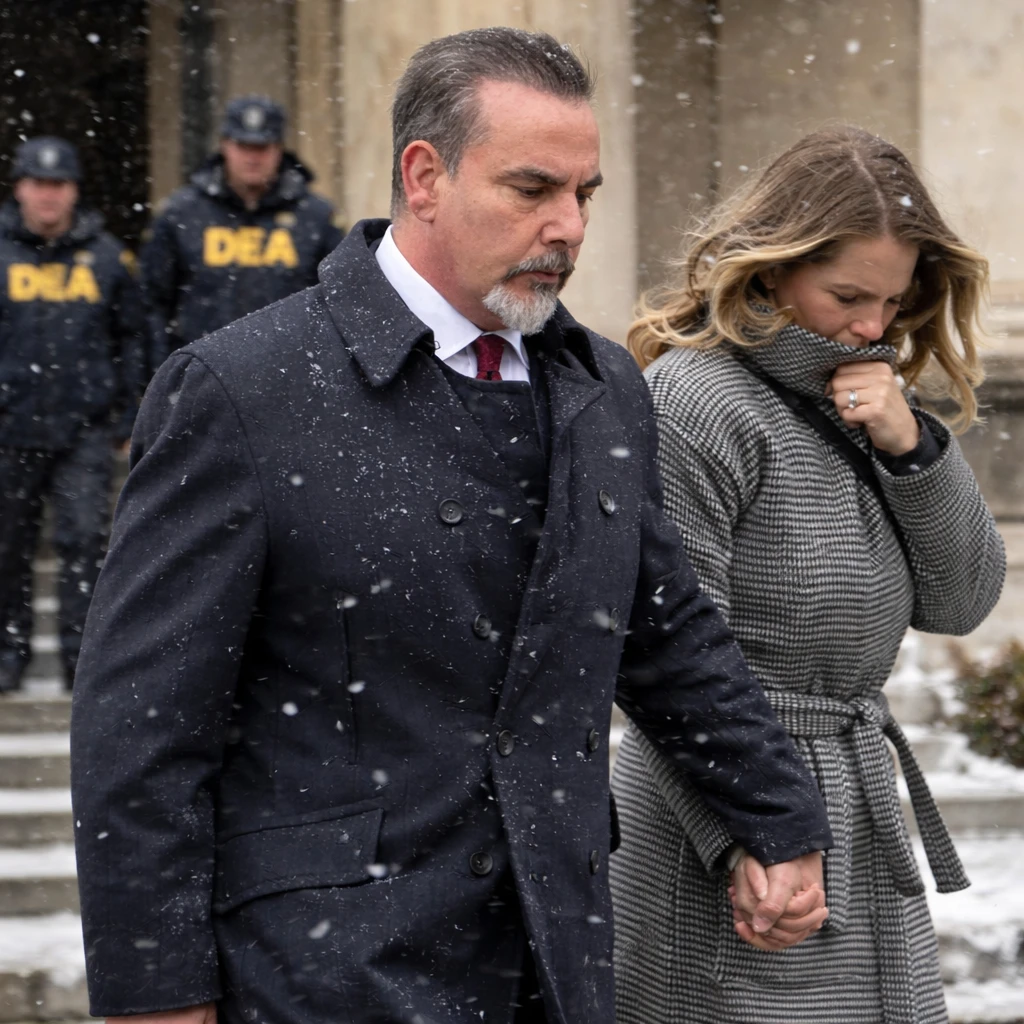

Joseph Bongiovanni spent two decades on the front lines with the U.S. Drug Enforcement Administration, often serving as the "lead breacher" during raids—a role involving entering unknown and potentially dangerous situations first. However, the familiar apprehension he once felt facing uncertainty in these missions was echoed on the day of his sentencing in Buffalo, New York, where he appeared before a federal court judge accused of betraying the badge he wore.
At 61 years old, Bongiovanni, addressing the court, expressed his longstanding belief in his innocence and the pride he once took in his work. "I never knew what was on the other side of that door—that fear is what I feel today," he said, his voice carrying the weight of emotion as he pounded the defense table. Despite his statements, U.S. District Court Judge Lawrence J. Vilardo sentenced the former agent to five years in federal prison on multiple corruption charges.
This sentence was markedly lower than the 15-year term prosecutors had recommended. The reduction in sentencing took into account the complexity of the case and the jury’s earlier acquittal of Bongiovanni on the gravest allegations, which included claims he accepted $250,000 in bribes from organized crime figures.
Judge Vilardo reflected on the dichotomous nature of Bongiovanni‟s career and character, recognizing the conflicting narratives presented over two extensive trials. "There are two completely polar opposite versions of the facts and polar opposite versions of the defendant," the judge remarked, noting that a five-year sentence would be a significant hardship for someone unaccustomed to incarceration.
Defense counsel Parker MacKay highlighted the court’s recognition of Bongiovanni as a valued member of the Buffalo community and described the government’s sentencing demand as disproportionate to the convictions secured. MacKay reiterated his client's declaration of innocence and the intention to continue efforts to demonstrate it.
The legal proceedings culminated in 2024 with Bongiovanni being convicted on four counts of obstruction of justice, along with conspiracy to defraud the United States, conspiracy to distribute controlled substances, and making false statements to law enforcement officers.
Prosecutors portrayed Bongiovanni‟s misconduct as a severe breach of trust, comparing him to former DEA agent Jose Irizarry, who received a 12-year sentence for laundering money for Colombian drug cartels. They asserted that Bongiovanni’s "little dark secret" inflicted serious damage over an 11-year period by actively protecting organized crime interests rather than fulfilling his official duties.
Originating from a tight-knit Italian American neighborhood in North Buffalo, Bongiovanni was alleged to have prioritized loyalty to local crime figures over the DEA's mission. His courtroom sentencing witnessed an emotional response from his family, who broke into tears before the packed Buffalo courtroom.
The prosecution's narrative emphasized both acts of commission and omission in Bongiovanni’s corrupt behavior. Of particular note was a 2008 incident cited as a turning point when he reportedly failed to act on intelligence about known traffickers. These traffickers‟ enterprise expanded to become a large-scale network with connections extending to California, Vancouver, and New York City.
Additional accusations included falsifying DEA reports, mishandling sensitive documents, misleading colleagues, compromising confidential informants, shielding a sex trafficking operation at a local strip club, and aiding a high school teacher in maintaining an illicit marijuana growing operation. Prosecutors also alleged that Bongiovanni discouraged investigations focused on Italian American individuals in favor of targeting Black and Hispanic populations.
Assistant U.S. Attorney Joseph Tripi described the defendant’s conduct as a foundational betrayal to law enforcement and the community. The agent's downfall emerged amid a high-profile sex trafficking case involving dramatic developments such as the suicide of an implicated judge, police investigations dredging a pond in search of an overdose victim, and violent intimidation including the placement of dead rats at a witness’s residence—a witness believed to have died from a fentanyl overdose allegedly linked to the case.
The Pharoah’s Gentlemen’s Club situated outside Buffalo also factored into the investigation. The club’s owner, Peter Gerace Jr., a childhood friend of Bongiovanni’s, was convicted separately of involvement in sex trafficking and bribing the former agent. Authorities described Gerace as having close affiliations with the Buffalo Mafia and the Outlaws Motorcycle Club.
This case has also spotlighted persistent corruption challenges within the DEA. Over the previous decade, at least 17 DEA agents faced federal charges related to misconduct. Only recently, a former agent was charged with conspiring to launder millions and acquire military-grade firearms and explosives for a Mexican drug cartel.
Frank Tarentino, the DEA’s northeast associate chief of operations, stated that the sentence sent a strong message that any betrayal of the badge would be met with full legal consequences.
Bongiovanni’s case illustrates the complex interplay between community loyalty, law enforcement integrity, and the far-reaching implications of corruption within agencies tasked with combating drug trafficking and organized crime. It underscores the deep risks corruption poses not only to justice but to public safety and trust in institutions.