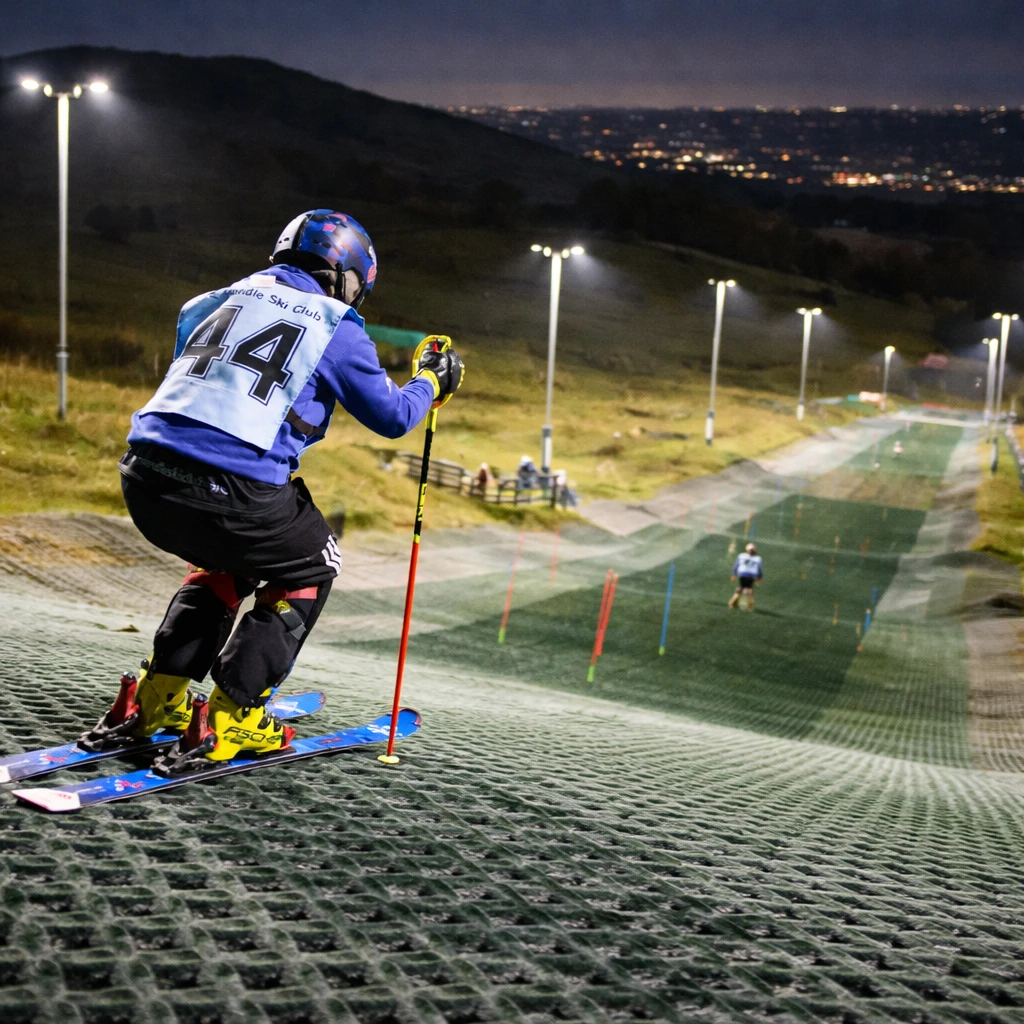

In the serene countryside of Ribble Valley in northwest England, Pendle Ski Club occupies a humble spot on a short, artificial skiing incline roughly 140 meters long and 10 meters wide. This gentle slope, lacking any natural snow, is covered by plastic matting where tufts of grass often poke through. The surrounding fields are home to sheep that roam freely, sometimes crossing the slope during training sessions, reflecting the club's integration into its rural environment.
John Holmes, an instructor and longtime volunteer at Pendle Ski Club, describes the facility as modest but effective. "We wouldn't change it for the world," he says, noting that while the environment is unique, it fosters success. This perspective was proven through the career of Dave "Rocket" Ryding, who began skiing there at six years old and continued through his teenage years.
Ryding's achievements are exceptional, especially given Britain's limited tradition in alpine skiing. His most notable accomplishment is becoming the only British skier to win a World Cup race in alpine skiing's nearly six-decade history. This victory was secured in Kitzbuehel, Austria, a venue renowned for its difficulty and prestige.
Now 39, Ryding approaches the final stages of his career, preparing as a contender for medals at the upcoming Milan Cortina Winter Olympics.
Reflecting on his origins, Ryding acknowledges that his path is uncommon. "People find it hard to believe it was possible," he told reporters. Growing up on dry slopes has defined him as an athlete and gained him recognition beyond what might be afforded to skiers from traditional winter sports nations like Austria or Sweden. He hopes his story will inspire future generations in Britain.
Britain's climate poses challenges for winter sports enthusiasts. According to the UK's Met Office, the country averages only 13 days of lying snow annually, and the nation hosts around 67 ski slopes, including a few indoor snowdomes. Against this backdrop, Ryding's progression from artificial slopes to international success was unlikely to many.
Training often occurred on warm summer days, where athletes contended with friction burns from the coarse plastic surface, occasional interruptions by wandering sheep, and the natural beauty designated by the government as an "area of outstanding natural beauty." Ryding recalls, "If the sheep wanted to cross the slope during training, we had to stop respectfully and wait for them."
The slope's length resulted in very brief runs, taking Ryding approximately 12 seconds from top to bottom. Despite this, he believes the experience contributed positively to his professional performance. On snowy courses, particularly at flat starts, Ryding considers himself exceptionally fast compared to his peers.
Holmes has closely observed Ryding's development, noting that training on the bristly surface imparts essential technical skills, such as weight distribution, edge control, and turn shaping, that newer participants often struggle to master. "Those who start on the bristles learn the fundamentals," Holmes explains.
Pendle Ski Club has grown to include around 600 members, ranging widely in age from children to septuagenarians, all drawn by the club's welcoming atmosphere and coaching. Inside the clubhouse, tributes to Ryding abound, featuring a Union Jack flag emblazoned with his nickname "Rocket" and a photo urging, "Your Ski Club Needs You."
When Ryding competes internationally, local teens and elders alike gather around televisions in the clubhouse to cheer him on. Jayden Cuttriss, a 16-year-old club member, views Ryding's journey as evidence that "it's possible for anyone" to reach the Olympics starting from this modest facility. Jonathan Fenton, the club's eldest participant at 77, regards Ryding as "the best British skier we've ever had and an inspiration for all."
As Ryding prepares to retire after this Olympic season and his fifth Games, he aims to improve on his previous best individual Olympic finish of ninth place in 2018. He also seeks to secure Britain's first Olympic medal in alpine skiing. Notably, Alain Baxter won a bronze medal in 2002 but was later disqualified due to a failed drug test.
Looking beyond his competitive career, Ryding plans to contribute to British skiing by developing pathways similar to the one he followed. He intends to encourage young athletes, improve financial support structures, and elevate the sport nationally. "No one has done it from the dry slopes before," he notes, emphasizing his unique understanding of the progression needed at each stage to succeed.