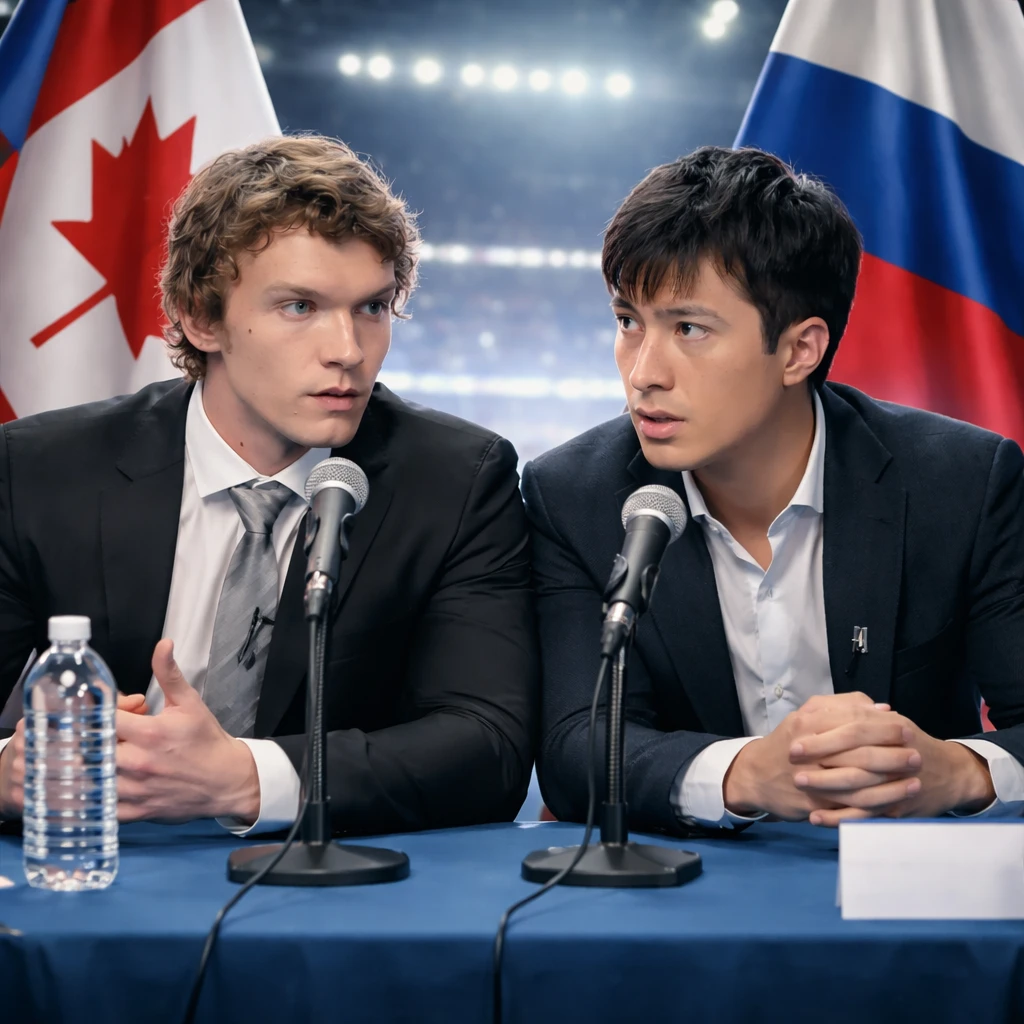

The television series 'Heated Rivalry', a drama that depicts a decade-spanning secret relationship between Canadian Shane Hollander and Russian Ilya Rozanov, is rapidly becoming a global sensation, notably impacting audiences in Russia where LGBTQ+ content faces stringent legal restrictions. Starring Hudson Williams and Connor Storrie, the series originated from Rachel Reid's 2019 novel and has evolved from a grassroots success in North America in late 2025 to a worldwide phenomenon.
The show explores themes of covert love and personal longing, blending gradual emotional development with explicit intimate scenes. It gained prestigious visibility as its primary actors appeared at high-profile venues such as the Golden Globes and fashion events in Milan, along with their involvement in the Milan Cortina Winter Olympics, underscoring the show's cultural significance internationally.
Despite Russia’s official ban on homosexuality and the absence of sanctioned distribution channels, 'Heated Rivalry' has found a robust following within the country. Its reception on Russian streaming and film databases, particularly Kinopoisk, has been remarkably positive, achieving an 8.6 rating that surpasses popular Western series including 'Breaking Bad' and 'Game of Thrones'. Fan interest thrives via unauthorized streaming platforms, circumventing Western streaming service sanctions and domestic censorship.
Mikhail Zygar, a journalist and author born in the Soviet Union who experienced life as a closeted gay man in Russia, commented on the show’s influence. He noted that despite pervasive social and legal constraints, the series represents a significant cultural milestone, offering a platform that challenges prevailing discourses and supports normalizing LGBTQ+ narratives in Russia.
Zygar emphasized that the popularity of 'Heated Rivalry' may alter broader social perceptions by portraying same-sex love as natural and beautiful, contributing to subtle shifts in audience attitudes despite the hostile environment.
However, the political climate remains deeply unfavourable toward LGBTQ+ rights in Russia. Since the escalation of the war with Ukraine in 2022, Russian authorities intensified repression, framing LGBTQ+ advocacy as a Western threat to traditional values. Legal measures now criminalize positive or neutral representations of LGBTQ+ individuals, impose bans on gender-affirming medical practices and changes in official documents, and classify support for LGBTQ+ causes as extremist activity, potentially resulting in severe legal sanctions.
Georgy Soldatov, head of the Sorok Sorokov center in Moscow and aligned with the Russian Orthodox Church, expressed alarm at the series’ explicit content, which led to his filing a formal complaint with the Prosecutor General’s Office citing concerns of prohibited propaganda. This stance aligns with ongoing efforts to censor LGBTQ+ depictions in various media, including edited or redubbed content in television series to remove LGBTQ+ references.
The environment for LGBTQ+ activism in Russia is further marked by legal and punitive actions, such as criminal investigations into publishing houses distributing LGBTQ+ literature and the detention of personnel associated with these works.
Contrastingly, in the United States, sales of LGBTQ+ romance novels are experiencing significant growth, with 'Heated Rivalry' leading a surge of over 100% in unit sales in early 2026 compared to the previous year, as tracked by industry analysts.
Overall, Zygar interprets the Russian audience’s engagement with 'Heated Rivalry' as a form of cultural resistance against state propaganda and repression, highlighting efforts by individuals to maintain personal freedoms and reject enforced narratives despite formidable obstacles.