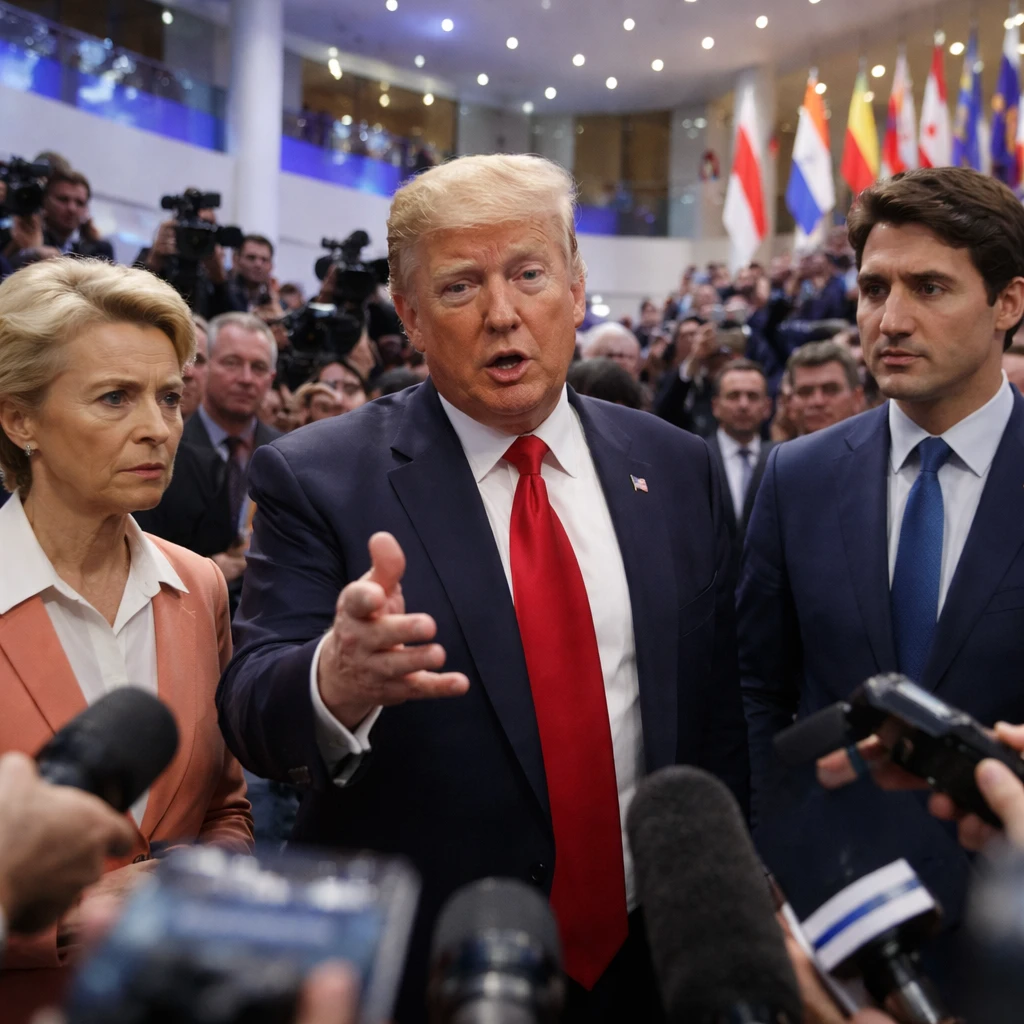
In Davos, Switzerland, a gathering of world leaders at the annual World Economic Forum was marked by serious admonitions and unfiltered language in response to U.S. President Donald Trump's persistent campaign to purchase Greenland and introduce associated tariffs.
French President Emmanuel Macron, visibly affected by an eye infection and wearing aviator sunglasses, issued a stern warning against what he described as a "new colonial approach" jeopardizing decades of international cooperation.
Canadian Prime Minister and former central banker Mark Carney emphasized the importance of mid-tier nations banding together to sustain multilateralism, opposing attempts by dominant powers to act unilaterally. He described the necessity for a "dense web of connections" to navigate great power rivalries effectively.
California Governor Gavin Newsom openly expressed frustration during interactions with European delegates, bluntly urging them to abandon complicity and demonstrate resolve. Newsom criticized the world leaders' perceived failure to push back against aggressive diplomacy, likening dealings with President Trump to negotiations with a predatory "T-Rex," imploring leaders to adopt fortitude and sincerity in their international conduct.
He stated emphatically, "I can’t take this complicity. People rolling over. I should’ve brought a bunch of knee pads for all the world leaders. I hope people understand how pathetic they look on the world stage. From an American perspective, it’s embarrassing." He condemned diplomatic niceties as insufficient and demanded stronger responses.
During his address, President Macron began with a sardonic remark on the current era's supposed "peace, stability and predictability" before condemning the resurgence of imperial ambitions. He decried a global trend toward a lawless environment where might supersedes international law. He specifically criticized U.S. trade policies aimed at undermining European exports, imposing tariffs, and challenging territorial sovereignty, framing such maneuvers as fundamentally unacceptable.
Mark Carney articulated that while great powers have the capacity to act independently due to their market size and military strength, middle powers must collaborate to survive and influence global affairs. Reiterating Canada's support for Greenland and Denmark's sovereign right over Greenland's future, Carney firmly opposed U.S. territorial expansion ambitions in the Arctic.
Meanwhile, U.S. Treasury Secretary Scott Bessent, ahead of President Trump's scheduled forum address, sought to downplay tensions, stating relations between the U.S. and Europe have never been closer and advising calm amidst what he described as hysterical reactions. He reaffirmed the undisputed NATO partnership and collective efforts to address the conflict between Russia and Ukraine, acknowledging the possibility of disagreements on Greenland.
Belgian Prime Minister Bart De Wever criticized the repeated violations of European "red lines" by Washington’s Greenland provocations. He warned that yielding now would lead to a loss of dignity and signal the decline of decades-long Atlantic cooperation. De Wever, citing philosopher Antonio Gramsci, underscored that the future of the transatlantic alliance hinges on President Trump's decisions, portraying him as a figure capable of either preserving or destroying these bonds.
European Commission President Ursula von der Leyen cautioned against the dangers of an escalating diplomatic downturn that could only benefit geopolitical adversaries. She condemned the proposed new tariffs as a misstep between established allies and underscored the binding nature of existing trade agreements between the EU and the U.S. Von der Leyen emphasized Europe’s responsibility to respond to changing international pressures by evolving into a stronger, more autonomous union, noting the special friendship shared with the American people and warning against actions that would harm collective strategic interests.
The forum's debates underscored the complexities of balancing national ambitions with global partnerships, as key figures called for renewed commitment to diplomatic integrity, multilateral collaboration, and respect for sovereignty amidst rising tensions over Greenland's status.