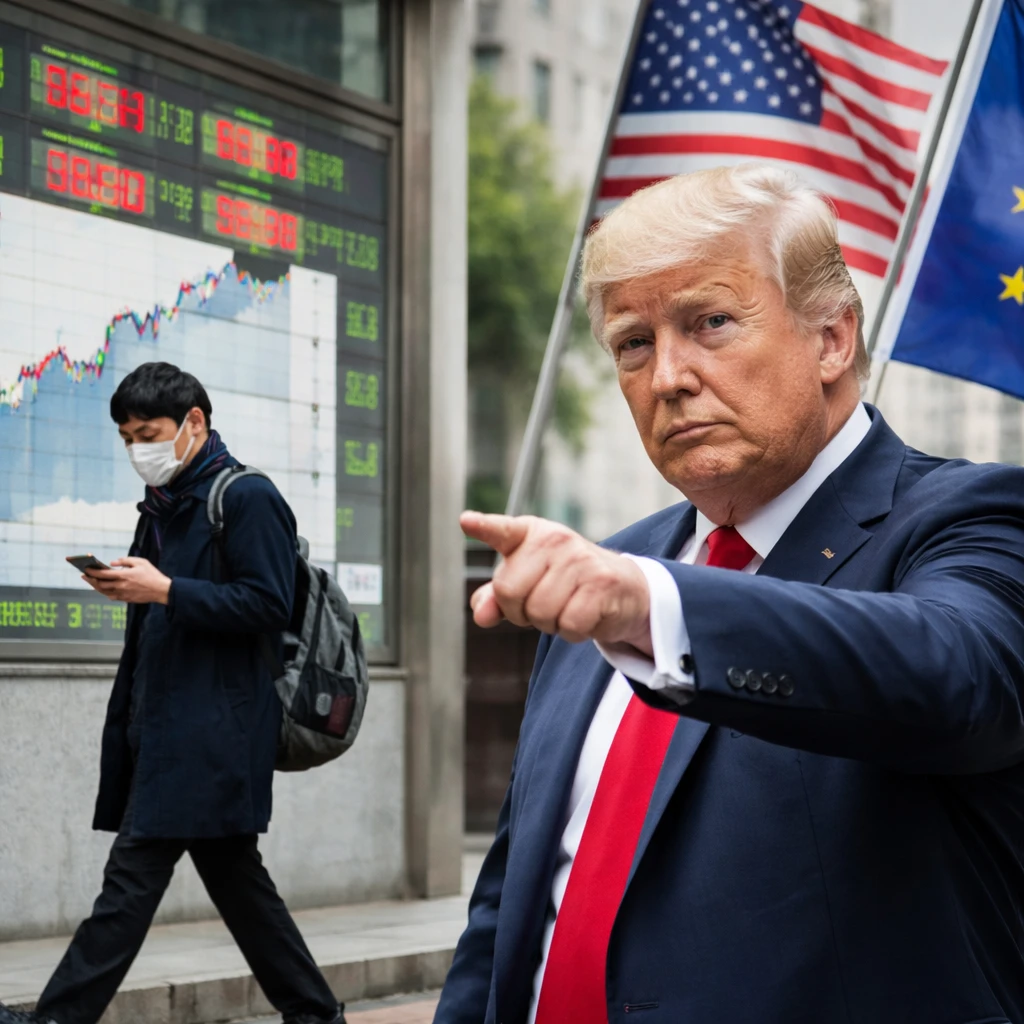

U.S. stock futures declined on Monday in response to President Donald Trump's announcement of a potential 10% tariff increase on imports from eight European countries. This threat emerged from disagreements over Greenland, with the U.S. government seeking control over the territory, a move the European nations opposed.
The countries facing these tariff threats—Denmark, Norway, Sweden, France, Germany, the United Kingdom, the Netherlands, and Finland—issued a unified and robust statement condemning the U.S. threats. They highlighted the potential damage such measures could cause to transatlantic relations, warning of the escalation risks stemming from such actions. This collective response stands out as the most forceful European opposition since President Trump assumed office nearly a year ago.
Following the announcement, U.S. market indicators reacted negatively. The S&P 500 futures dropped by 0.9%, with the Dow Jones Industrial Average futures also falling by 0.8%. Stephen Innes from SPI Asset Management commented on the broader implications, noting that these developments challenge the strategic trust and alignment foundational to U.S.-Europe economic relations. He indicated that such geopolitical disturbances might reduce the automatic appeal of investing in U.S. assets, leading to a gradual rather than sudden market adjustment with potentially significant consequences.
In Asia, stock market performances were mixed as investors absorbed these developments alongside domestic economic news. China reported a 5% annual growth rate in its economy for 2025, although growth decelerated in the last quarter. Export performance remained strong, which compensated for comparatively soft domestic consumption. Oil prices registered slight increases during these trading sessions.
Regionally, Hong Kong's Hang Seng index declined by 1.1%, settling at 26,563.90, whereas the Shanghai Composite index edged up by 0.3% to 4,114.00. Japan's Nikkei 225 decreased by 0.7% to 53,583.57 amid political movements, with Prime Minister Sanae Takaichi preparing for a parliamentary dissolution and a snap election anticipated next month.
Contrasting with these declines, South Korea's Kospi rose by 1.3%, driven by advances in technology stocks such as SK Hynix, which increased by 1.1%. Taiwan's Taiex also appreciated by 0.7%, whereas India's Sensex declined by 0.6%.
Last Friday saw modest declines on Wall Street as the initial week of corporate earnings season concluded. The S&P 500 contracted by 0.1%, the Dow decreased by 0.2%, and the Nasdaq Composite slightly fell by 0.1%. Despite overall weekly losses across these indices, small-cap stocks saw slight gains, evidenced by the Russell 2000's 0.1% increase. The technology sector remained a primary mover, with large technology firms registering gains that compensated for losses in other sectors.
Investors closely monitor earnings reports for insights into consumer spending behavior and corporate performance amid ongoing inflation pressures and increased tariffs. The technology sector, particularly companies influenced by the growing focus on artificial intelligence, is a focal point for gauging valuation justification.
This week promises a more extensive range of corporate earnings disclosures, including airlines, industrial entities, and technology firms. United Airlines, 3M, and Intel are among the companies scheduled to announce their quarterly results.
Economic attention is also on U.S. inflation metrics, specifically the upcoming release of the personal consumption expenditures (PCE) price index, the Federal Reserve's preferred inflation gauge. Ahead of its next policy meeting in two weeks, the Fed is widely expected to maintain prevailing benchmark interest rates, balancing a slowing labor market against persistent inflation that remains above its 2% target.
In commodities, U.S. benchmark crude oil prices slipped by 28 cents to $59.06 per barrel. This followed a period of volatility linked to widespread protests in Iran targeting national leadership. Meanwhile, Brent crude oil decreased by 34 cents, settling at $63.79 per barrel.
Precious metals showed notable price increases, with gold rising by 1.8% and silver surging 5.3%. Currency markets reflected mild fluctuations: the U.S. dollar appreciated slightly to 158.06 Japanese yen from 157.93 yen, and the euro rose to $1.1628 from $1.1581.