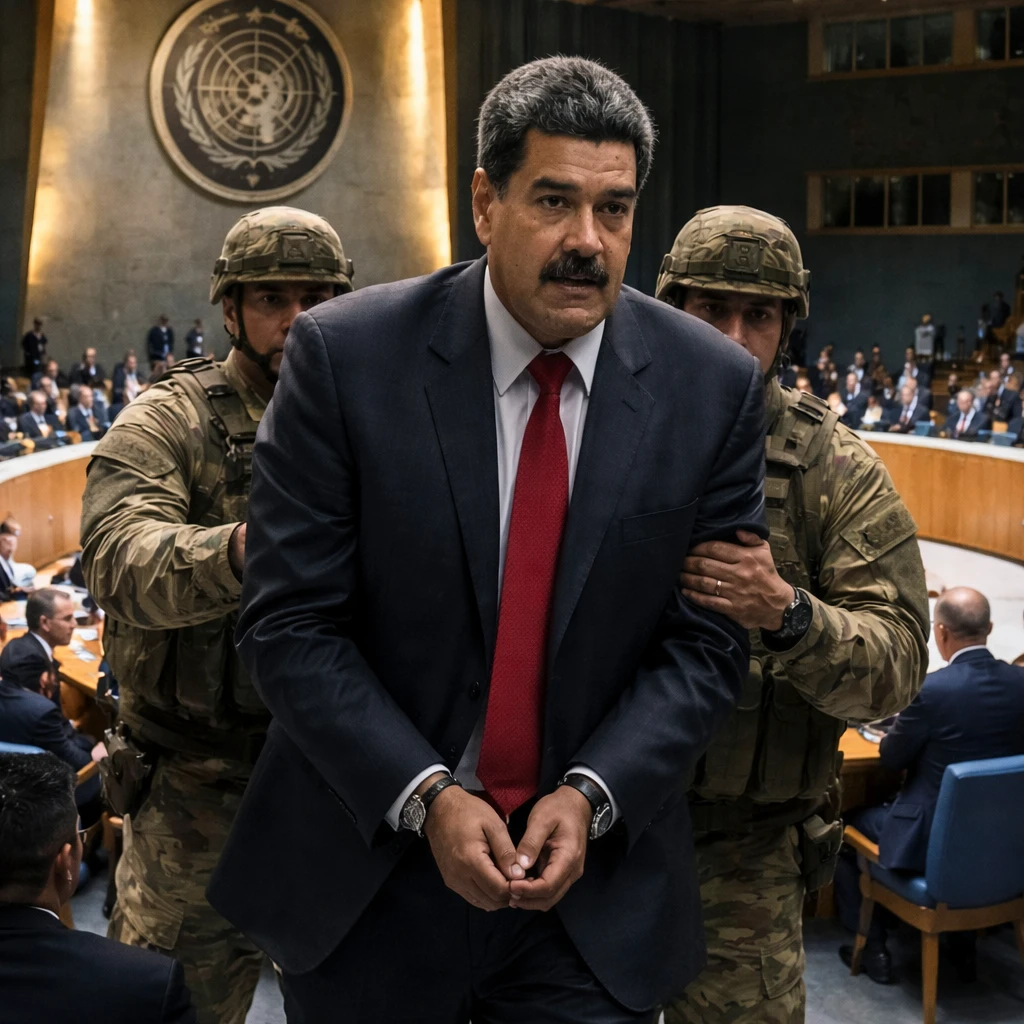
On Monday, the United Nations Security Council held an urgent meeting to address the controversial US military operation in Venezuela that led to the apprehension of the nation's leader, Nicolás Maduro. This session featured voices from both US allies and critics, reflecting diverging perspectives on the legality and consequences of the intervention.
Amid the discussions, several delegations underscored reservations about US President Donald Trump's aggressive stance, which extends beyond Venezuela. Recent remarks from the US leader suggested possible military actions against neighboring countries such as Colombia and Mexico, purportedly linked to combatting drug trafficking. Additionally, Trump has revived assertions regarding the acquisition of Greenland, a Danish territory rich in minerals, citing US security concerns. Denmark officially responded by emphasizing the sanctity of national borders without directly naming the United States but warning against attempts to alter sovereignty unlawfully.
Christina Markus Lassen, Denmark's ambassador to the UN, stated, "The inviolability of borders is not up for negotiation." She affirmed Venezuela's sovereignty and cautioned against any state attempting to sway political dynamics there through force or actions contravening international law.
France presented a nuanced position. Despite French President Emmanuel Macron's recent public endorsement of Maduro's capture, France's UN Deputy Ambassador Jay Dharmadhikari critiqued the military operation, describing it as contradictory to both peaceful dispute resolution and the principle prohibiting the use of force. Dharmadhikari warned that breaches by any of the Security Council's five permanent members undermine the entire framework of the international order.
Conversely, the United States staunchly defended its actions. US envoy Mike Waltz characterized the operation as a precise law enforcement action and questioned the Security Council's condemnation, implying that legitimacy cannot be extended to leaders labeled as "narco-terrorists" through international institutions if it equates them with democratically elected officials. Waltz highlighted the contested nature of Maduro's 2024 reelection.
UN Secretary-General Antonio Guterres expressed deep concern over the apparent disregard for international law associated with the January 3 incident. He warned that such serious actions could establish troubling precedents for future state interactions worldwide.
Representing Venezuela, Ambassador Samuel Moncada appealed to the United Nations to go beyond implicit criticism and take concrete measures demanding the United States release Maduro and his spouse. Moncada condemned the "kidnapping" of a head of state, the bombing within Venezuelan territory, and threats of additional military actions as signals that diminish respect for international law and elevate force to the dominant tool in global relations. He cautioned that tolerating such conduct risks fostering instability internationally.
Neighboring Colombia's representative expressed alarm at the operation, likening it to severe external interference reminiscent of prior disruptive episodes. Ambassador Leonor Zalabata emphasized that democracy cannot be sustained or advanced through violence, coercion, or economic interests.
Russia and China, both permanent Security Council members and traditional critics of US foreign policy, joined the chorus opposing the US move. Russian Ambassador Vassily Nebenzia rejected any US unilateral claims to impose punishments or interventions outside international law and sovereignty norms. Both nations stressed that the UN should collectively oppose a perceived regression to a chaotic and lawless international order. Notably, Maduro's close ties with Russia and the significance of China as a primary destination for Venezuelan oil underpin these positions.
Earlier that week, the US forces seized Maduro and his wife from their residence on a Venezuelan military base, subsequently transporting them to a US warship en route to New York. They face charges indicting them in a narco-terrorism conspiracy as outlined by the US Justice Department. Maduro denied all accusations in his initial Manhattan court appearance. The operation came after the US augmented military presence near Venezuela's coast and targeted vessels alleged to be involved in drug trafficking. President Trump has publicly stated intentions for the US to administer Venezuela temporarily and exploit its significant oil resources for international markets.
Senator Marco Rubio countered by indicating that the US would uphold existing oil embargoes on sanctioned tankers, utilizing this leverage to push for policy reforms within Venezuela.