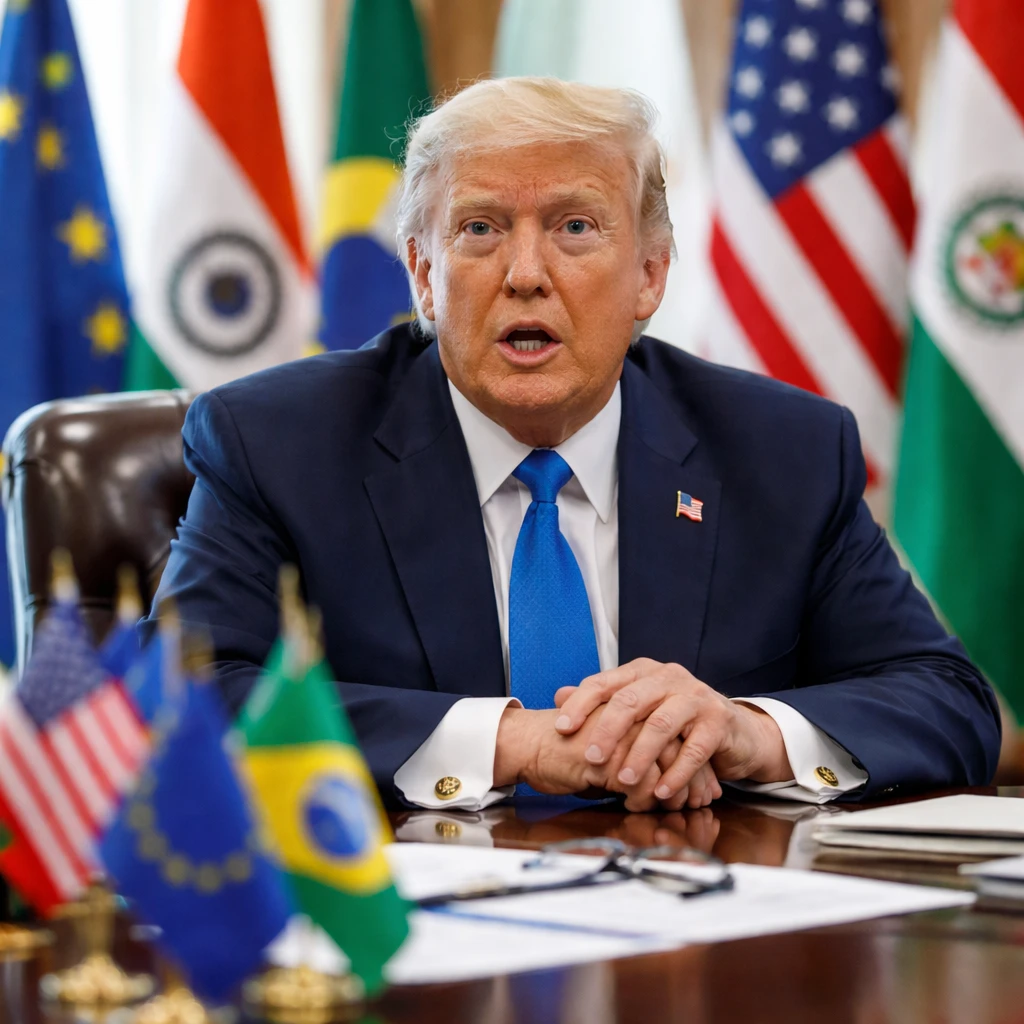

Over the past year, longstanding allies of the United States have found themselves navigating a challenging trade environment shaped by President Donald Trump’s frequently changing tariff measures. Efforts have intensified among these countries to establish new economic partnerships, often bridging old divisions, to reduce their dependency on U.S. markets amid rising protectionism.
Several central banks and international investors have reacted to this landscape by decreasing their holdings of U.S. dollars and increasing investments in gold. This trend could potentially lessen American economic influence worldwide and contribute to upward pressure on domestic interest rates and living costs, heightening existing public discontent over financial burdens.
During the summer and fall seasons of last year, President Trump employed the threat of imposing steep duties on imports as leverage to compel entities such as the European Union, Japan, and South Korea to accept agreements favoring the United States. These agreements included commitments to substantial investments within U.S. borders.
However, these arrangements have proven unreliable. The president has frequently introduced new tariffs against these same partners after they believed they had fulfilled concessions. For example, shortly after finalizing a deal with the EU, new tariff threats emerged against eight European countries following their opposition to his Greenland acquisition proposal, a threat that was later withdrawn. More recently, Trump signaled a potential 100% tariff on Canadian goods due to Canada’s adjustments in its tariff policies on Chinese electric vehicles, diverging from U.S. stances.
According to Wendy Cutler, former U.S. trade negotiator and senior vice president at the Asia Society Policy Institute, partners are discovering the limited shielding effect of trade deals that favor one side. This realization has turbocharged efforts to diversify international trade dependencies.
Supporters of Trump’s approach, such as Paul Winfree, CEO of the Economic Policy Innovation Institute and a former deputy director of the White House Domestic Policy Council, observe the decline in foreign central banks’ U.S. Treasury holdings as a vulnerability potentially exploitable by adversaries. He notes that while not all Trump advisors believed the U.S. fully leveraged the dollar’s dominance as a reserve currency, many nations are eager to challenge this status.
A White House spokesperson, Kush Desai, maintains that the President remains resolute in bolstering the U.S. dollar’s global dominance.
Among the significant developments in alternative trade frameworks is the recently concluded agreement between the European Union and India, a notable achievement after nearly two decades of negotiations. Similarly, an agreement between the EU and South America's Mercosur countries culminated after 25 years, aiming to establish a free trade zone encompassing over 700 million people.
Maurice Obstfeld, a senior fellow at the Peterson Institute for International Economics, highlights that while these deals have been long in the making, the pressure from U.S. trade policies accelerated their completion. European exporters have widely praised the India agreement for reducing tariffs on machinery and signaling support for rule-based international commerce.
Meanwhile, President Trump declared via social media a new deal with India, promising tariff reductions after India committed to halting purchases of Russian oil, a critical funding source for Russia's ongoing conflict in Ukraine. Trump announced India would lower tariffs on American products to zero and increase imports from the U.S. significantly. Trade experts await formal documentation to elucidate the exact terms.
Trump remains confident in America’s economic clout, emphasizing the country’s vast market and resources as leverage points. Countries heavily reliant on U.S. security and market access, such as South Korea, face challenges in resisting these pressures. When Trump raised tariffs on South Korean goods due to delays in legislative approval of agreed investments, South Korea responded by expediting efforts to pass relevant laws, underlining the complex interplay between trade and geopolitical considerations.
Canada’s trade relationship with the U.S., responsible for 75% of its exports, remains deeply interconnected, with adjustments viewed as incremental rather than disruptive.
Nevertheless, the global repudiation of the U.S. tariff approach is affecting currency dynamics, with the dollar recently declining to levels not seen since 2022 against other major currencies.
Daniel McDowell, a political scientist at Syracuse University, remarks on a perceptible shift in global sentiment under Trump’s administration, where the U.S. is increasingly perceived as erratic rather than stable. This perception is influencing public and private investors to reassess their financial exposure to the U.S. dollar.
Collectively, these developments underscore a transformative moment in global trade relationships, with allied nations seeking new paths to economic security amid shifting U.S. policies.