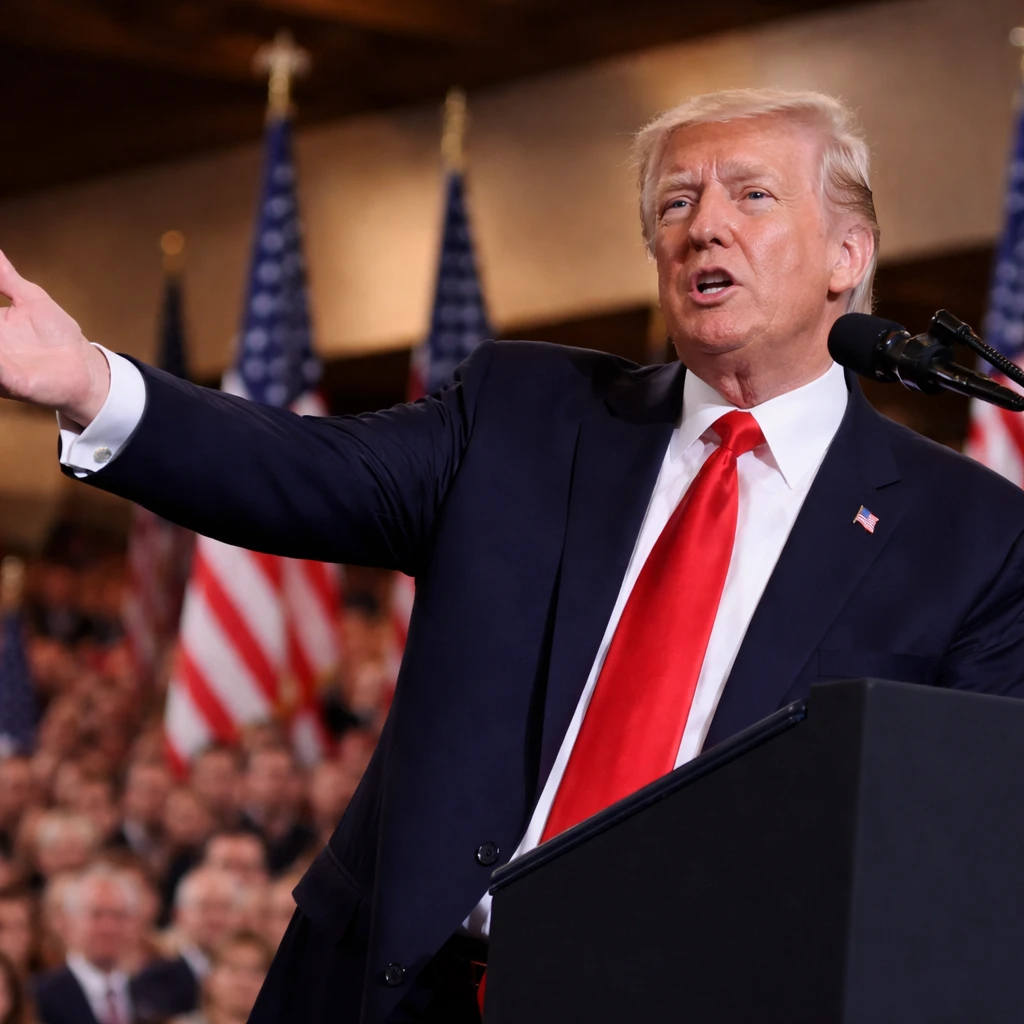

As President Donald Trump approaches the one-year mark of his second term, a survey conducted by the AP-NORC Center for Public Affairs Research provides insight into how the Republican base evaluates his administration’s impact, particularly in the economic realm. The findings indicate a distinct discrepancy between the populace’s recollection of economic gains during Trump’s initial tenure and the current sentiment concerning his economic leadership amid domestic and international turbulence.
Only 16% of Republicans currently affirm that Trump has significantly aided in mitigating the cost of living, a sharp decline from 49% recorded in April 2024 reflecting his first term’s progress. Despite this dissatisfaction with economic outcomes, there remains robust Republican support for the president’s approach to immigration, even though some members express reservations regarding certain enforcement tactics.
In New Rochelle, New York, 64-year-old John Candela exemplifies this split in views. He reports no improvement in his household’s finances under the current administration, citing unchanged wages alongside persistent expenses, such as the $5 price tag on Oreos. Nonetheless, he remains hopeful for change by the end of Trump’s four-year term, underscoring the patience expressed by some within the Republican base. "I would expect it to be different by the time his four years are up," he remarked.
The survey identifies emerging vulnerabilities among consumers concerning the economy, particularly related to Trump’s flagship promise of cost reduction. Although inflationary pressures have lessened slightly, prices for many goods linger above levels noted at the inauguration last January.
Despite these economic challenges, there is scant evidence that core Republican supporters are withdrawing their endorsement of Trump. Approximately 80% of Republicans continue to approve of his overall job performance, a striking contrast to the roughly 40% approval rate observed among the general adult population. Candela expressed nuanced approval: "I don’t like the man as a human being. I don’t like his brashness. I don’t like his roughness. I don’t like how he types out his texts all capital as if he’s yelling at everybody. But what I approve of is what he is doing to try and get the country on track."
Detailed evaluation of economic factors reveals considerable skepticism among Republicans about the administration’s effectiveness in delivering on economic promises during the current term. Just under 40% of GOP respondents say Trump has contributed to addressing the cost of living to at least a minor extent, a marked drop from 79% who affirmed this during his previous term. Job creation perceptions have similarly diminished: Only just over half acknowledge improvements in their second term, compared to 85% in the earlier administration phase, when 62% indicated significant job growth.
On healthcare affordability, approximately one-third of Republican respondents believe Trump has made some progress in reducing costs, lower than the 53% who accredited him with such achievements in the first term. This dip coincides with the expiration of federal healthcare subsidies for over 20 million Americans on January 1, which caused significant increases in healthcare expenses for many households.
In Waxahachie, Texas, Ryan James Hughes, a 28-year-old children’s pastor and three-time Trump supporter, shares a similar experience, observing that medical bills remain burdensome for his family. However, he articulated a stance of personal responsibility over government intervention in securing financial stability, stating, "I’m not looking to the government to secure my financial future."
Immigration remains an area of strong performance in the president’s portfolio from the perspective of the Republican base, despite continued controversies surrounding federal enforcement. Approximately 80% of Republicans feel Trump has positively contributed to immigration and border security in the current term, mirroring figures from his first administration. While the majority believe Trump has achieved an appropriate balance in deporting undocumented immigrants, a significant minority think measures could be intensified.
Approval for Trump’s immigration policy among Republicans has declined somewhat over the past year, dropping from 88% in March to 76% in the most recent survey. Kevin Kellenbarger, 69, a retired printing company employee and thrice Trump voter from Lancaster, Ohio, frames his party loyalty through his Christian faith but expresses unease about recent enforcement incidents, such as the fatal shooting of Renee Good by a federal immigration agent in Minneapolis. Nevertheless, he attributes broader border management challenges to the policies of President Joe Biden and insists on the necessity of removals.
Conversations with various Republicans reveal apprehensions about aggressive enforcement tactics but also encourage a focus on immigrants with criminal records, aligning with campaign pledges. Nationally, only 38% of all adults approve of Trump’s leadership on immigration, while 61% disapprove.
Republican Liz Gonzalez, a 40-year-old rancher and farmer from Palestine, Texas, who is the daughter of Mexican immigrants, underscores the human element of immigration debates. She empathizes with families striving for the American dream but argues that federal agents should be allowed to perform their duties to maintain order and prevent chaos.
When evaluating broader sentiments, about two-thirds of Republicans express the belief that the country is better off since Trump reassumed the presidency, although just half extend this optimism to their own personal or family circumstances. This national outlook may temper dissatisfaction with economic conditions.
Missouri resident Phyllis Gilpin, 62, credits Trump with attentiveness to the electorate’s concerns but criticizes his arrogance and name-calling habits. She calls for a political environment transcending partisan divisions, hoping for unity beyond Democratic and Republican labels.
The AP-NORC poll incorporated responses from 1,203 adults surveyed from January 8 to 11, drawing from a statistically representative sample of the U.S. population. The margin of error stands at plus or minus 3.9 percentage points for the entire adult cohort, and 6 percentage points within the subset of 404 Republicans polled.