
The British indie rock band Wet Leg recently assembled a unique assortment of items, including velvet worms crafted by their guitarist Hester Chambers, an exaggerated hairstyle from a previous music video, and gloves resembling lizards, before retreating to an Airbnb to conceptualize the cover for their sophomore album. Lead singer Rhian Teasdale, who co-directed the art for the "Moisturizer" cover alongside Iris Luz and Lava La Rue, described the intent to create an image simultaneously "super girly and feminine" yet "totally repulsive." She explained that the resulting contrast was designed to evoke strong reactions.
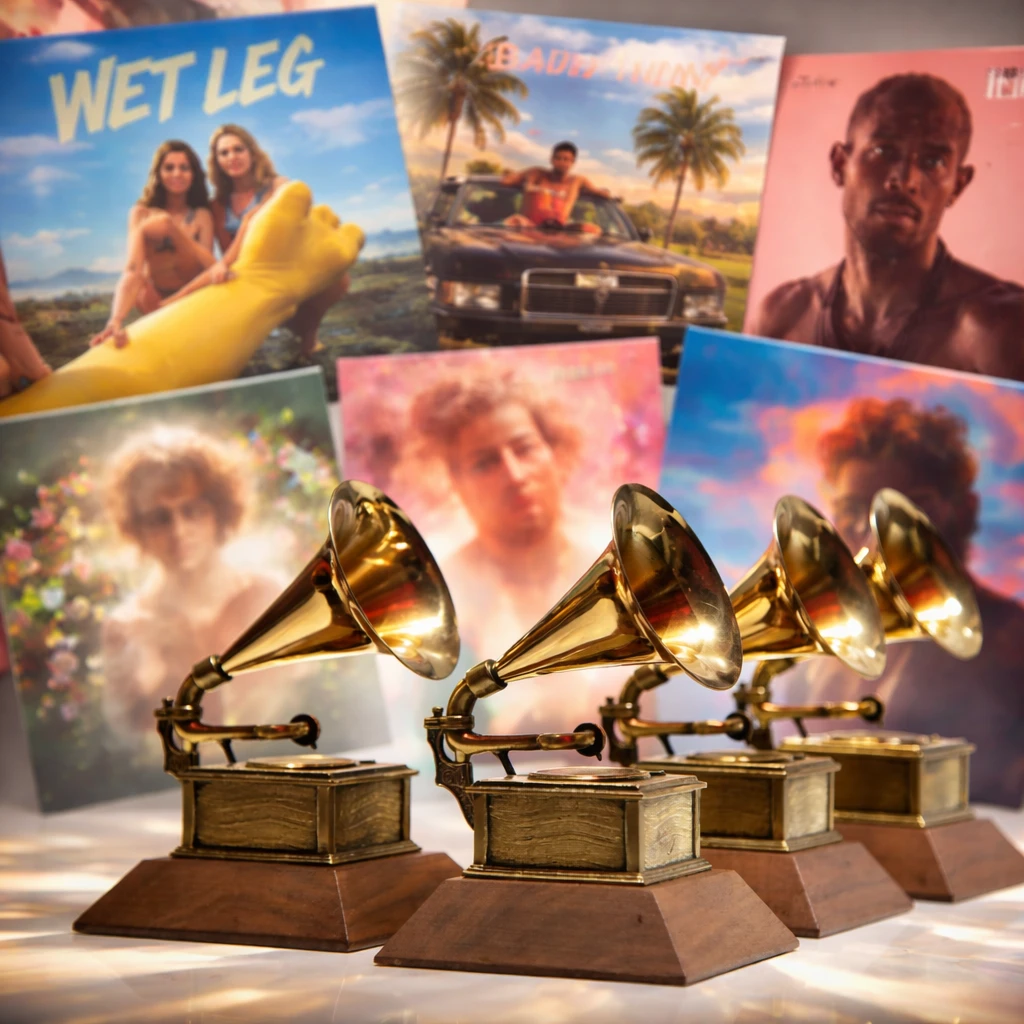
The resulting album cover has garnered a Grammy nomination for Best Album Cover, marking the reintroduction of the award category for the first time in over fifty years. Other nominees in this newly revived category include Bad Bunny's "Debí Tirar Más Fotos," Tyler, the Creator's "Chromakopia," Perfume Genius' "Glory," and Djo's "The Crux." Notably, the Grammy for Best Album Cover is awarded to the project’s art directors, with recording artists also credited as nominees in all cases except for Perfume Genius’ "Glory."
Historically, album covers were considered within the broader Best Recording Package category, which evaluated the full array of a release’s physical components and visual materials. The previous year saw the award go to Charli XCX, Brent David Freaney, and Imogene Strauss for the recording package of "Brat," celebrated for its distinctive green hue permeating pop culture.
Harvey Mason Jr., CEO of the Recording Academy, indicated that the decision to reinstate Best Album Cover as a separate category aims to honor the continuing importance of visual representation in music, especially amid the shifts prompted by digital distribution. He emphasized the Academy's intent to further acknowledge the artists who contribute to music’s creative impact beyond the sound itself.
From the perspective of creative teams, the return of this award underlines the intricate work involved in constructing the visual identities that accompany music releases. Photographer Neil Krug, nominated for "The Crux," expressed that an effective album cover becomes integral to a record’s identity, describing it as part of the "language and fabric" that defines exceptional music records.
Regarding Tyler, the Creator's "Chromakopia," the defining portrait features a monochrome close-up with the artist's face partially obscured by a mask. Luis "Panch" Perez, director of photography, noted that this expression captured Tyler's eyes in an intense gaze during the final photograph of the shoot. Perez highlighted that achieving the image involved tapping into a "shared unspoken language" cultivated over years of collaboration, guided by surrealist and old Hollywood inspirations. He also remarked on Tyler’s precise control over his movements in front of the camera.
Perfume Genius collaborated with art directors Cody Critcheloe and Andrew J.S. for the cover of "Glory," which depicts the artist lying on a patchwork carpet inside a dimly lit, intimate room. The image includes elements such as stiletto boots extending toward a bright window and colorful cords coiled across the floor, invoking the ambiance of a live performance setting. This visual was intended to symbolize the tension explored throughout the album, balancing personal introspection with public confidence.
Critcheloe, who also served as photographer for the cover, explained that the objective was not to depict a specific scene or choreography but to capture a certain "energy." He expressed satisfaction that audiences perceive the cover’s aesthetic as elusive and defying precise classification, which he regards as an indicator of successful art direction.
Wet Leg’s "Moisturizer" cover portrays Teasdale in a creature-like pose, squatting with extended hands and an unsettling grin directed at the camera. She indicated that this visual metaphor aligns with the album’s exploration of themes such as love, longing, and moments of wild, "feral" emotion.
Djo’s third album, "The Crux," features a cover set in a fictional hotel inspired by Brooklyn, located on the Paramount Studios backlot. Photographer Neil Krug, the artist Djo (Joe Keery), and collaborator Jake Hirshland drew inspiration from dense, cinematic scenes such as Alfred Hitchcock’s "Rear Window," while also scouting real locations in New York and Atlanta, where Keery was filming. After settling on the studio lot, they cast figures to occupy the scene, including a couple kissing and a man disputing a parking ticket, aiming to create a rich and layered tableau. Keery himself is portrayed from behind, hanging out of a window in a white suit. The art director William Wesley II managed various production elements including designing a neon sign reminiscent of iconic hotel signage. Wesley emphasized that every detail was intentional and the culmination of many contributors’ efforts.
Bad Bunny’s cover for "Debí Tirar Más Fotos" is characterized by simplicity: two white plastic chairs nestled beside plantain trees, emblematic of Puerto Rican and broader Caribbean culture. Shot by Puerto Rican photographer Eric Rojas and art directed by Bad Bunny himself, the image evokes nostalgia and intimate gatherings akin to days spent at the beach or backyard social events. Notably, both "Debí Tirar Más Fotos" and "Chromakopia" have also achieved nominations for Album of the Year.
Regarding eligibility, the Grammy rules specify that an album need not exist in a physical format to qualify in this category, highlighting a distinction from the Best Recording Package. However, all the nominated works this year are available on vinyl or CD. Neil Krug, experienced in crafting covers for artists like Lana Del Rey and Tame Impala, emphasized the importance of vinyl in making album art a tangible presence within personal spaces, augmenting the listener’s experience beyond digital formats.
Voters for the category assess aspects including creativity, design quality, and the effectiveness of illustrations, photography, or graphic components. The Grammy trophies are awarded to the art directors, while certificates are granted to supporting designers, illustrators, or photographers as appropriate.
Reflecting some initial complexities in implementing the revived category, the nominees’ list underwent revisions before voting commenced. For "The Crux," additional contributors such as Djo, Krug, Hirshland, and Taylor Vandergrift were added alongside art director Wesley. In contrast, for "Chromakopia," Luis "Panch" Perez and photographer Shaun Llewellyn were removed and replaced solely by Tyler, the Creator. Similarly, for "Moisturizer," Iris Luz and Lava La Rue joined Teasdale among the nominees, with other members of the band removed.
Critcheloe expressed surprise and enthusiasm about his nomination, having been unaware the category existed. He noted his appreciation for producing work that is "strange, subversive, and irreverent," and enjoys reaching a broader audience than anticipated.
The 68th Grammy Awards, where this category will be featured, are scheduled for February 1, 2026, at Crypto.com Arena in Los Angeles, with broadcasts planned on CBS and streaming via Paramount+. Further details and ongoing coverage of the event will be made available through relevant channels.