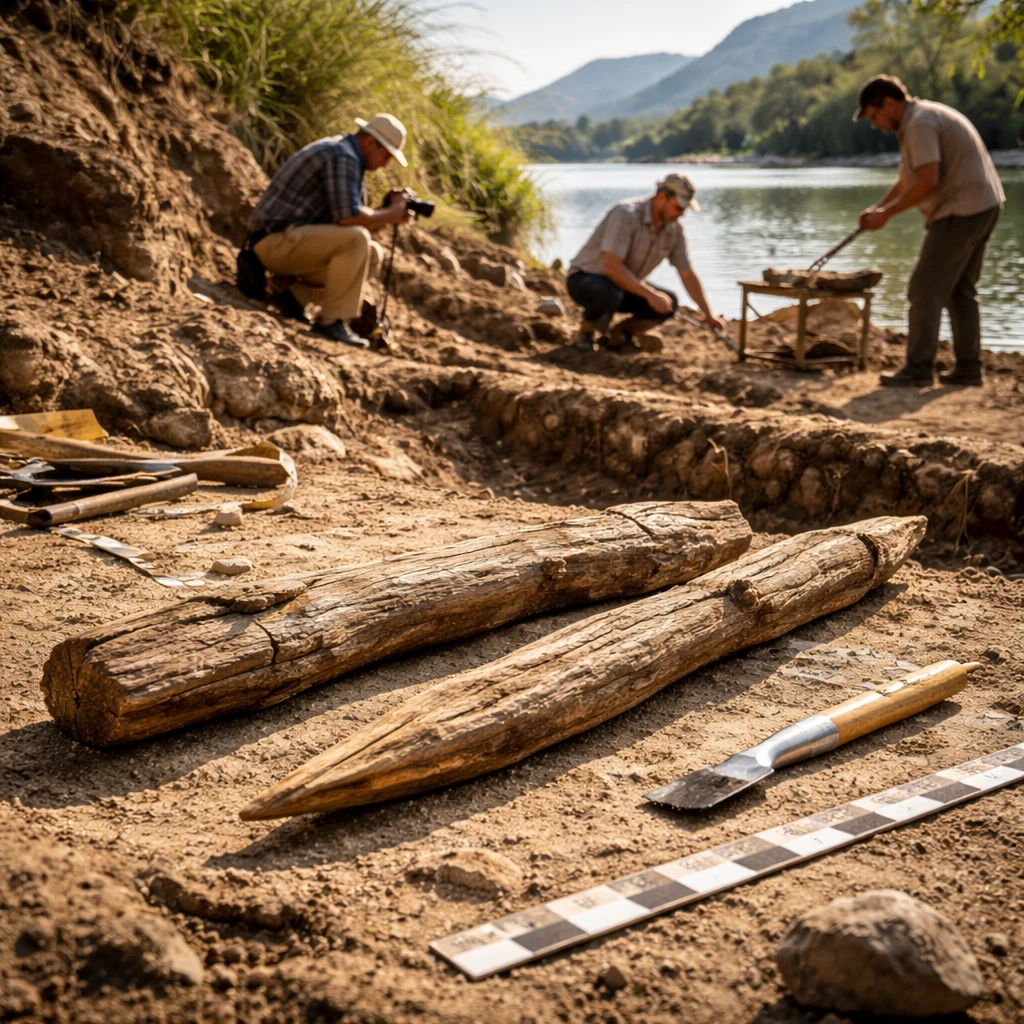

In a groundbreaking discovery from Greece's Megalopolis basin, archaeologists uncovered two wooden tools that rank as the oldest yet recognized by science. These artifacts, dating back approximately 430,000 years, provide exceptional insight into the tool-making practices of ancient human predecessors.
One of the tools resembles a slender stick measuring roughly 80 centimeters (2 1/2 feet) in length, likely utilized for digging in muddy terrain. The other is a smaller object composed of willow or poplar wood, exhibiting an enigmatic form that suggests potential use in shaping stone implements. This interpretation was outlined in a recent publication in the Proceedings of the National Academy of Sciences.
While stone, bone, and wooden tools have long been associated with early humans, direct evidence of wooden tools is significantly scarce due to wood's rapid decomposition. Preservation generally occurs only under particular environmental conditions, such as in ice, caves, or submerged contexts. In this instance, the rapid sedimentation and persistent wet surroundings at the site likely contributed to the remarkable conservation of the wooden artifacts.
The site itself has been a rich source of archaeological material over several years, including stone tools and elephant bones bearing cut marks. Although the wooden tools have not been directly dated, their association with the site’s stratigraphy, dated around 430,000 years ago, provides a reliable estimate of their antiquity.
“I’ve always just been thrilled to be able to touch these objects,” said Annemieke Milks, a researcher affiliated with the University of Reading and a co-author of the study.
No human remains have been recovered from the site to date, leaving the precise identity of the tool users uncertain. Possible candidates include Neanderthals, early human ancestors, or other hominin groups. This gap underscores the challenges inherent in reconstructing behavioral aspects of prehistoric populations.
Jarod Hutson, an archaeologist at the Smithsonian National Museum of Natural History who was not involved in the research, comments on the site’s potential: “The Greek site probably holds many more significant finds waiting to be unearthed. However, these two new wooden tools are subtle in appearance, which complicates their interpretation.” Hutson further notes the difficulty in attributing clear functions to these implements due to their unassuming forms.
Comparable prehistoric wooden tools include spear points from Germany and digging implements approximately 300,000 years old from China, believed to have aided in plant harvesting activities. This new discovery in Greece enriches understanding of early human technological diversity, revealing a relatively obscure aspect of their survival toolkit.
As study co-author Katerina Harvati of the University of Tübingen articulated in correspondence: “These artifacts offer a rare glimpse into the sophisticated and varied toolsets deployed by early humans.” Their preservation allows modern researchers to infer dimensions of ancient craftsmanship and resource utilization not often accessible through more durable materials like stone.