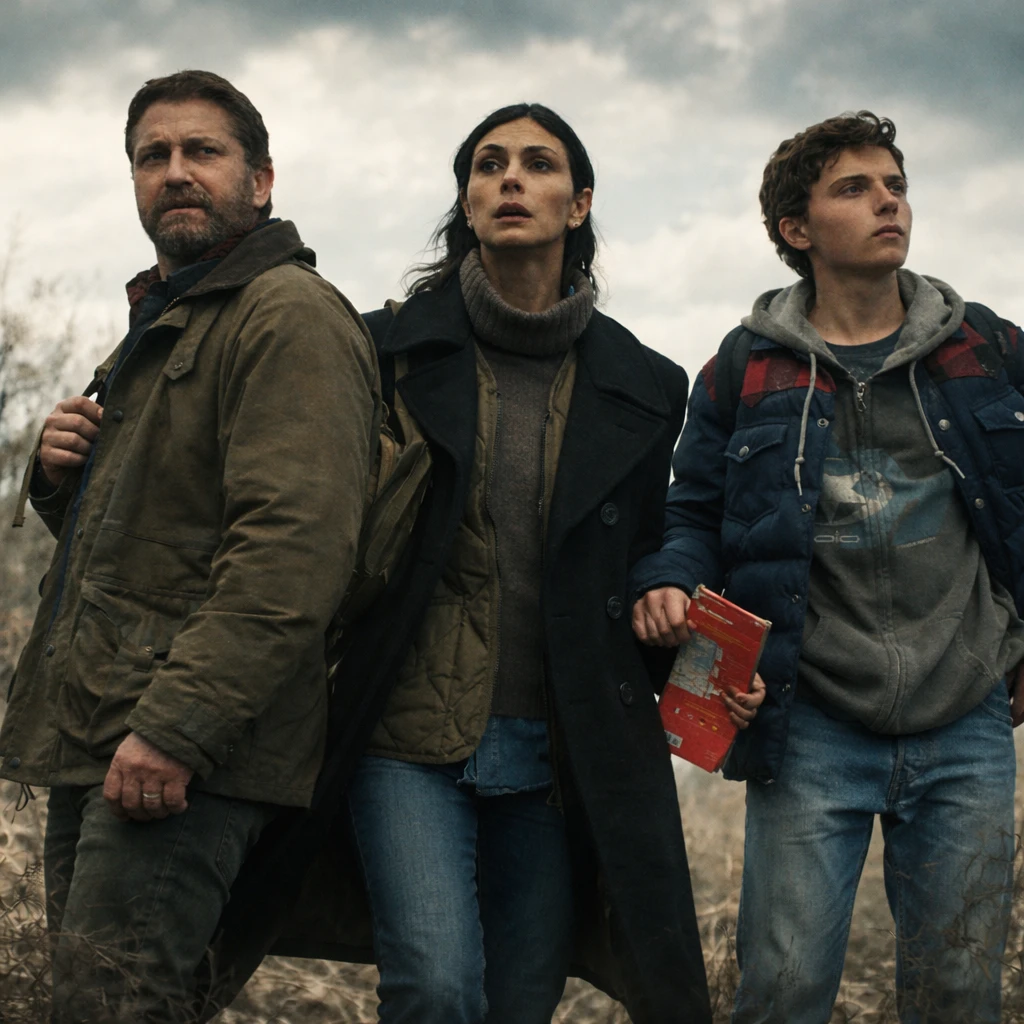

Releasing a film during a time when the name "Greenland" carries notable geopolitical significance might seem fortuitous, yet this connection is largely incidental to the movie’s narrative. Greenland 2: Migration, the follow-up to Ric Roman Waugh’s 2020 disaster drama, presents a continuation of Earth's struggle after catastrophic comet impacts, but unfortunately fails to leave a lasting impression beyond its title.
The story picks up five years after the Clarke meteor devastated much of the planet, leaving the remnants of civilization grappling with radioactive contamination and environmental collapse. The titular Greenland, once known for its icy expanses, has become an inhospitable environment, forcing survivors to seek refuge underground in a bunker amid the ash-covered remains of civilization.
Gerard Butler reprises his role as John Garrity, a determined but taciturn man whose survivalist instincts guide him through this desolate world. His wife Allison, portrayed by Morena Baccarin, embodies the emotional weight of the crisis, displaying fear and anxiety as she navigates leadership responsibilities within the bunker’s governing committee. The narrative introduces their teenage son Nathan, played by Roman Griffin Davis, whose coming-of-age transpires in this bleak, confined existence.
The surviving group attempts to maintain some semblance of normalcy by holding school, social events, and exercise classes underground, while the outside remains highly radioactive and dangerous. John periodically ventures above in protective gear to scavenge supplies, emphasizing the ever-present peril of their environment.
Global conditions remain dire, with little safe haven. Previous locations such as Iceland, Canada, and most of Europe have succumbed to the comet’s destructive aftermath. Within this context, speculation arises about a potential sanctuary in southern France – a crater region possibly spared such devastation, offering breathable air and fertile land.
Social tensions emerge over the acceptance of migrants seeking entrance into the bunker community, reflecting the strains imposed by scarcity and fear. Allison advocates for compassion, successfully securing refuge for some, although the damage to their own safety felt irreversible.
Disaster escalates when the underground shelter is demolished by a massive earthquake, forcing the survivors to escape to the coastline just before a tsunami strikes. They manage to board a rescue vessel, which later loses fuel but eventually lands near a partially submerged Liverpool, depicted as a flooded metropolis reminiscent of familiar historical cities altered by catastrophe.
From this point, the family embarks on a precarious journey toward London, where Allison hopes to reconnect with a friend. The path is fraught with dangers including a perilous crossing of what remains of the English Channel via fragile bridges, emphasizing the precariousness of life in this transformed world.
Throughout this journey, the film introduces various characters whose interactions lack sufficient depth to leave a meaningful impact on the viewer. Attempts to explore emotional connections, such as Nathan’s brief relationship with a young girl, remain underdeveloped and ultimately fade from the storyline.
As the family’s ultimate destination remains uncertain, so does the fate of the purported safe zone in southern France. Moreover, Greenland—the film’s namesake—serves merely as a setting for the opening, quickly fading into the background and offering little to distinguish the sequel from other post-apocalyptic narratives.
Rated PG-13 by the Motion Picture Association for intense violence, bloody imagery, and action sequences, Greenland 2: Migration runs for 98 minutes and delivers a somber, predominantly bleak outlook on survival rather than suspense or compelling character arcs. Its subdued tone and lack of memorable moments result in a modest one and a half-star rating out of four.