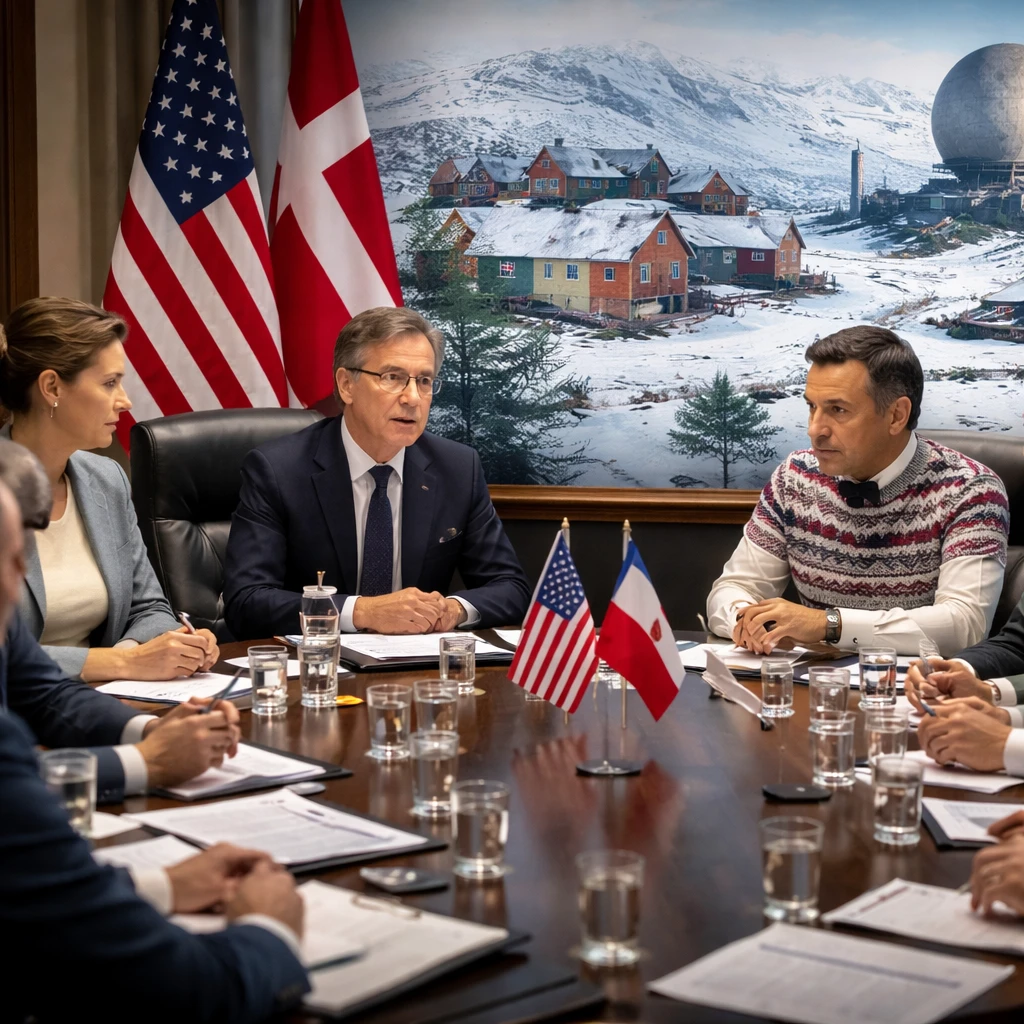

In Washington on Wednesday, officials representing Greenland and Denmark engaged in critical talks with senior United States officials regarding the future of Greenland, a semi-autonomous territory under Danish sovereignty. The dialogue was marked by heightened US pressure following President Donald Trump's public assertion that Greenland's acquisition is vital for American national security interests.
During the discussions, Vice President JD Vance and Secretary of State Marco Rubio met with Danish Foreign Minister Lars Løkke Rasmussen and Greenlandic Foreign Minister Vivian Motzfeldt. The meetings, lasting approximately one hour, aimed to address the complex geopolitical and strategic concerns surrounding Greenland.
Prior to these talks, President Trump reiterated his stance on social media, emphasizing the necessity for the United States to secure Greenland's ownership. He urged NATO to play a leading role in facilitating this acquisition and warned that failure to do so might allow rival powers such as Russia or China to assert control, a scenario he determined to be unacceptable.
Trump articulated, "NATO becomes far more formidable and effective with Greenland in the hands of the UNITED STATES. Anything less than that is unacceptable." This declarative position reflects the administration's strategic prioritization of Greenland amid rising global competition in the Arctic region.
In contrast, representatives from Greenland responding through social media questioned the unilateral nature of these propositions, asking, "Why don't you ask us?" They pointed out that only a minority of the island's residents support integration into the United States, signaling a significant divergence in perspectives.
Locally, the sentiment among Greenland's population is largely in opposition to U.S. takeover attempts. In Nuuk, the capital, many residents conveyed frustration with international attention. Tuuta Mikaelsen, a local student aged 22, expressed hope that American officials would respect Greenland's autonomy and "back off." The island's Prime Minister, Jens-Frederik Nielsen, reinforced this position at a Copenhagen press conference, stressing, "If we have to choose between the United States and Denmark here and now, we choose Denmark. We choose NATO. We choose the Kingdom of Denmark. We choose the EU." This declaration underscores Greenland's commitment to its current political alliances and sovereignty under Denmark.
Responding to Nielsen's remarks, President Trump stated he disagreed with the Danish official, asserting unfamiliarity and indicating that such dissent might pose challenges for Nielsen. This interaction further illuminates the tensions between the involved parties.
Strategically, Greenland's importance has escalated as climate change diminishes its ice coverage, potentially opening shorter trade routes to Asia and facilitating access to valuable mineral deposits essential to technology manufacturing. These developments heighten international interest in the island's resources and geopolitical positioning.
Denmark has pledged to bolster its military footprint on the island, with the Defense Ministry announcing the deployment of capabilities and units commencing Wednesday. This increase in military presence will involve aircraft, vessels, and personnel, including contributions from NATO allies. Defense Minister Troels Lund Poulsen stated that Danish authorities, alongside Arctic and European allies, will explore ways to enhance military activity and presence in the region.
President Trump has also conveyed that Greenland is critical to the United States' Golden Dome missile defense program and has cited the perceived threat posed by Russian and Chinese naval operations near the island to justify American control. However, these assertions have been questioned by local experts and residents, who report little to no evidence of such foreign military activity.
Lars Vintner, a heating engineer engaged in local outdoor activities, remarked that the only Chinese presence he noticed was commercial, such as in fast food outlets, and has not encountered foreign military vessels. His acquaintance, Hans Nørgaard, dismissed President Trump's claims as ‘‘fantasy.’’ These perspectives indicate skepticism about the purported security threats motivating the US interest.
Denmark maintains that while the United States may expand its existing military bases on Greenland, the overarching goal is cooperation rather than territorial transfer. Some locals, including Vintner, suggest that economic interests drive the American focus on Greenland's untapped natural resources, with security serving as a pretext.
Mikaelsen emphasized the benefits Greenlanders receive as part of Denmark, including free healthcare, education, and study support, expressing reluctance about losing these under U.S. governance.
Diplomatic interactions continue, with Danish Foreign Minister Løkke Rasmussen and Greenlandic Foreign Minister Motzfeldt, aided by Denmark's ambassador to the U.S., scheduled to meet with members of the Arctic Caucus in the United States Senate. A bipartisan group of U.S. lawmakers plans to travel to Copenhagen shortly for further discussions with Danish and Greenlandic officials.
Recently, Denmark's major European allies, together with Danish Prime Minister Mette Frederiksen, issued a joint statement affirming that Greenland's destiny lies solely with its inhabitants and Danish authorities, underscoring that external parties should not impose decisions concerning Greenland's status.
French Foreign Minister Jean-Noël Barrot announced plans to open a French consulate in Greenland on February 6, reflecting growing European engagement in Arctic affairs. Barrot criticized the notion of one NATO member undermining another, describing it as counterproductive to US interests and calling for an end to such coercive tactics.