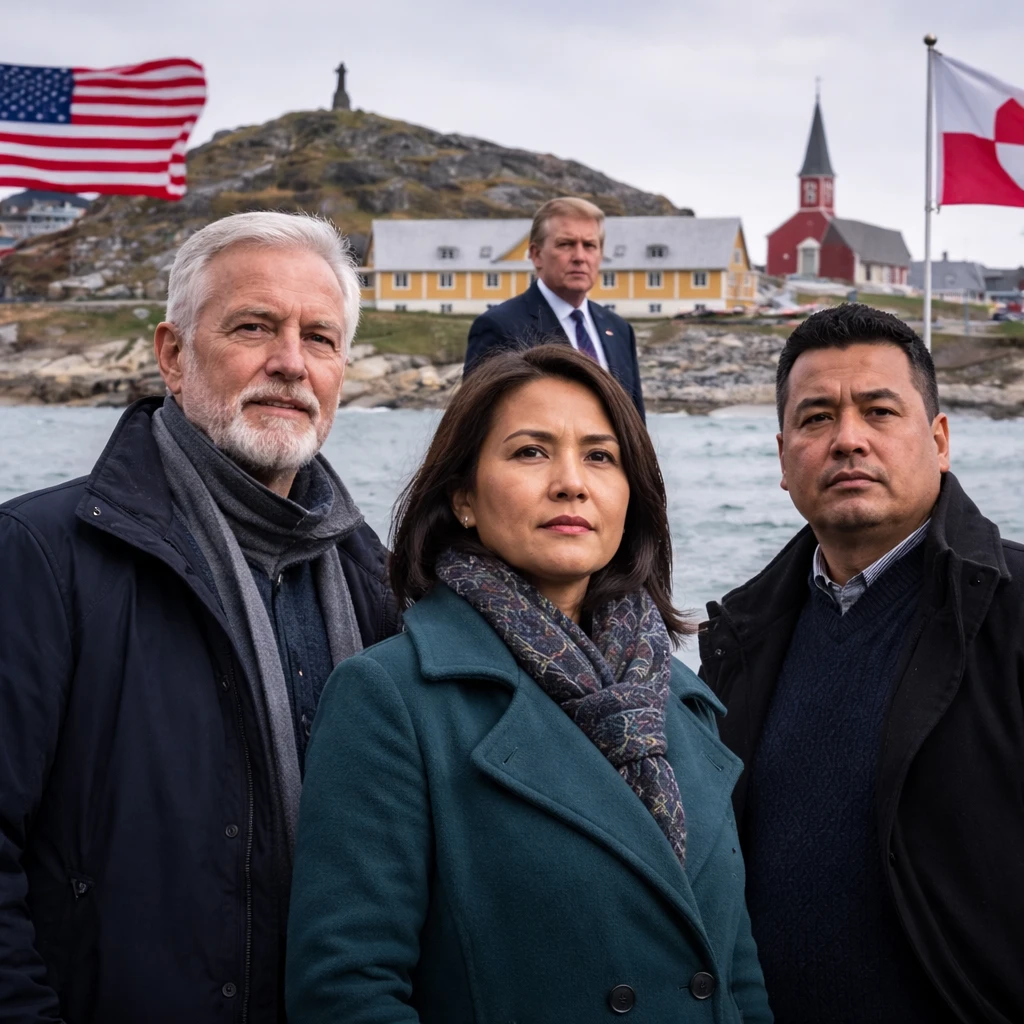
In a decisive statement released recently, Greenland's prime minister Jens-Frederik Nielsen, alongside four other party leaders, voiced strong opposition to repeated overtures from U.S. President Donald Trump regarding American acquisition of Greenland. The leaders underscored that Greenlanders themselves must determine their homeland's destiny, categorically rejecting any assimilation into either the United States or Denmark.
President Trump reiterated his interest in securing Greenland for the United States, describing it as an initiative he wishes to accomplish "the easy way." He warned of potential takeovers by Russia or China if the U.S. does not act, implying a strategic imperative to preempt other powers from establishing a presence there. Trump further suggested that failure to negotiate amicably could result in a more forceful approach, though specific measures were not delineated. The White House has acknowledged exploring a spectrum of options, including deploying military force, to facilitate control of the island.
Responding to these developments, the Greenlandic party leaders reaffirmed that decisions regarding their island cannot be dictated externally but must arise from engagements among Greenland’s people. Addressing the broader context, their statement also called for an end to what they described as U.S. disregard for Greenland's sovereignty and autonomy.
Concurrently, officials from Denmark, Greenland, and the United States convened in Washington for discussions centered on the recent U.S. overtures, with plans to reconvene in the near term. The Danish Prime Minister, Mette Frederiksen, has expressed grave concerns, suggesting that any American takeover attempt of Greenland might jeopardize the North Atlantic Treaty Organization (NATO) alliance.
The Greenlandic statement highlighted adherence to international legal frameworks as integral to any deliberations about the island's fate: "The work on Greenland’s future takes place in dialogue with the Greenlandic people and is prepared on the basis of international laws." The leaders emphasized that no external party should interfere or exert pressure that accelerates decision-making without local consensus.
Signatories of the statement included Nielsen, Pele Broberg, Múte B. Egede, Aleqa Hammond, and Aqqalu C. Jerimiassen, representing a unified front across Greenland’s political spectrum.
Greenland, notably the world's largest island, hosts a population of about 57,000 and lacks an independent military force. Its defense is the responsibility of Denmark, whose military capabilities are significantly exceeded by those of the United States. The ambiguity remains regarding how allied NATO members might react should the United States pursue forcible acquisition of the island or if Denmark requires support in such a scenario.