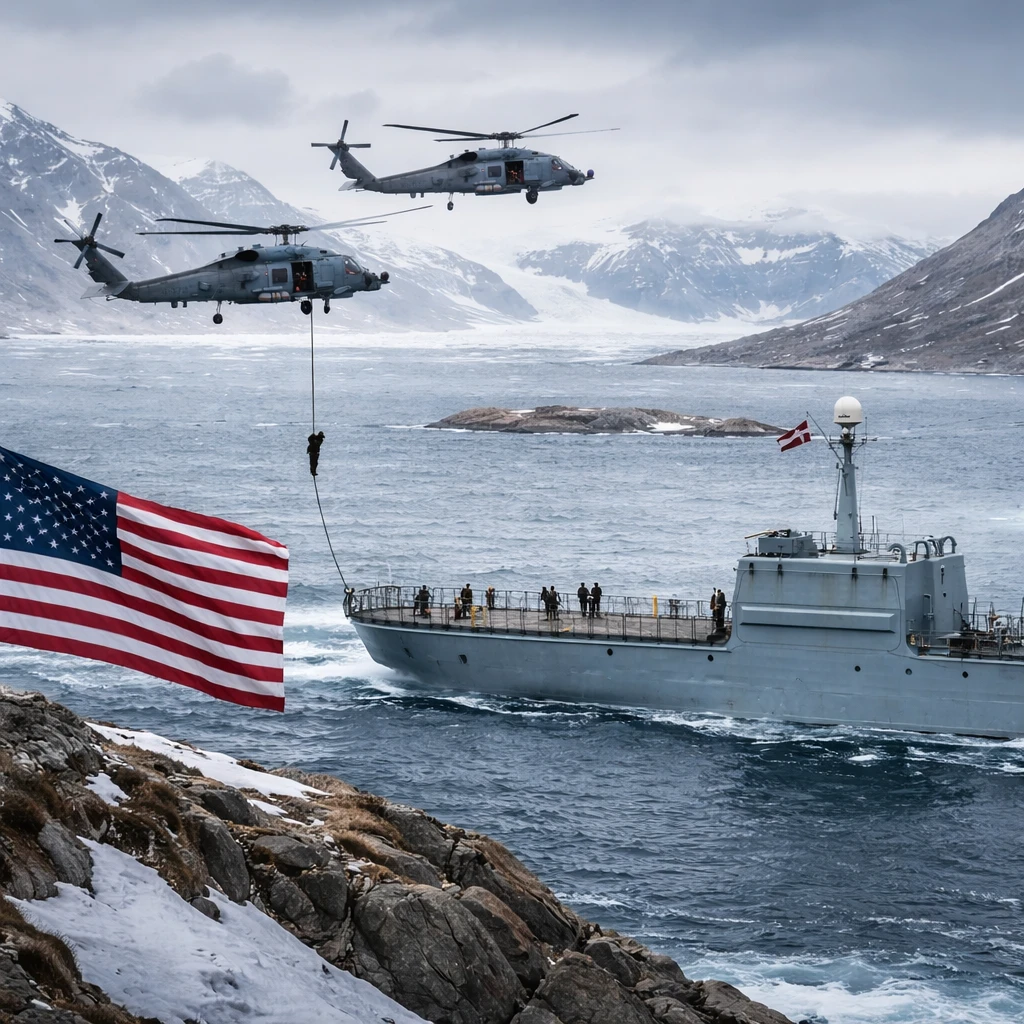

Greenland, predominantly located above the Arctic Circle, holds a critical position in the evolving discourse on global security and economic interests, emerging as a vital asset amid escalating international confrontations and climate-induced transformation. This mineral-rich island serves as a frontier guarding access to the Arctic and North Atlantic, accentuating its strategic importance for nations with interests in these regions.
The United States, under President Donald Trump's administration, expressed an explicit desire to gain control over Greenland, targeting the island’s resources and military advantages in safeguarding North American approaches. Despite the island's strategic value to the US, both Greenland's autonomous government and Denmark, which retains sovereignty, have firmly resisted American overtures. Greenlanders assert their right to self-determination, emphasizing that the island's future should be determined by its own people.
With a population of approximately 56,000, predominantly Inuit, Greenland had historically remained peripheral in global politics until recent shifts spotlighted its geographic and resource significance. More than eighty percent of the territory lies within the Arctic Circle, positioning Greenland as a critical locus for defense and resource competition.
Geopolitical Significance of Greenland's Location
Situated northeast of Canada, Greenland's placement has long been a keystone in North American defense strategies. During World War II, the United States established a presence to prevent Nazi occupation and to secure vital shipping lanes across the North Atlantic. Post-Cold War, the Arctic was an arena for international collaboration, but ongoing climate change has reduced the Arctic ice cap, facilitating the emergence of the northwest passage and reigniting geopolitical competition over territorial claims and natural resources.
Emerging Security Threats and International Rivalry
In pursuit of Arctic influence, China declared itself a "near-Arctic state" in 2018, aiming to bolster its strategic and economic foothold via its Belt and Road Initiative, particularly the proposed "Polar Silk Road." This move drew criticism from US officials wary of increased militarization and territorial disputes reminiscent of the South China Sea conflicts.
Simultaneously, Russia has intensified its military and infrastructural investments in the Arctic, refurbishing Soviet-era bases, constructing new facilities since 2014, and reinforcing its Northern Fleet's presence. The resurgence of Russian military activity, especially amid its 2022 invasion of Ukraine, has heightened concerns among European nations about NATO's posture and territorial stability in the Arctic. President Vladimir Putin has articulated Russia's intent to enhance its military capacity in the region, while also signaling openness to multilateral cooperation.
US Military Infrastructure and Allied Defense Initiatives
The United States maintains the Pituffik Space Base in northwest Greenland, a facility dedicated to missile warning, defense systems, and space surveillance in coordination with NATO. Greenland also oversees part of the critical GIUK Gap, a maritime corridor essential for monitoring Russian naval activity in the North Atlantic.
Denmark has undertaken significant measures to fortify its military presence in Greenland and adjacent North Atlantic territories. An investment of approximately $2.3 billion was announced to augment surveillance capabilities and sovereignty enforcement, encompassing the commissioning of new Arctic patrol vessels, long-range drones, and satellite technology. Greenland's capital, Nuuk, hosts Denmark’s Joint Arctic Command, responsible for regional defense, supplemented by smaller installations and the elite Sirius Dog Sled Patrol, which operates in the Arctic wilderness.
Abundant Mineral Resources and Economic Considerations
Greenland harbors extensive deposits of rare earth minerals, crucial components for advanced technologies including mobile devices, computers, and electric batteries projected to underpin future global economic growth. These resources have attracted international interest, particularly from the US and Western nations, as they seek to diversify supply chains and reduce reliance on current dominant suppliers.
Despite this potential, the development of Greenland’s mineral wealth confronts substantial challenges. The island's extreme climate imposes logistical constraints, while stringent environmental regulations add complexity for investors aiming to exploit these resources responsibly.