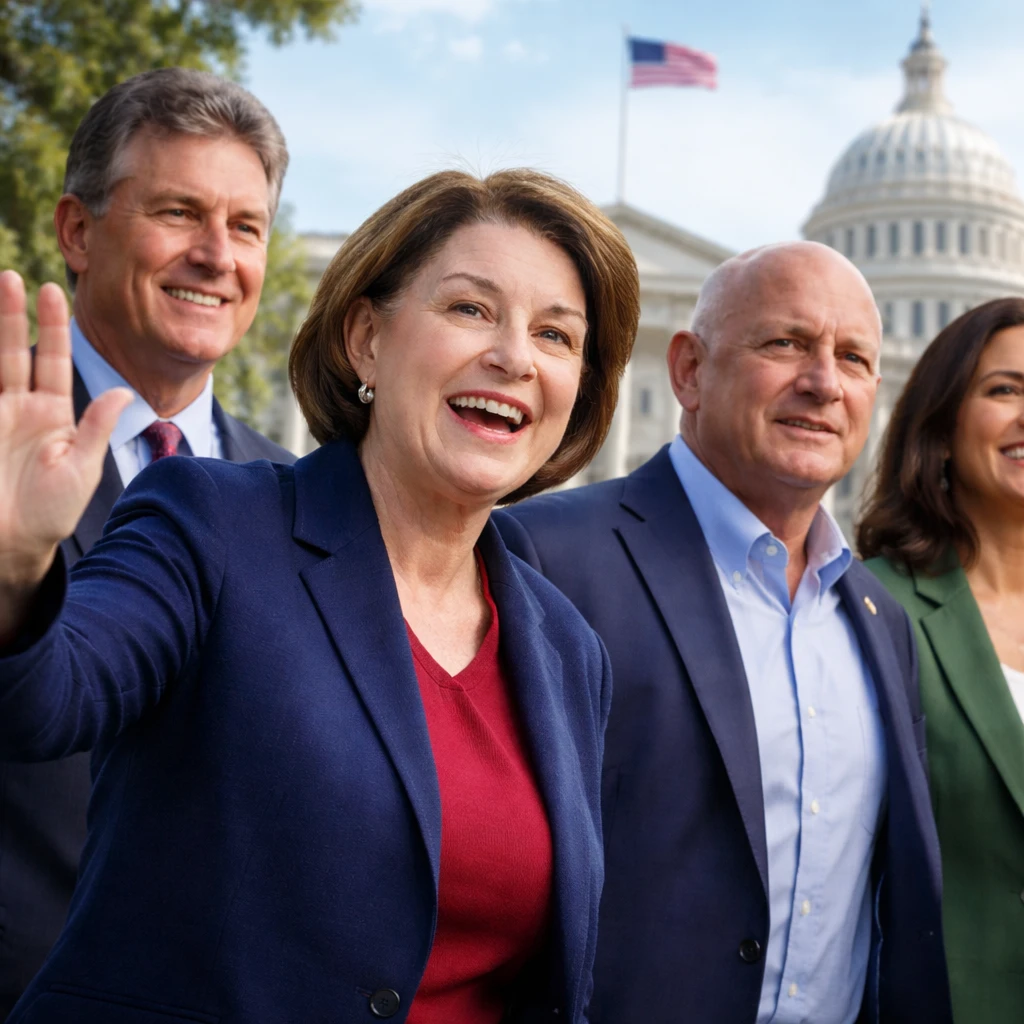

WASHINGTON – A noticeable shift is underway as more U.S. senators express a desire to depart from their roles in Congress to pursue leadership positions within their home states. Demonstrating this trend, Minnesota Democrat Amy Klobuchar became the fourth incumbent senator to declare a gubernatorial campaign for 2026 when she announced her bid recently. This unprecedented number, the highest in recent years, follows others such as Colorado Democrat Michael Bennet, Tennessee Republican Marsha Blackburn, and Alabama Republican Tommy Tuberville, all seeking to transition to governorships.
This phenomenon mirrors a reorientation in political aspirations, where the Senate no longer represents the ultimate political ambition it once was. Formerly viewed as the climax of a political career or a vital platform for presidential aspirations, the Senate is now perceived as an institution hampered by stagnation and dysfunction that limits lawmakers' ability to enact change.
The governor’s mansion, in contrast, offers a level of practical authority often absent in the Senate. As chief executives of their states, governors can directly implement policy, develop administrative records, and gain heightened public visibility. Tommy Tuberville articulated this sentiment, remarking that he believes he can accomplish far more in the gubernatorial role than in his current Senate position.
The quartet of senators seeking governorships is part of a wider exodus from the Senate, with eleven senators already announcing retirements for the upcoming cycle, including nine whose terms culminate next year. Michael Bennet’s decision, although surprising to some, stems from a long-standing frustration with the slow pace of legislative progress in Washington, especially under the current political climate shaped by former President Donald Trump.
Bennet emphasized that challenges such as economic affordability cannot be effectively tackled at the federal level, pointing to partisan gridlock. He cited Trump’s antagonistic stance toward Colorado — including punitive threats related to a county clerk's legal issues and the veto of a water project vital to rural communities — as evidence of the strained federal-state dynamic intensifying partisan divides, which traditionally were less pronounced in state politics.
These developments illustrate how national political conflicts increasingly influence state governance, prompting candidates like Bennet and his Democratic primary opponent Phil Weiser to highlight their readiness to confront national-level partisanship at the state level.
This cycle promises the most significant Senate turnover in over a decade. Even without further retirements, the departure of candidates such as Tuberville—who was elected in 2020—represents a notable change; Tuberville conveyed that his motivation to run for governor stems from a desire to have a more impactful role where his vote and decisions directly affect state governance.
Political historian Matt Dallek of George Washington University observed the multifaceted forces underpinning this migration. While the Senate has become a less appealing environment due to growing dysfunction and diminished legislative successes, the governorship offers a contrasting prospect. Governors possess executive authority and often can pursue bipartisan initiatives in states that must balance budgets, fostering more functional governance settings often described as "labs of democracy." He pointed out that governors like Greg Abbott of Texas and Ron DeSantis of Florida serve as templates for influential leadership on key issues including immigration and cultural policies.
Historical data highlights that 22 U.S. senators have transitioned directly to governorships since direct senatorial elections began in 1913, with seven moving straight from the Senate to the governor's office. A recent example includes Mike Braun of Indiana, who successfully won his state’s governor race while still serving as a junior senator.
The accumulation of these retirements and candidacies signals a notable transformation in political career trajectories and invites scrutiny on the future effectiveness and composition of the Senate amidst mounting state-level political ambitions.