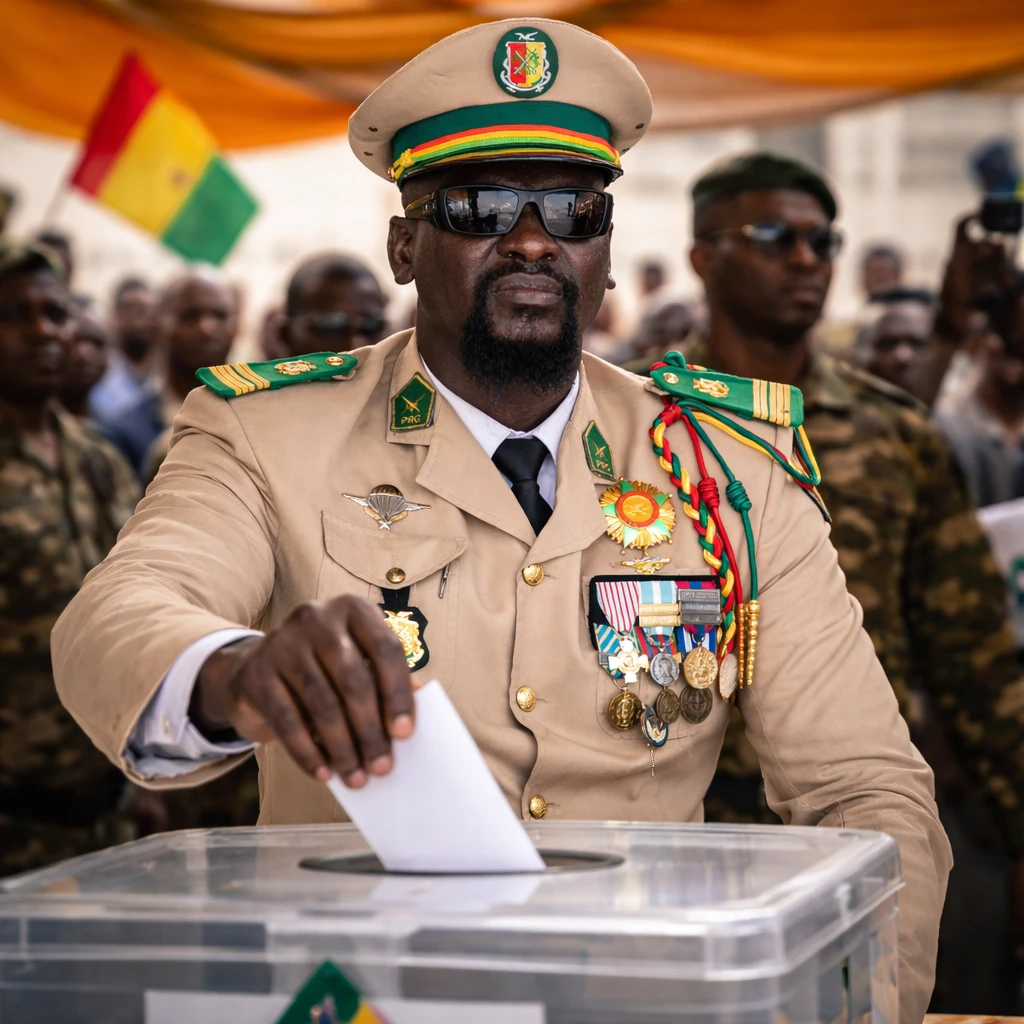

Guinea carried out a presidential election on Sunday, marking the first such poll since the military overthrow of President Alpha Condé in 2021. The electoral contest is widely anticipated to result in a victory for Gen. Mamadi Doumbouya, who led the coup and now faces limited opposition as political competitors have been marginalized.
This election-year follows a transitional period initiated over four years ago when Doumbouya seized power. Since then, critics have accused his administration of suppressing primary opposition parties and dissenting voices, contributing to a fragmented candidate field of nine contenders, none of whom substantially threatens the junta leader’s position.
Despite Guinea’s abundant natural resources—most notably being the top producer of bauxite, the main ingredient in aluminum manufacturing—more than 50% of its population of approximately 15 million is enduring severe poverty and food shortages, as reported by the World Food Program.
For youth such as 18-year-old Conakry resident Idrissa Camara, the election represents a beacon of hope. Having been unemployed since graduating university five years prior, Camara relies on sporadic work to sustain himself and looks to the vote to drive improvements in living conditions and economic opportunities across the country.
While polling proceeded largely without incident nationwide, participation levels were dampened in multiple locations. Opposition parties excluded from contesting urged citizens to abstain, influencing turnout. Poll stations closed at 7 p.m. local time with counting commencing promptly thereafter. Official results are predicted within two days, with a runoff election scheduled if no candidate secures an outright majority.
The vote was conducted under provisions of a new constitution enacted after a September referendum. Significant changes in this document include the lifting of prohibitions against military officials running for presidency and an increase of the presidential term from five to seven years, reforms that faced opposition boycotts but were approved decisively.
This election fits into a broader regional pattern in Africa, where a series of military coups has unsettled established governments, often justified by claims that preceding administrations failed in governance and security. Political analyst Aboubacar Sidiki Diakité noted that the poll symbolizes a fresh chapter in Guinea’s political evolution, reinforcing hopes for normalized international relations. However, he emphasized that Doumbouya remains the clear favorite, given the sidelining of his major rivals and the election body’s government oversight.
The political environment post-coup has been characterized by diminished opposition capacity, with civil society leaders facing restrictions, detentions of critics, and press censorship. Authorities disbanded over 50 political parties, a move described as an attempt to streamline political competition but criticized internationally. Security efforts were robust, involving around 12,000 police personnel, checkpoints in key areas, and actions reported to neutralize armed groups posing threats to national stability.
Among the candidates, Doumbouya's main competitor is Yero Baldé of the Democratic Front of Guinea, formerly an education minister, whose platform centers on governance reforms and anti-corruption initiatives. Doumbouya’s campaign highlights infrastructure developments and institutional reforms implemented since his ascendancy.
A cornerstone of Doumbouya’s governance has been the advancement of the Simandou iron ore project—a massive venture predominantly owned by Chinese interests, which commenced operations recently after extensive delays. This initiative is linked to a national development framework aimed at expanding employment and diversifying the economy across sectors including agriculture, education, transportation, technology, and healthcare.
Supporters point to digital skill programs introduced under Doumbouya’s tenure as evidence of progress. High school student Mamadama Touré, endorsing the leader, cited improved access to information and communication technologies as a key achievement.
The election involved around 6.7 million registered voters. Some, like 22-year-old Issatou Bah from Conakry, expressed uncertainty about participation, reflecting wider concerns about the efficacy of elections to effect change, despite multiple voting opportunities previously.