
ATLANTA – The incidence of Guinea worm infections among humans dropped to a record low of 10 cases worldwide in 2025, The Carter Center announced on Friday. These cases were detected exclusively in three countries: Chad, Ethiopia, and South Sudan.
This achievement comes shortly after the passing of former U.S. President Jimmy Carter, who was deeply involved in the fight against the parasitic disease through the program developed by his namesake Carter Center in the 1980s. At that time, millions were afflicted across several developing regions. Adam Weiss, director of the Guinea worm eradication program at The Carter Center, reflected on President Carter’s enduring commitment, noting: "We think about President Carter’s legacy and his drive to achieve zero cases. While these diseases might not rank as the highest global priorities, they represent the gravest challenges to those affected. We remain focused on his mission to alleviate as much suffering as possible."
In the breakdown of 2025 cases, Chad reported four human infections, Ethiopia also accounted for four, and South Sudan two. Despite reductions in some areas, animal infections persist in the hundreds, complicating the eradication outlook. The Guinea worm’s continued presence in animals increases the difficulty of completely halting transmission.
Compared to 2024, when 15 human cases were recorded, 2025's ten cases represent a 33% decrease. Furthermore, several countries that previously reported infections—Angola, Cameroon, the Central African Republic, and Mali—registered zero human cases for the second year running. The complete extinction of Guinea worm would place it alongside smallpox as one of only two human diseases ever eradicated.
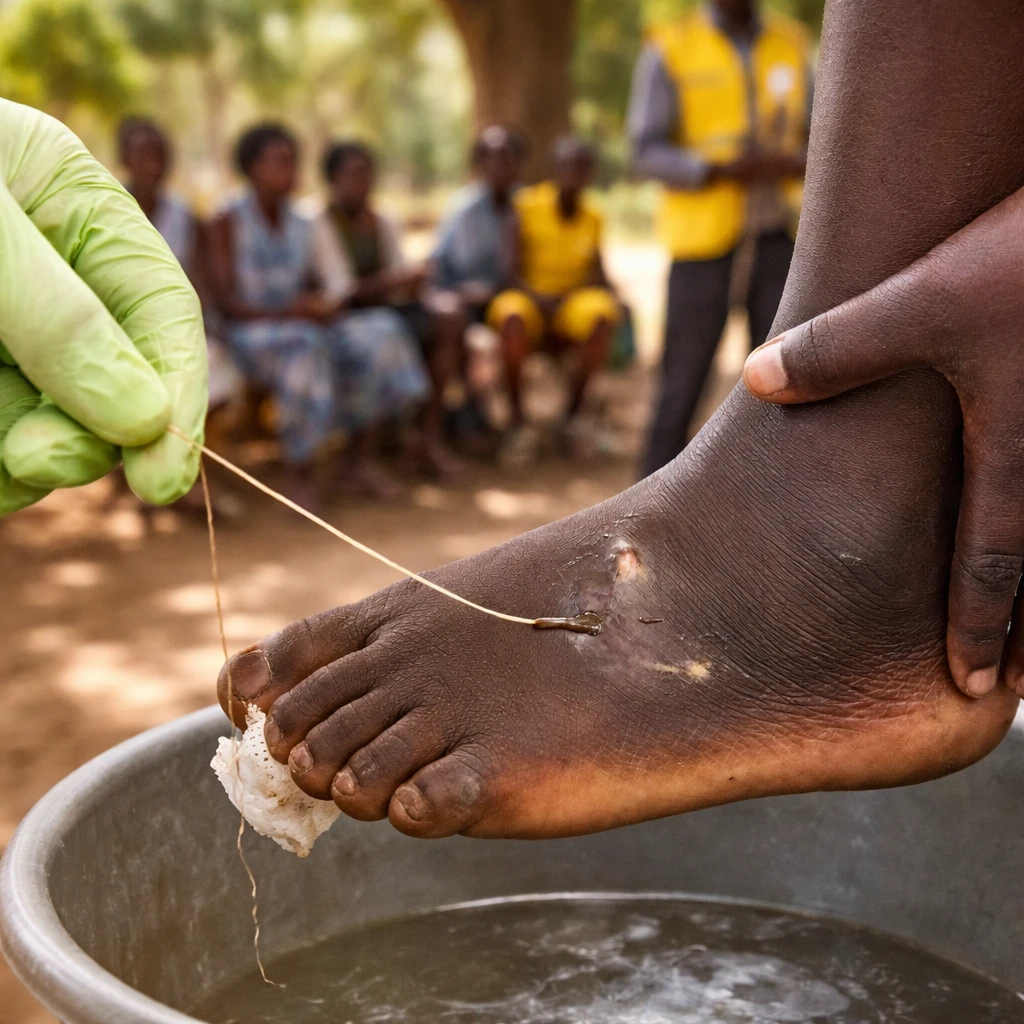
The infection is contracted by ingesting water contaminated with Guinea worm larvae. Once inside a human host, the worm can grow up to one meter in length with a diameter roughly the size of a strand of spaghetti. The parasite eventually emerges from the body through painful blisters. Individuals suffering from the infection sometimes seek relief by immersing themselves in water bodies, inadvertently releasing larvae back into the water, perpetuating the transmission cycle. Similarly, animals that access contaminated water sources can maintain the infectious cycle through their own infections. Consumption of aquatic organisms such as fish or amphibians harboring larvae can also transmit the parasite to humans.
Since its inception, The Carter Center’s eradication initiative has collaborated closely with national health ministries and various organizations to educate at-risk communities, train volunteers, and distribute water filters. Currently, there is no specific treatment for Guinea worm infection beyond pain management. Weiss emphasized that the next phase of eradication efforts involves developing diagnostic testing methods, particularly for animal infections. Early detection prior to visible symptoms could allow for behavioral modifications that prevent further contamination of water sources.
Regarding animal infections reported in 2025, Chad recorded 147 cases—a 47% decrease from previous figures, though the country remains a significant hotspot for animal infections. Cameroon reported 445 infections, Angola 70, Mali 17, South Sudan three, and Ethiopia one. Former President Carter and his wife Rosalynn actively participated in extensive field visits across endemic countries alongside Center staff and collaborators from the World Health Organization and national officials, building a coordinated effort toward disease elimination.
Weiss also commented on logistical impacts arising from the United States’ reduced engagement with international health organizations during the Trump administration, including the withdrawal from the World Health Organization and changes to foreign aid funding. Despite these challenges, the Guinea worm eradication program has maintained its operational presence and progress on the ground.