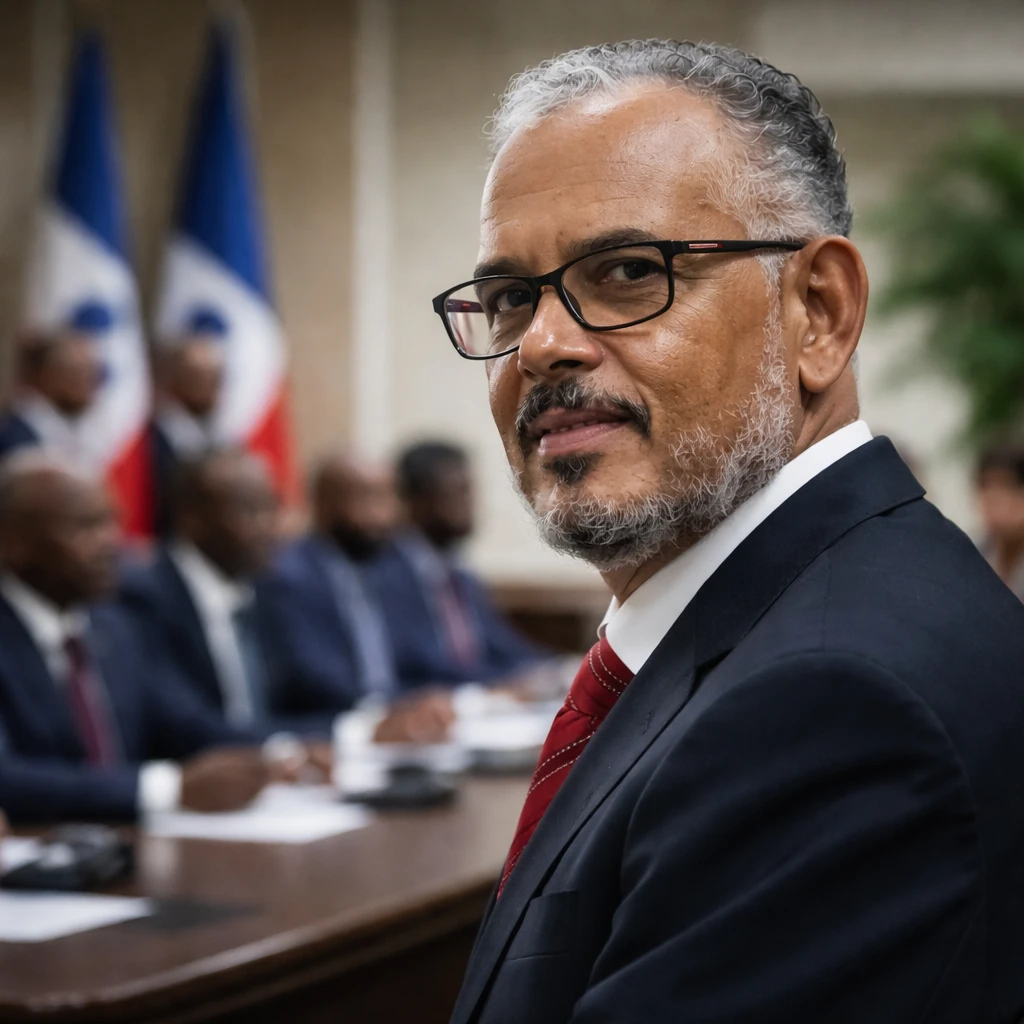

In a significant escalation of Haiti's protracted political instability, the Transitional Presidential Council announced on Friday that it had voted to remove Prime Minister Alix Didier Fils-Aimé from office. This development comes barely two weeks before the council itself is due to step down, plunging the country further into uncertainty.
Edgard Leblanc Fils, alongside fellow council member Leslie Voltaire, revealed at a press conference that the decision was reached through a majority vote conducted on Thursday. This action directly challenges the United States government's appeals for a steady leadership during this turbulent period in the Caribbean nation. Notably, no other members of the nine-member council participated in Friday's briefing.
The US Department of State had previously conveyed in a statement on Thursday evening the essential role of keeping Fils-Aimé in his position to bolster Haiti's strategic efforts to dismantle gangs terrorizing the country. The statement underscored that any political figures supporting violent gangs could face serious repercussions.
Leblanc did not provide specific reasons for the withdrawal of support for Fils-Aimé, who was appointed prime minister by the council in November 2024. However, he affirmed plans to nominate a successor within 30 days, emphasizing the need to "fully restore security and stability, initiate a cycle of development, rectify previous mistakes, and look towards the future." He stated, "We are confident our decision serves the country’s best interests, and we expect the international community to acknowledge our resolutions."
Voltaire remarked that the council was responsible for initially selecting Fils-Aimé, dismissing any suggestion that foreign actors influenced the choice. He asserted that the council intends to choose his replacement and establish a new government free from external intervention. "While many seek Haitian solutions to the crisis, once we begin to implement them, the international community intervenes with full force," he remarked.
Despite recognizing Fils-Aimé’s capabilities and zeal, Voltaire conveyed that the population's needs remain unmet under his administration. With the council’s mandate nearing its end, Voltaire expressed a desire for the latter half of its term to continue with "a strong team." Moreover, he stipulated that if political parties and civil society fail to identify the "best among the best" by February 6, the council will pursue alternative solutions.
This announcement surfaced amid intensifying pressure on the council to conduct comprehensive general elections, a process that has not occurred in Haiti for over a decade. Provisional dates have been set for August and December this year to elect a president, marking the first such vote since President Jovenel Moïse was assassinated at his residence in July 2021.
Since that assassination, gang-related violence has worsened dramatically. Armed groups are estimated to control approximately 90 percent of the capital, Port-au-Prince, and large sections of the central regions. United Nations reports cite over 8,100 homicides from January to November last year in this nation of nearly 11 million people, although the figures are believed to be underreported.
Leblanc advocated for political organizations, civil society, and religious sectors to unite and decide on effective governance strategies post-February 7, the date the council is scheduled to resign. Commenting on the potential aftermath of the council’s term, Michael Deibert, an author with expertise on Haiti, warned that failure to step down as planned could exacerbate volatility and insecurity in an already fragile political and constitutional environment. He also predicted possible escalations in the weeks ahead, noting the highly transactional and shifting nature of political alliances within the country.
Of the nine council members, seven possess voting rights, and a majority of five votes is necessary for decisions. It remains unclear whether Laurent Saint-Cyr, the current head of the council, supported the prime minister's dismissal. Earlier in the week, Saint-Cyr had issued a statement opposing any attempts to undermine governmental stability before the February 7 deadline.
Also on Friday, a spokesperson confirmed that US Secretary of State Marco Rubio had spoken with Fils-Aimé to reaffirm the White House’s commitment to Haiti’s stability and security. Rubio emphasized that sustained gang violence can only be curtailed through decisive, consistent leadership with comprehensive popular support. Additionally, Rubio stated that the council must dissolve on February 7, warning against corrupt actors seeking to interfere with Haiti’s path to an elected government for personal gain, according to Deputy Spokesperson Tommy Pigott.