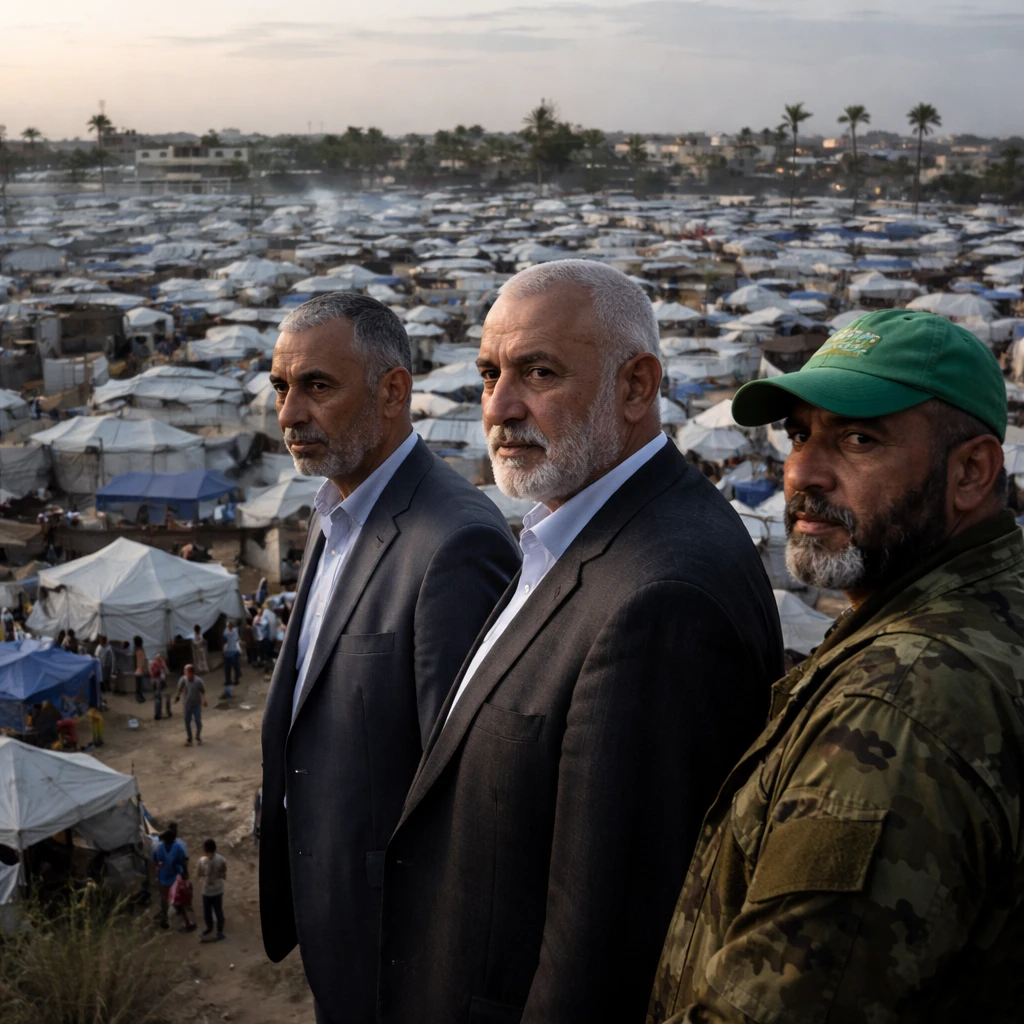

Hamas declared on Sunday its plan to dissolve its current administrative body governing Gaza once a newly formed Palestinian technocratic leadership committee assumes control over the region, a directive emerging from the peace framework facilitated by the United States. However, specifics regarding the timetable for this governmental handover were not disclosed by Hamas.
Neither Hamas nor the rival Palestinian Authority, recognized internationally as the official Palestinian representative, has revealed the identities of the proposed technocratic committee members. These individuals are expected to have no formal political affiliations. Furthermore, it is yet to be confirmed whether Israel and the United States will grant approval for these appointments.
The envisioned “Board of Peace,” an internationally led oversight institution initiated under former U.S. President Trump, is tasked with supervising the governance transition and additional components of the ceasefire that took effect on October 10. The board’s responsibilities extend to disarming Hamas and deploying an international security force within Gaza. To date, the exact composition of this supervisory board has not been publicly announced.
Meanwhile, hostilities have not entirely ceased, with Palestinian medical officials reporting that three Palestinians have succumbed to Israeli gunfire since the ceasefire began.
The ceasefire agreement initiated a cessation of active combat and facilitated the release of hostages detained in Gaza in exchange for thousands of Palestinians held in Israeli custody. Efforts continue to recover the remains of the last hostage remaining in Gaza. According to an Egyptian official familiar with the closed-door discussions—speaking anonymously due to the sensitivity of the matter—a Hamas delegation is scheduled to engage in further talks with Egyptian, Qatari, and Turkish representatives to progress towards the agreement's second phase.
Uncertainty Surrounds Future Governance in Gaza
Hamas spokesperson Hazem Kassem, in a statement on his Telegram channel, urged expediting the formation of the technocratic committee. The Egyptian official further stated that Hamas plans to convene with other Palestinian factions within the week to finalize the committee’s structure, with Khalil al-Hayya, Hamas's chief negotiator, slated to lead the Hamas delegation.
Former President Donald Trump has articulated that the “Board of Peace” would monitor the technocratic committee’s activities while overseeing Hamas’s disarmament, the introduction of an international security presence, the withdrawal of Israeli troops, and the reconstruction of Gaza. However, American authorities report slow progress across these measures. The Board's membership roster is expected to be announced imminently.
In a recent development, Israeli Prime Minister Benjamin Netanyahu announced the selection of Bulgarian diplomat Nickolay Mladenov as the board’s director-general. Mladenov’s extensive experience includes roles as Bulgaria’s defense and foreign minister, the United Nations envoy to Iraq, and from 2015 to 2020, the UN Middle East peace envoy. His tenure was marked by professional ties with Israel and efforts to ease tensions between Israel and Hamas.
On the same day, Israeli Foreign Minister Gideon Saar met with Japanese Foreign Minister Toshimitsu Motegi in Jerusalem, where Saar reaffirmed Israel's commitment to enforcing Trump’s peace plan. Motegi expressed Japan's readiness to actively contribute to sustaining the ceasefire. According to Japan's Foreign Ministry, Motegi visited the Civil-Military Coordination Center, which is responsible for monitoring the ceasefire, and planned to confer with both Israeli leadership and Palestinian representatives in the Israeli-occupied West Bank.
Ongoing Violence Persists Despite Ceasefire
Violence has not fully abated in Gaza since the ceasefire. Local health facilities reported the deaths of two men from gunfire in Bani Suhaila, a southern town in Gaza, as recorded by Nasser Hospital. Earlier that day, a male individual was killed by Israeli gunfire in Gaza City's Tuffah neighborhood, as reported by Al-Ahly Hospital.
In response, the Israeli military characterized the Tuffah incident as an engagement with a "terrorist" approaching Israeli forces in northern Gaza, resulting in lethal force. A subsequent military statement confirmed the elimination of an armed individual in southern Gaza who approached Israeli troops.
Both Israel and Hamas have accused one another of breaching the ceasefire agreement. Israeli air strikes continue to result in significant Palestinian casualties, with local health authorities reporting over 400 deaths since the truce took effect. The Israel Defense Forces maintain that all post-ceasefire actions are reactive to breaches of the accord.
Israeli Political Turmoil as Security Probe Advances
Separately, Israeli police revealed that a senior official from Prime Minister Netanyahu's office is currently under interrogation concerning allegations of obstruction related to an investigation into the unauthorized disclosure of classified military information to a German tabloid last year.
Israeli media have identified the official as Tzachi Braverman, Netanyahu's chief of staff who is anticipated to serve as Israel's next ambassador to the United Kingdom in the near future. This inquiry is an extension of a broader scandal implicating Netanyahu's inner circle in leaking sensitive data to German publication Bild with the objective of improving the Prime Minister's public standing following the deaths of six hostages in Gaza in 2024.
This investigation intensified following a revealing interview with Eli Feldstein, Netanyahu’s former spokesperson, on Kan News. Feldstein disclosed a secretive meeting with Braverman in a subterranean parking facility at an unusual hour, during which Braverman allegedly proposed efforts to terminate the probe. Feldstein faces indictments linked to the scandal.
Responding to these developments, opposition leader Yair Lapid demanded Braverman's suspension as ambassador, emphasizing that an individual suspected of obstructing a critical security investigation should not represent Israel internationally. Conversely, Foreign Minister Gideon Saar defended the appointment, affirming that Braverman's designation would remain unchanged unless formal charges or legal trials ensue.