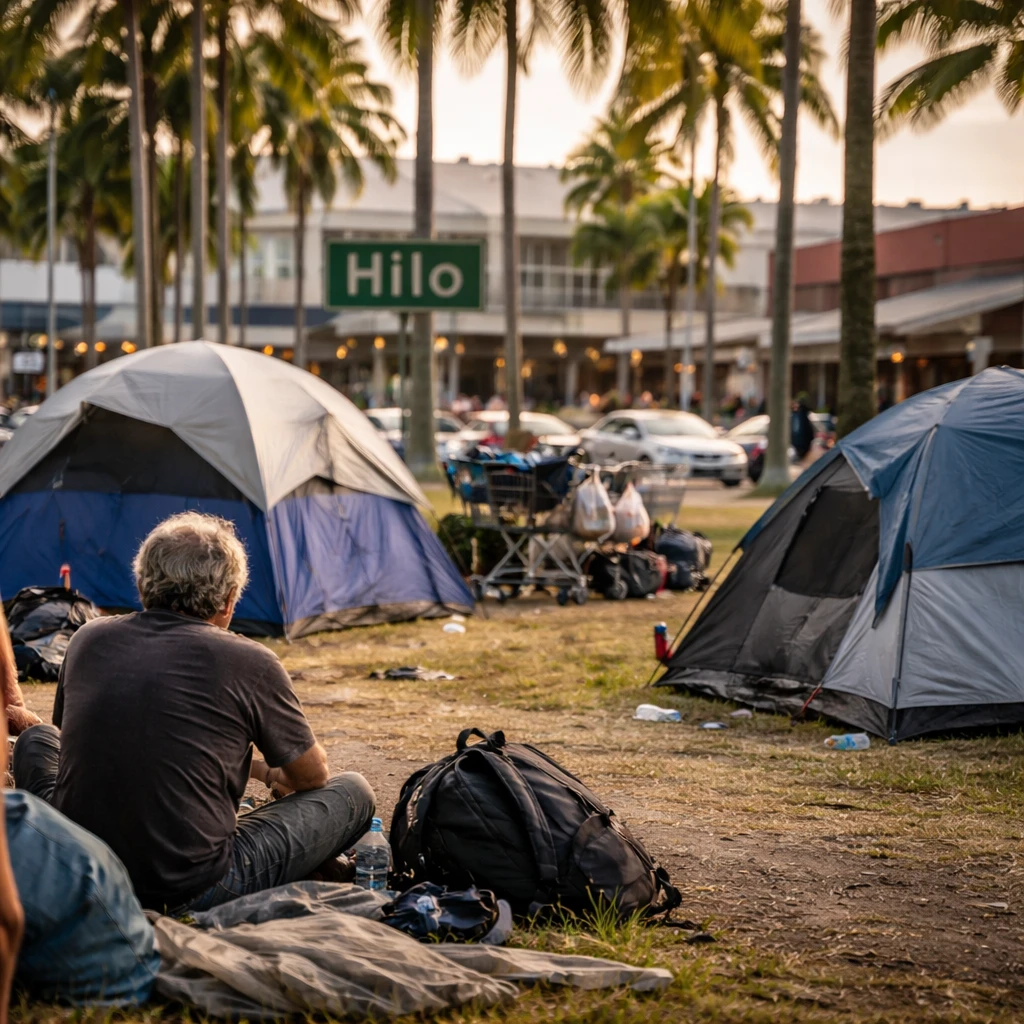
Approximately four years ago, the Hawai'i County Council began a substantial effort to address homelessness locally, allocating an initial portion of what would grow to a $33 million investment. Despite this large commitment, tangible progress remains elusive, and support within the council is waning. In the previous month, a narrowly approved $6 million request for outreach and homeless program funding passed with a slim 5-4 vote.
During the funding discussion, Ashley Kierkiewicz, representing the Puna district, posed a critical question: "Has the tens of millions of dollars that Hawai'i County has invested in this program actually made a dent? Are we better off as a community?" She reflected on the street-level reality, noting that walking through downtown Pāhoa and Hilo neighborhoods does not suggest improvement, underscoring a disconnect between financial input and observed conditions.
Matt Kaneali'i-Kleinfelder, also from Puna, echoed these concerns, expecting evident results after a $30 million expenditure on homelessness over three years but finding none.
The council members' opinions carry weight as the county distributes funds for homeless programs through the Homelessness and Housing Fund, which is slated to expire in 2027 unless renewed by the council.
Heather Kimball, council member for the Hāmākua Coast, supported continuation of funding but advocated for an audit to evaluate spending details and program effectiveness. She indicated an audit proposal would be presented to the council within the month, emphasizing the need for transparent data to inform future funding decisions. Despite a lack of constituent complaints about the programs, Kimball acknowledged a prevailing perception that the homelessness situation has deteriorated.
The latest round of funding granted $6 million to nonprofits engaged in outreach, temporary shelter, long-term housing, and supportive services, with an additional $5.14 million proposed for major shelters and safe spaces across East and West Hawai'i, as well as a permanent supportive housing initiative in Kona. This subsequent package awaits council approval amid uncertain reception.
In a December hearing, Kierkiewicz vocalized frustration regarding the efficacy of existing support, pointing to individuals resistant to rules, creating unsanitary conditions in parks, and causing maintenance burdens. She expressed personal concern as a taxpayer and a mother about public safety and community responsibility, highlighting the extensive cleanup efforts required in public spaces.
Council member Rebecca Villegas from Kona also criticized recurring grant recipients whose programs appear to have minimal impact, voicing exasperation over the distribution of funds.
Brandee Menino, CEO of HOPE Services Hawai'i, acknowledged growing frustrations over the issue's worsening trajectory. Citing federal funding challenges that may exacerbate homelessness, Menino advocated for continuation of the Homelessness and Housing Fund, referencing data showing 552 individuals transitioned from homelessness to housing last fiscal year with support from HOPE Services and similar agencies.
According to Menino, 74% of clients assisted remain housed due to sustained support, but the influx of newly homeless individuals is growing. She noted county data indicating 80% of homeless people would accept shelter if available, underscoring an affordable housing shortage. Nearly half of homeless-to-housed transitions rely on housing subsidies, identifying subsidies and affordable units as critical bottlenecks.
The county's community development office reports attempts to address council concerns by prioritizing grants for essential services and diversifying geographically and among nonprofits. However, Kēhaulani Costa, the community development administrator, warned of nonprofit struggles following funding cuts, anticipating reductions in shelter beds and outreach programs.
A 2024 consultant evaluation identified insufficient truly affordable housing and recommended viewing the Homelessness and Housing Fund as part of a larger county strategy. Proposals include establishing an Office of Homelessness and extending flexible funding beyond 2027 to meet growing homelessness and housing instability needs.
Yet council dissatisfaction persists. Kierkiewicz emphasized the fund was intended as temporary, projecting eventual discontinuation. Council member Dennis "Fresh" Onishi advocated for social service programs with clear sunset provisions, expecting agencies to develop independent funding sources.
Kaneali'i-Kleinfelder referenced California's $24 billion expenditure over five years without homelessness decreases as cautionary, stressing the necessity of measurable outcomes for county investments or risk being "in a bad spot."
As Hawai'i County contends with mounting homelessness despite substantial financial resources, the debate centers on the balance between continued funding, program effectiveness, and strategic planning amid a complex social challenge.