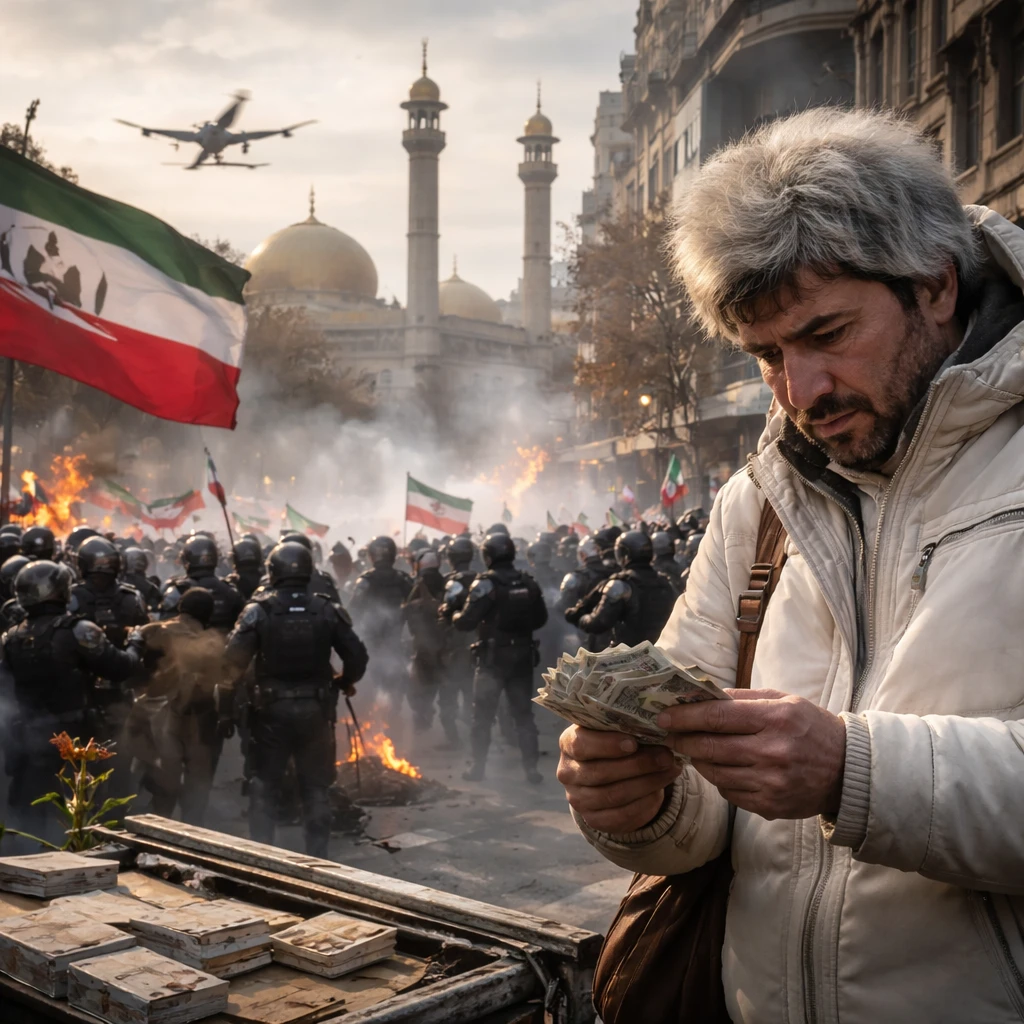
Concerns about a possible U.S. military strike on Iran have prompted Iranian officials to appeal to broader Middle Eastern nations as the country grapples with widespread protests entering their second month. The discourse emerges in parallel with Iran’s currency, the rial, dropping to a record depreciation against the U.S. dollar, reflecting deepening economic challenges linked to the unrest.
Saudi Arabia and the United Arab Emirates have declared that they will not permit their airspace to serve as a corridor for any offensive operations targeting Iran. Contrasting this stance, the United States has strategically positioned the USS Abraham Lincoln alongside several guided missile destroyers within the region. These naval assets are equipped to conduct attacks launched from the sea.
Currency traders within Iran reported the rial's decline to an all-time low of 1.6 million per U.S. dollar, a stark deterioration from its historic value of approximately 32,000 per dollar a decade earlier. This downward trend has persisted since late last year, originating concerns over the country’s financial stability — a critical factor instrumental in triggering the protests that increasingly question the ruling theocracy.
U.S. President Donald Trump’s intentions regarding military action remain ambiguous, though he has issued warnings tied to Iran’s suppression of demonstrators and potential executions. Activist groups estimate that the death toll from the protests stands at no fewer than 6,373 individuals.
Parallel to military posturing, Trump expressed a desire for diplomatic progress, advocating for Iran to engage promptly in discussions focused on nuclear disarmament. He emphasized the urgency of concluding an equitable arrangement that benefits all parties involved, posting on his social media platform a call for Iran to “come to the table” before time runs out.
Referencing recent confrontations coinciding with Israel’s 12-day conflict with Iran, Trump cautioned that any subsequent U.S. attack would be significantly more severe. Iran’s permanent mission to the United Nations responded swiftly, reiterating readiness for negotiation contingent upon mutual respect, but also affirming a firm stance on self-defense if provoked.
U.S. Secretary of State Marco Rubio highlighted that the bolstered military presence in the Middle East aims principally to guard against possible Iranian threats targeting U.S. personnel and allied interests. He underscored the prudence of maintaining a posture capable of rapid response, including preemptive actions if necessary, to protect thousands of American service members and infrastructure.
Rubio refrained from speculating on the prospects for political change within Iran, commenting only that the regime appears to be more vulnerable than at any recent point. Observers note that Iran’s state media predominantly labels protestors as “terrorists,” reflecting an official narrative since Tehran imposed an extensive internet blackout roughly three weeks ago.
The Iranian population, witnessing distressing images of violence against demonstrators, faces intensified anxiety as economic conditions worsen. Mohammad Heidari, a Tehran-based educator, lamented the failure of his generation to impart more constructive lessons to youth amid the turmoil. He reflected on the tragic toll of thousands killed, alongside numerous injuries and detentions.
Diplomatic developments include proactive talks between Iran’s Foreign Minister Abbas Araghchi and regional counterparts. Egypt’s top diplomat, Badr Abdelatty, engaged with both Araghchi and U.S. Middle East envoy Steve Witkoff, who has prior experience negotiating over Iran’s nuclear activities. Their discussions focus on de-escalation to prevent further instability.
Additional diplomatic outreach involved Turkey’s Foreign Minister contacting Araghchi, with Turkish authorities expressing concerns about potential fallout from any military intervention, including possible refugee influxes.
Moreover, Saudi Arabia’s Crown Prince Mohammed bin Salman conveyed to Iranian President Masoud Pezeshkian that Saudi Arabia will forbid usage of its airspace or territory for any military operation or attack against Iran by any party. The UAE issued a similar declaration. Both nations currently host U.S. military bases and personnel.
Qatar, another critical regional partner hosting a significant American base, also received outreach from Iranian officials seeking to address the mounting tensions. Araghchi emphasized that diplomatic progress cannot be achieved through military threats, insisting that negotiations require the abandonment of ultimatums and unreasonable demands.
Amid the continuing unrest, Iran's internet blackout has hindered independent reporting, but activists have managed to utilize satellite technologies such as Starlink to relay information. The U.S.-based Human Rights Activists News Agency, which has a credible track record in documenting Iranian protests, reported over 6,373 confirmed fatalities, including nearly 6,000 protestors, over 200 members of security forces, children, and non-demonstrating civilians. Additionally, they estimate more than 42,450 arrests.
Verification efforts rely on an extensive network of on-the-ground contacts in Iran, though independent confirmation remains limited due to official communication restrictions. Iranian authorities, contrastingly, cited a death toll of 3,117, categorizing the majority as civilians and security personnel, with the remaining fatalities identified as terrorists. Historically, the regime has underreported casualties from internal conflicts.
The magnitude of casualties surpasses any comparable unrest in Iran over recent decades and evokes memories of the upheaval during the 1979 Islamic Revolution.
Initial demonstrations began on December 28 in response to the rial’s dramatic depreciation and rapidly expanded nationwide. Iran has since endured one of its most extended and comprehensive internet blackouts on record.