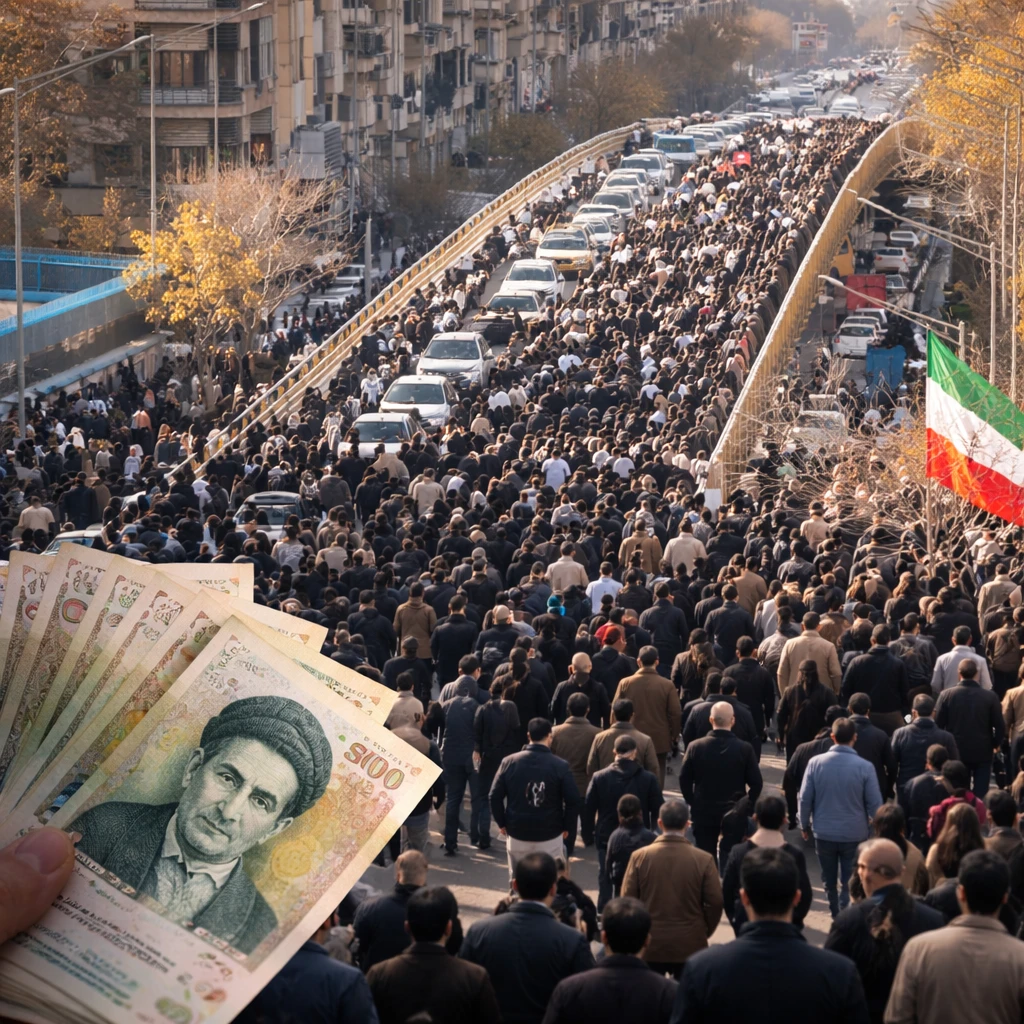

On Monday, Iran experienced its largest wave of protests in three years as the national currency, the rial, plunged to an all-time low against the US dollar, triggering the resignation of the Central Bank's governor, Mohammad Reza Farzin. State television officially announced Farzin's departure amidst widespread demonstrations in Tehran's Saadi Street and the Shush district near the expansive Grand Bazaar. This historic marketplace remains vital to Iran's social and political landscape, having played a pivotal role during the 1979 Islamic Revolution which overthrew the monarchy and shifted power to Islamist governance.
Confirmation came from the official IRNA news agency of protests not only in the capital but also from eyewitness accounts reporting similar scenes in other major urban centers such as Isfahan, Shiraz, and Mashhad. In certain areas within Tehran, police employed tear gas in efforts to disperse the crowds.
The scope of Monday's unrest marked the greatest since 2022 when nationwide demonstrations erupted following the death of Mahsa Jina Amini, a 22-year-old woman who died while in custody after being arrested by moral police over veil regulations.
Eyewitness reports to various outlets detailed that many merchants shut their businesses on Monday, urging peers to join in a form of economic protest, with the semi-official ILNA agency highlighting that several shops remained closed while others chose to stay open.
Protests on the preceding day had been concentrated primarily within two large central Tehran street markets, where demonstrators vocalized anti-government slogans amidst a tense atmosphere.
The Iranian rial's value nosedived to approximately 1.42 million rials per US dollar on Sunday before slightly recovering to 1.38 million rials per dollar by Monday. Speculation about Farzin stepping down had circulated over the past week. Upon his appointment in 2022, the rial traded near 430,000 per dollar, underscoring the precipitous currency depreciation over a short period.
This rapid drop in the rial's value has escalated inflationary trends, causing substantial hikes in food prices and other essential commodities, placing additional strain on household budgets—a situation that could worsen following recent increases in gasoline prices. Official state statistics reveal that the inflation rate reached 42.2% in December year-over-year, a 1.8% jump from November, with food prices surging by 72%, and health and medical goods by 50% compared to the previous December. Analysts and critics warn these figures may portend looming hyperinflation.
Further apprehension stems from government reports suggesting an impending increase in taxes with the start of the Iranian new year on March 21.
For context, during the 2015 nuclear agreement—which temporarily lifted international sanctions in exchange for strict oversight of Iran's nuclear program—the rial traded around 32,000 per US dollar. However, this deal unraveled after the United States, under President Donald Trump, withdrew unilaterally in 2018.
Beyond economic factors, geopolitical tensions contribute to instability. The aftermath of a 12-day conflict with Israel in June and lingering fears of a broader confrontation possibly involving the United States have raised market anxieties. Moreover, the United Nations reinstated sanctions in September tied to Iran’s nuclear activities, freezing foreign assets, halting arms transactions, and imposing restrictions linked to Iran's ballistic missile program.
These compounded challenges reveal a complex scenario for Iran’s financial and social stability, as citizens grapple with soaring inflation, devaluation of the national currency, and geopolitical uncertainties unfolding simultaneously.