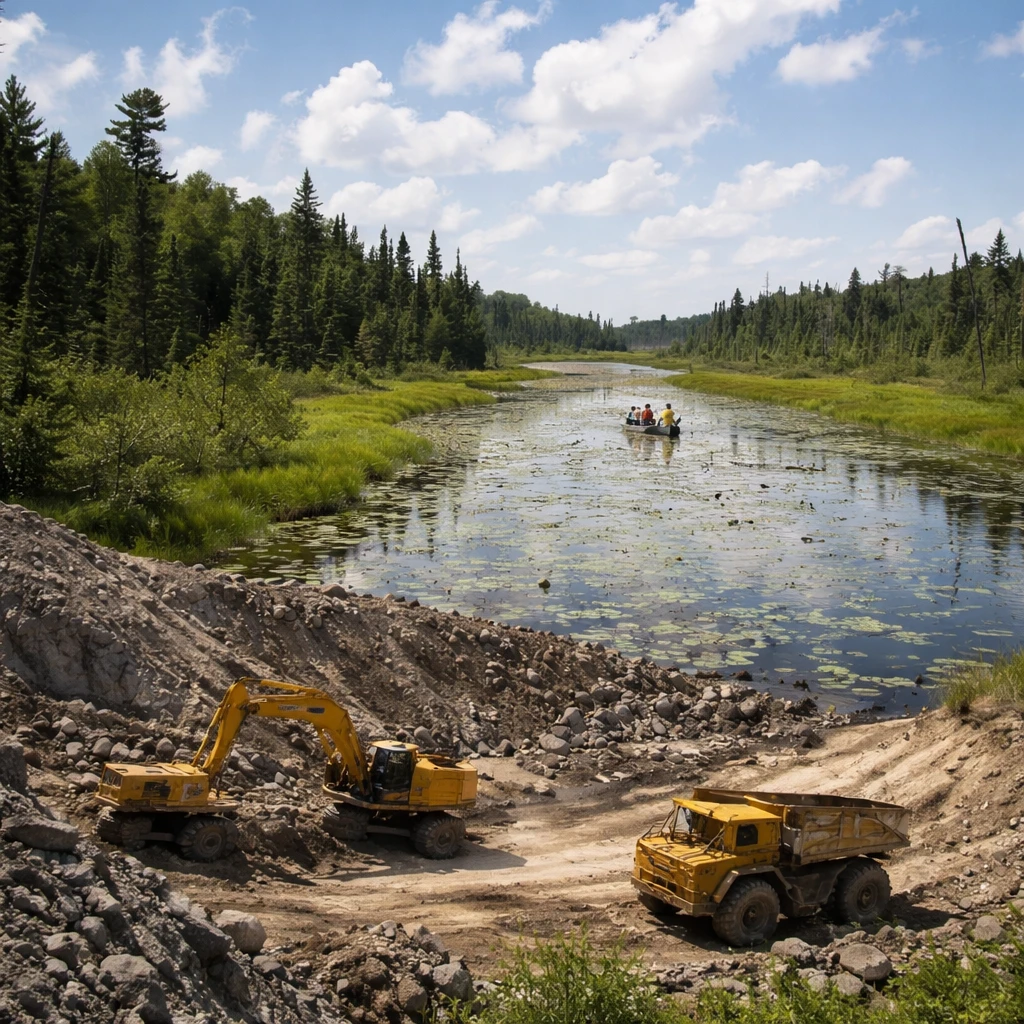
On Wednesday, the U.S. House of Representatives took a significant step toward ending a 20-year restriction on mining activities adjoining the Boundary Waters Canoe Area Wilderness in Minnesota. The House passed a resolution that would remove the twenty-year moratorium on mining in this region, moving the measure forward to the Senate for consideration. Should the Senate approve the resolution, it would then be presented to the president for final endorsement. The move reflects a growing push by Congressional Republicans aiming to revitalize mining operations in an area marked for environmental protection, despite cautions from conservation groups that such developments might severely damage a nationally treasured wilderness area favored by outdoor enthusiasts.
Situated in far northeastern Minnesota, the Boundary Waters Canoe Area Wilderness encompasses an extensive expanse of largely pristine forests, lakes, and wetlands within the Superior National Forest. Spanning approximately 150 miles along the U.S.-Canada border, this region is subject to stringent regulations that limit human impact — commercial logging is prohibited, aircraft must maintain altitudes above 4,000 feet except when responding to emergencies, and motorized boats are restricted to designated zones. These measures have preserved a natural sanctuary that annually attracts hundreds of thousands of visitors seeking recreational activities such as camping, hiking, kayaking, and canoeing. Government data indicate that visitor permits issued by the U.S. Forest Service numbered around 776,000 between 2020 and 2024.
Mining potential in this forested area stems from underlying deposits contained within the Duluth Complex, a geological formation within the forest boundaries that holds copper, nickel, cobalt, lead, zinc, iron, silver, and gold. Twin Metals Minnesota LLC, a subsidiary of the Chilean mining company Antofagasta Minerals, proposed in 2019 to mine copper, nickel, cobalt, and other precious metals in this location, submitting a formal plan to the Department of the Interior. The Biden administration responded in 2023 by imposing a 20-year moratorium on mining over roughly 400 square miles to safeguard the watershed and the sensitive wilderness area.
However, policy shifts under the Trump administration signaled a renewed focus on mineral resource development. President Trump declared a national energy emergency shortly after taking office again a year ago, aiming to boost domestic production of energy and critical minerals. Legal opinions from 2017 were reinstated last fall, allowing Twin Metals to renew leases within the Superior National Forest. Subsequently, Minnesota state regulators approved exploratory mining plans in December. Representative Pete Stauber, a Republican from Duluth, introduced the current resolution to revoke the Biden-era moratorium. Stauber argued that the mining ban has resulted in lost job opportunities, jeopardized mineral security, and represents an assault on local ways of life.
The debate on the House floor featured starkly contrasting viewpoints. Republicans emphasized the necessity of accessing key minerals like cobalt, copper, and nickel to maintain competitive advantages over rival nations such as China and Russia. Stauber criticized the mining ban as a ‘‘dangerous, purely political decision,’’ suggesting that extracting minerals domestically is preferable to reliance on foreign sources from adversarial countries. In contrast, Democrats stressed the irreversible threat mining poses to a fragile ecosystem, questioning the rationale since mined materials would likely enter the global market regardless. Minnesota Democrat Betty McCollum asserted that some natural areas warrant preservation beyond economic interests.
The resolution was presented under the Congressional Review Act, a legislative mechanism that permits Congress to overturn certain federal agency actions. Democratic lawmakers contended that the resolution was procedurally improper, citing the requirement to introduce such measures within 60 days of the original rule’s implementation, whereas this action occurred roughly three years later. They further argued that the law does not authorize Congress to nullify protections dedicated to public lands, warning that passing the resolution could set a harmful precedent. Republicans responded by claiming the Biden administration failed to properly notify Congress about the mining ban in 2023.
The vote in the House concluded with 214 in favor and 208 opposed. Notably, one Republican, Don Bacon from Nebraska, voted against the measure, while one Democrat, Jared Golden from Maine, supported it. Matthew Schultz, representing Sportsmen for the Boundary Waters, interpreted Bacon's dissenting vote as an indication that the issue transcends partisan lines. Schultz emphasized that the community of hunters, fishers, anglers, and outdoor enthusiasts collectively desires the protection of this wilderness area, irrespective of political affiliation. He cautioned that if the resolution passes the Senate, it could lead to reduction in public lands and restricted access.
As the resolution awaits consideration in the Senate — where Republicans hold a narrow majority of 53 seats — the timeline and outcome remain uncertain. The deliberation will influence stakeholders across multiple sectors, including environmental conservation interests, outdoor recreation industries, and mining enterprises engaged in the extraction of strategic minerals vital for various industrial and technological applications.
January 21, 2026
News & Politics
House Approves Measure to Lift Mining Restrictions Near Minnesota Wilderness
Legislative Action Advances to Senate Amid Debate Over Environmental Protection and Mineral Resource Development

Avery Klein
Senior Equity Analyst
Summary
The U.S. House of Representatives has passed a resolution aimed at overturning a two-decade mining prohibition established near Minnesota's Boundary Waters Canoe Area Wilderness. The legislation, backed by Republicans, seeks to pave the way for mining operations within the Superior National Forest, countering environmentalist objections concerned about potential ecological harm. The measure now proceeds to the Senate, with potential implications for natural resource management, environmental conservation, and the mining sector.
Key Points
The U.S. House approved a resolution to lift a two-decade mining ban near Minnesota's Boundary Waters Canoe Area Wilderness, advancing the measure to the Senate.
Republicans argue the move is essential for securing domestic supplies of critical minerals like cobalt, copper, and nickel, positioning the U.S. competitively against nations such as China and Russia.
Environmentalists warn that mining operations could jeopardize a pristine and heavily regulated wilderness area that supports significant outdoor recreation activity and ecological diversity.
Risks
- Potential environmental degradation and contamination of watershed ecosystems in the Boundary Waters Canoe Area as a result of mining activities, which could adversely affect local wildlife and outdoor recreation economies.
- Procedural challenges and political opposition may delay or obstruct final approval in the Senate, creating regulatory uncertainty for mining companies and investors.
- Approval of the resolution could set precedents for weakening public land protections, possibly leading to wider exploitation of protected natural areas, impacting sectors reliant on conservation and sustainable land use.
Disclosure
This article is based on factual reporting of legislative developments and official statements. The content reflects available information without speculation or endorsement of policy positions.