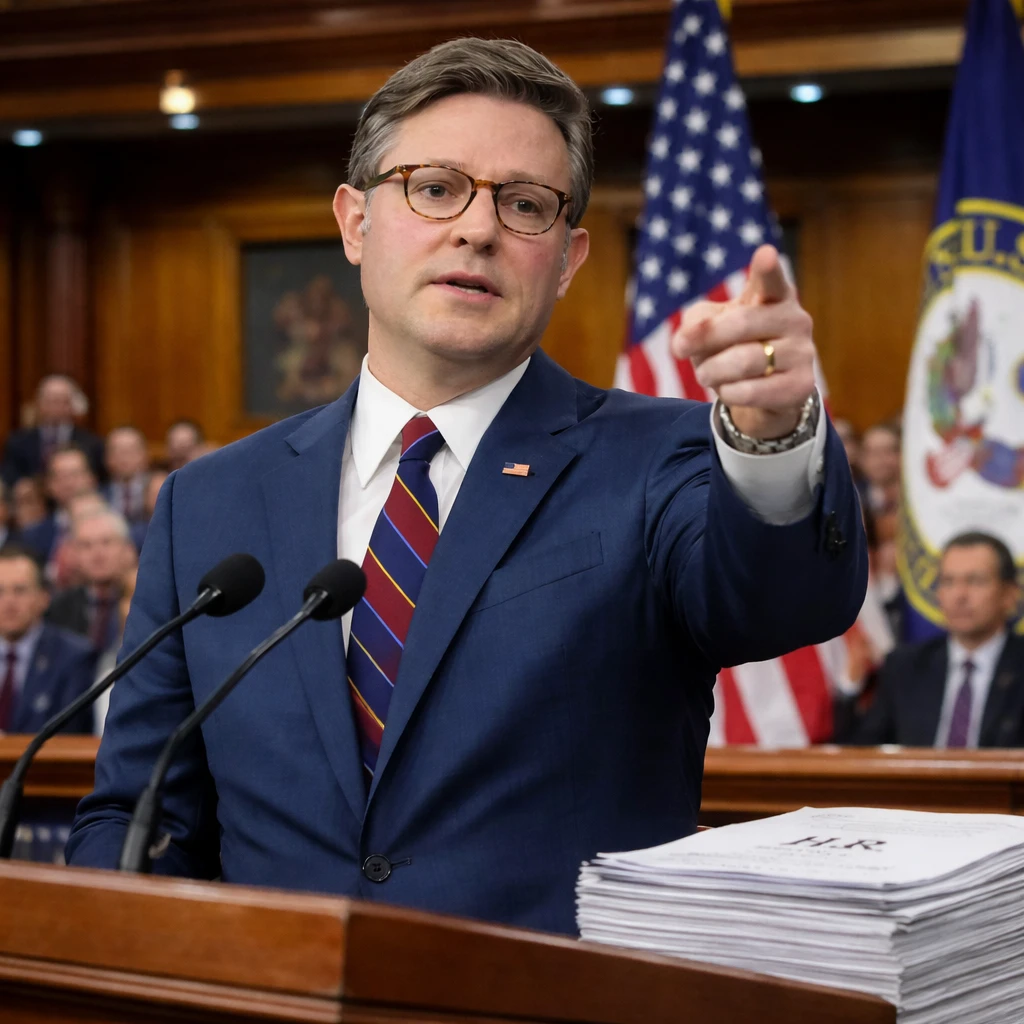

WASHINGTON — The House of Representatives advanced the final collection of fiscal year spending bills on Thursday, aiming to circumvent a government funding gap like the unprecedented 43-day shutdown experienced last fall. The package includes four appropriations bills with an aggregate spending figure nearing $1.2 trillion. These measures now proceed to the Senate, where timely ratification is required before the January 30 deadline to avoid disruptions in federal operations.
Three of the bills garnered broad support across party lines, securing funds for the Department of Defense as well as agencies including Education, Transportation, and Health and Human Services. Contrastingly, the appropriations bill for the Department of Homeland Security became a focal point of division, as Democratic lawmakers expressed significant reservations about its support for President Donald Trump's rigorous immigration enforcement policies.
The Homeland Security bill succeeded in the House with a 220-207 vote, despite Democratic resistance, while the overall spending package, which also authorizes a 3.8 percent pay increase for military personnel, passed decisively by 341-88.
Prior to the voting, Democratic leadership unequivocally opposed the Homeland Security funding bill. They answered growing demands from their caucus for a stronger opposition to the administration's intensified immigration enforcement activity, notably concentrated in regions such as the Minneapolis area. This is where U.S. Immigration and Customs Enforcement (ICE) has deployed over 2,000 officers and where a recent fatal shooting by an ICE agent claimed the life of Renee Good, a mother of three.
In a consolidated statement, Democratic leaders criticized President Trump's assurances that deportations would prioritize violent felons, contending that ICE has, instead, targeted legal immigrants and American citizens. The statement, signed by Democratic leader Hakeem Jeffries, Democratic Whip Katherine Clark, and Democratic Caucus Chair Pete Aguilar, condemned the perceived misuse of taxpayer funds that led to the tragic death of Renee Nicole Good. They called for an end to what they characterized as extremism in enforcement actions.
Democrats faced constrained avenues to manifest their opposition to the Homeland Security bill. While continuing resolutions typically serve to temporarily finance agencies to prevent shutdowns, Democrats feared such a resolution would cede further discretionary spending authority to the administration. Rep. Rosa DeLauro, the leading Democrat on the House Appropriations Committee, expressed concern over surrendering budgetary control.
Moreover, reluctance to halt Homeland Security funding stemmed from worries that a failure to pass the bill would impair disaster aid and critical operations of agencies like the Transportation Security Administration. Meanwhile, ICE and Customs and Border Protection would likely persist in their operations, potentially funded through resources allocated in the previous tax and spending legislation backed by Republicans. That legislation provided ICE with considerably increased funding — approximately $30 billion for operations and an additional $45 billion for detention facilities, dwarfing the typical $10 billion annual budget.
This year’s Homeland Security appropriations remain relatively flat compared to prior years' funding for ICE. The bill introduces checks on the ability of Homeland Security Secretary Kristi Noem to reallocate funds independently. It also allocates $20 million to procure and operate body-worn cameras for ICE and Customs and Border Protection officers engaged in immigration enforcement. Furthermore, the bill mandates monthly fiscal reports detailing the expenditure of funds stemming from the administration’s legislative provisions.
Rep. Henry Cuellar, a Democrat from Texas and a member of the Appropriations Committee, acknowledged that while the bill falls short of the comprehensive oversight Democrats desired, legislative control remains split among parties and branches of government. Notwithstanding, the bill represents a modest increase in supervision over Homeland Security expenditures.
Republicans lauded the bill for fulfilling the legislature's vital role in national security and promoting the administration’s "America first" agenda, according to Rep. Tom Cole, the Republican Appropriations Committee chairman.
The party also highlighted progress in eschewing a large omnibus spending bill frequently enacted near holidays in previous years, which they argue inflated federal spending. The current appropriations process, though delayed by several months, seeks to slightly reduce non-defense discretionary spending.
Rep. Mark Alford of Missouri emphasized the message conveyed through this approach — a recommitment of the House to active governance and legislative responsibility.
During the House floor debates, multiple Democratic members articulated their opposition to funding Homeland Security, focusing particularly on ICE's accelerated recruitment to enforce the president’s expansive deportation policies. Rep. Betty McCollum of Minnesota criticized the impact on her state’s residents, describing broad racial profiling and the apprehension of individuals, including legal residents, from their communities, sometimes witnessed by terrified children. She likened these actions to those of a "gestapo," a sentiment echoed by Rep. Jerrold Nadler of New York. Massachusetts Rep. Katherine Clark framed the bill as sanctioning political violence by the government against its populace and called for collective rejection of the bill.
Rep. Cole condemned derogatory remarks directed at ICE during the debate, describing them as irresponsible and capable of fostering misconceptions regarding the agency's operations.
Late in the legislative process, the House appended a measure to repeal the capacity of senators to file lawsuits against the government over cellphone data collection related to the January 6, 2021 Capitol attack investigation conducted by special counsel Jack Smith. This provision counters a prior allowance for suits, potentially claiming damages up to $500,000. The amendment was adopted by unanimous House consent following critical responses.