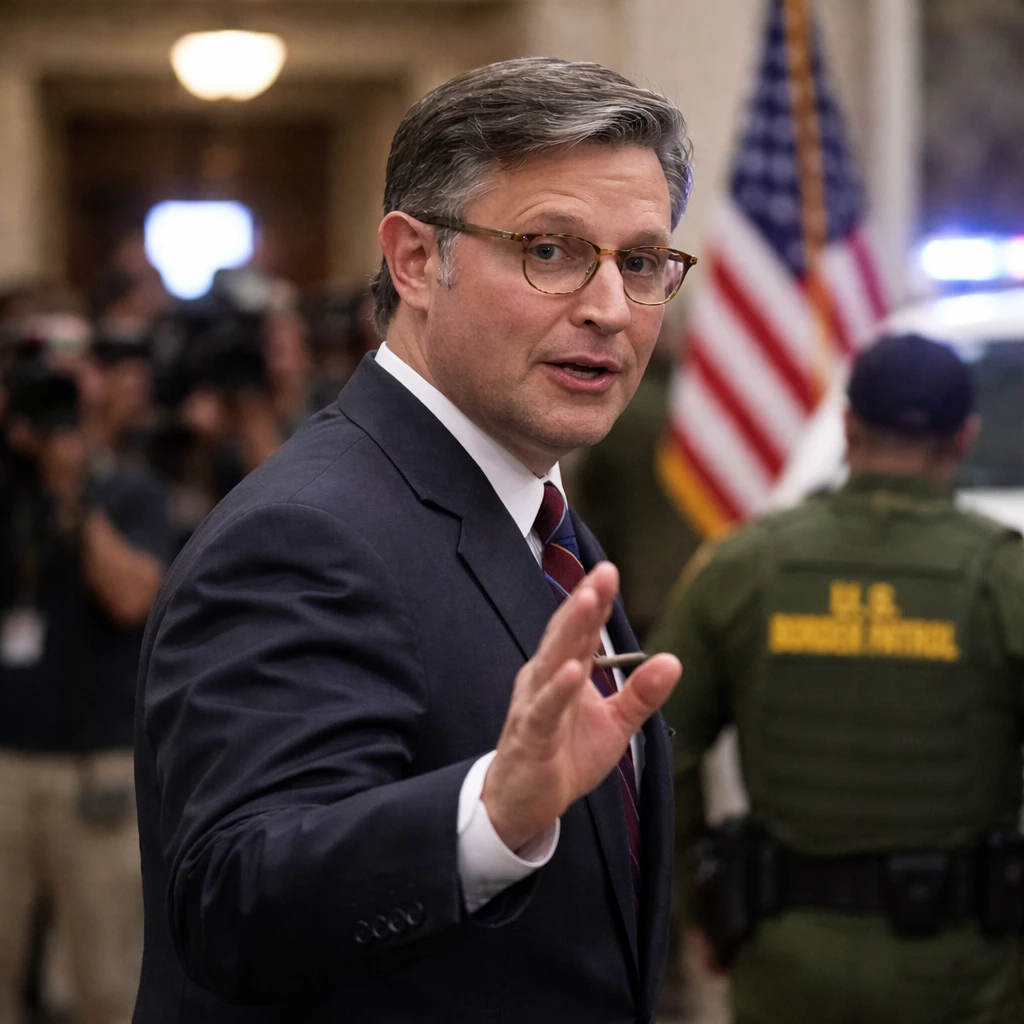

In Washington, House Speaker Mike Johnson revealed on Sunday that a vote on the government funding framework will not occur for several more days, which will prolong the partial federal shutdown into the upcoming week. The extension results from unresolved debates between Republicans and Democrats about imposing limits on broad immigration enforcement activities led by the Trump administration.
Johnson indicated that he is depending on assistance from President Donald Trump to facilitate passage of the bill. Trump reached an agreement with senators to separate funding for the Department of Homeland Security (DHS) from the comprehensive government funding package, following public backlash after two shootings during protests in Minneapolis regarding Immigration and Customs Enforcement (ICE) operations. The Senate-approved measure temporarily finances DHS for two weeks, setting a deadline for Congress to consider and vote on proposed changes to ICE activities.
Speaking on a national broadcast, Johnson emphasized that President Trump is directing the approach, stating, "It's his play call to do it this way," and noted that the Republican president has expressed a desire to "turn down the volume" on federal immigration enforcement maneuvers.
The Speaker confronts a significant challenge in advancing the funding bill through the House, as Democrats withhold support for swift approval. They demand additional constraints on ICE beyond the $20 million allocation for body cameras already included in the proposal. Specific Democratic priorities include mandating that immigration agents identify themselves and discontinuing roving patrols among other reforms.
House Democratic Leader Hakeem Jeffries described the situation, declaring, "What is clear is that the Department of Homeland Security needs to be dramatically reformed." He urged immediate negotiations rather than delays, underscoring constitutional concerns by insisting on judicial warrants preceding homeland security or ICE agents entering residences or removing individuals from vehicles.
This impasse necessitates Johnson to rely on his narrow Republican majority in the House, initiating procedural votes beginning in committee on Monday and delaying any full House vote to at least Tuesday. Meanwhile, House Democrats convened a private caucus call Sunday evening to assess their strategic response.
With the partial government shutdown entering its continuation phase, multiple federal agencies encounter funding interruptions, including defense, health, transportation, and housing sectors. The administration has issued shutdown guidance, though essential services remain operational. In the event of a persistent impasse, some federal employees may face furloughs or temporary unpaid status.
This is the second such disruption within months, as Congress uses the annual budgeting process to negotiate policy changes. The prior shutdown last fall, initiated by Democrats protesting health insurance tax break expirations, lasted 43 days—the longest in U.S. history. Although that standoff ended with a commitment to vote on maintaining Affordable Care Act subsidies, legislative progress stalled, resulting in premium increases that affected millions.
In contrast to previous disruptions, the current administration has expressed interest in a quicker shutdown resolution. Johnson recounted a recent Oval Office meeting where President Trump and border enforcement official Tom Homan engaged with Senate Democratic leader Chuck Schumer to negotiate an agreement. Potential compromises include body cameras and ending roving immigration agent patrols, both embedded in the current proposal.
However, Johnson explained that Democratic calls to remove agent masks and require name display on uniforms raise safety concerns for law enforcement officers targeted by protesters, and suggested President Trump would oppose such measures.
Despite these considerations, Democrats stress that immigration enforcement has escalated beyond acceptable limits, characterizing the situation as an emergency that must end, particularly in Minneapolis and other cities. Calls increase among lawmakers for Homeland Security Secretary Kristi Noem’s dismissal or impeachment.
Senator Chris Murphy, a prominent Democrat from Connecticut, criticized the current ICE operations as contributing to societal insecurity, framing upcoming negotiations as essential to restrain what he termed a "lawless and immoral immigration agency."