In Kiskunmajsa, a farming community situated on Hungary’s Great Plain, resident Oszkár Nagyapáti inspected the sandy ground of his property, probing the soil to detect the presence of groundwater that has steadily dwindled in recent years. "The situation is deteriorating more each year," he lamented as murky water slowly filled a hollow he had dug. "It's astonishing where all that water has vanished to."
Over time, Nagyapáti has witnessed his once fertile region succumb to increasing dryness. Fields that formerly sustained varied crops and grasses now bear deep fissures and creeping sand dunes, evoking landscapes more typical of desert environments than Central Europe.
This phenomenon is characteristic of a portion of southern Hungary known as the Homokhátság. Classified in some research as semiarid—a climate typically associated with regions such as parts of Africa, the southwestern United States, or Australia—this area experiences sparse rainfall, declining well yields, and a rapidly dropping water table.
A 2017 study published in European Countryside attributed this aridification to a confluence of climate alterations, unsustainable land practices, and inadequate environmental stewardship, marking it as a unique challenge within Europe. Historically, periodic flooding by the Danube and Tisza rivers replenished these lands, but the influence of climate change-induced droughts and suboptimal water retention strategies have rendered many fields inhospitable to agriculture and wildlife.
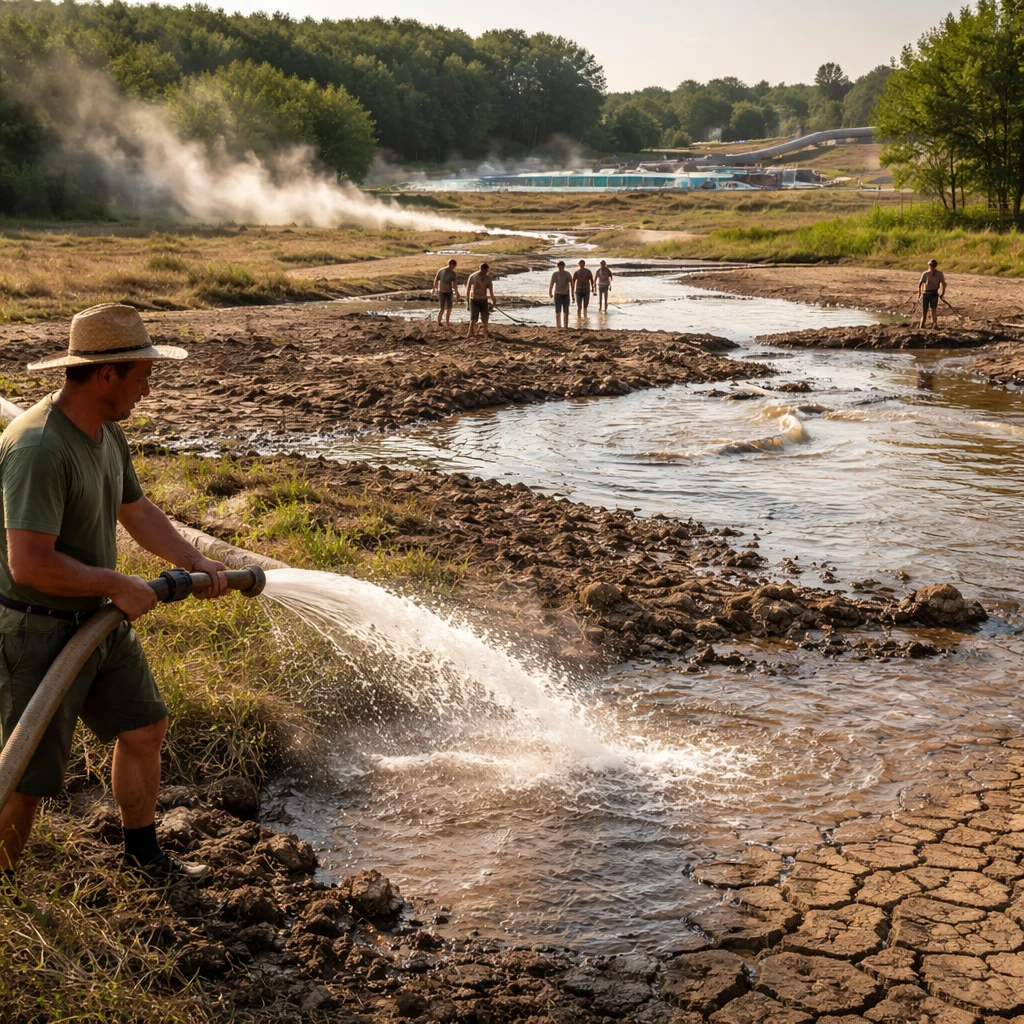
Confronted with these changes, Nagyapáti and a collective of local farmers and volunteers, who call themselves "water guardians," are attempting to halt the ongoing desiccation. Their efforts center on harnessing Hungary's abundant geothermal resources – specifically diverting surplus water from a nearby thermal spa that otherwise discharges wastefully into local canals. This thermal water is sourced from deep underground, rich in heat and minerals.
Beginning last year, the water guardians engaged with regional authorities and spa operators to negotiate the rerouting of this excess heated water onto agricultural lands. The plan involves the controlled inundation of a 2.5-hectare (approximately six-acre) depression, effectively simulating the natural flood cycles that once rejuvenated the plains before the rivers were channelized. Nagyapáti described the strategy: "When the flooded area fills and the water gradually recedes, a significant expanse of water surface will be established here, a striking contrast in our otherwise arid landscape."
Challenges identified by recent research include persistent layers of dry air close to the surface that inhibit rainfall, causing storms to pass over without precipitation and instead generate harsh winds that exacerbate surface soil drying. A 2024 investigation from Hungary's Eötvös Loránd University emphasizes that water retention measures are vital for mitigating the increasing volatility in seasonal and annual rainfall distributions driven by progressive warming.
The water guardians anticipate that their artificial flooding will not only replenish groundwater levels but also foster a localized microclimate through evaporation. This microclimate effect is expected to enhance humidity, reduce ambient temperatures and dust, and promote vegetation resurgence in surrounding areas.
Following an especially hot and dry summer, the team successfully blocked sluices along a nearby canal, enabling the spa’s diverted thermal water to accumulate slowly in the target field. After several months, a shallow marsh had formed, which, although modest in size, brought profound optimism to local residents. Nagyapáti remarked that within roughly a 4-kilometer radius, this intervention will positively influence soil moisture and vegetation, with hopes that the groundwater table will rise correspondingly.
The persistent drought afflicting the Great Hungarian Plain continues to threaten desertification, adversely impacting agricultural productivity and consequently Hungary's gross domestic product. This has prompted governmental responses including the establishment of a "drought task force" by Prime Minister Viktor Orbán.
Encouraged by initial ecological and hydrological improvements in their project area, the water guardians’ volunteer base has expanded to more than 30 individuals. They are pursuing plans to replicate the water retention initiative in additional fields and advocate for broader adoption of similar water conservation practices across Hungary's rural and urban settings.
Nagyapáti underscored the broader significance of their approach: "While we have sourced water from the spa here, the fundamental opportunity lies in retaining any water available – in villages, towns, or the countryside – to replenish precious groundwater resources."
December 28, 2025
News & Politics
Hungarian Farmers Combat Worsening Drought with Heated Spa Water
Innovative water retention efforts offer hope amidst escalating aridity in southern Hungary’s Great Plain

Derek Hwang
Materials & Mining Analyst
Summary
Farmers in the Kiskunmajsa region of southern Hungary are confronting intensifying drought conditions that have severely depleted groundwater and transformed fertile fields into cracked, sandy terrain. In response, local volunteers are channeling overflow from a nearby thermal spa to artificially flood fields, aiming to restore water tables and revive the ecosystem. These initiatives seek to recreate natural flooding cycles disrupted by climate change and land mismanagement, with early signs showing improvements in soil moisture, vegetation, and groundwater levels.
Key Points
The southern Hungarian Great Plain is experiencing accelerating drought conditions, leading to dropping groundwater and desert-like terrain.
Local farmers and volunteers, dubbed 'water guardians,' have initiated a plan to redirect overflow from a nearby thermal spa to flood fields artificially, aiming to restore water tables and improve local ecosystems.
Scientific studies highlight that climatic changes, land misuse, and poor environmental management have contributed to the region's unique aridification inside Europe, making water retention critical for future climate resilience.
Risks
- Continued climatic warming and shifting precipitation patterns may undermine water retention efforts, causing increasing dryness and ecosystem degradation.
- Inadequate regulation or limitations on thermal spa water usage could restrict the ability to sustain artificial flooding initiatives.
- The volatile nature of regional weather, including dry air layers that inhibit rainfall, presents persistent challenges to replenishing soil moisture and maintaining groundwater levels.
Disclosure
The article was independently researched and reported without external influence or sponsorship. The water retention project described remains in early stages with ongoing monitoring necessary to verify its long-term efficacy.