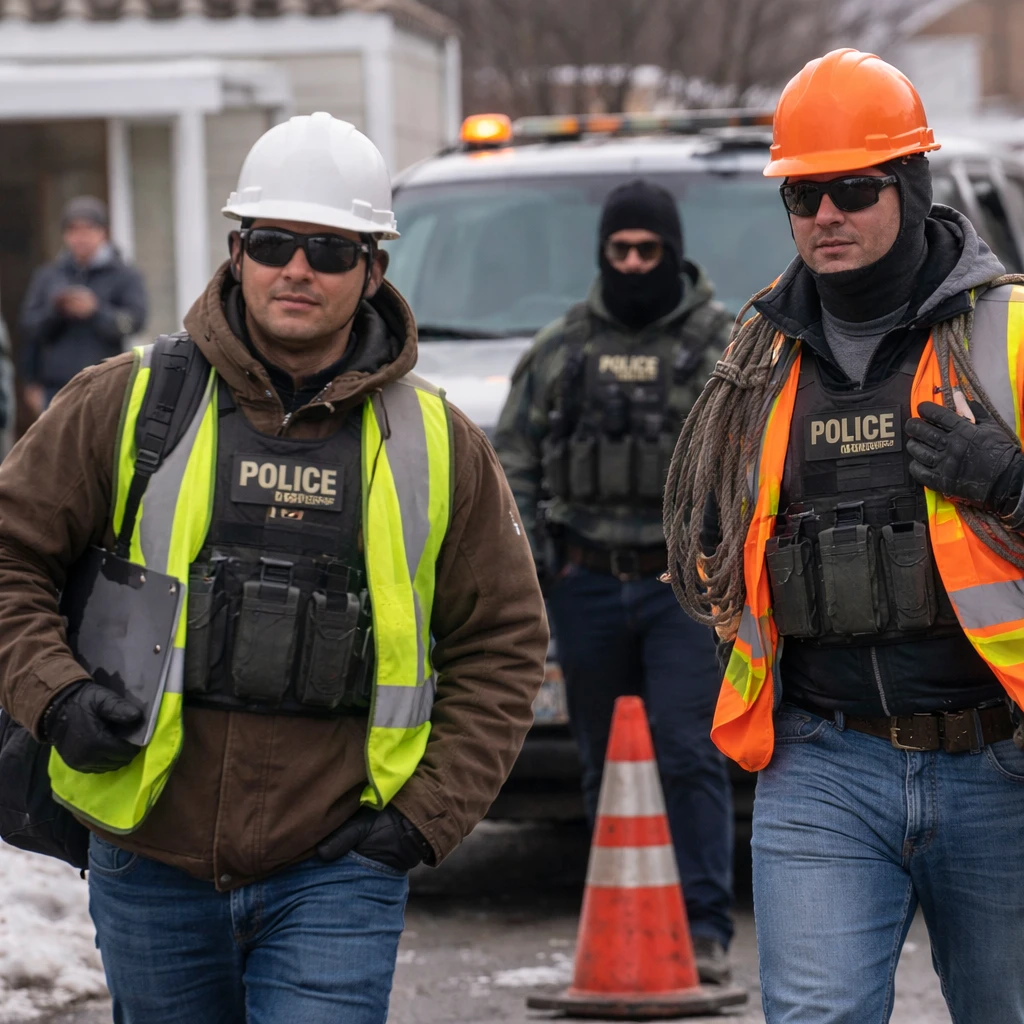

Suburban Minneapolis has witnessed a surge in unease as residents spot individuals dressed as utility workers outside local businesses, sparking suspicions about their true identities. Luis Ramirez, 31, owner of a family-run Mexican restaurant, observed men wearing bright safety vests and pristine white hard hats parked nearby in a vehicle labeled with a Wisconsin electrical company that appears nonexistent upon investigation.
On a particular day, when the same Nissan returned, Ramirez recorded an exchange with the two men, who concealed their faces and seemed to be clad in substantial tactical gear under their safety attire. Ramirez vocalized his frustration: "This is what our taxpayer money goes to: renting these vehicles with fake tags to come sit here and watch my business." Despite inquiries, representatives from the Department of Homeland Security and Immigration and Customs Enforcement (ICE) declined to confirm whether these individuals were federal immigration officers.
These encounters are becoming more frequent as Minnesota experiences an intensified immigration enforcement campaign. Legal experts and officials report rising incidents of federal agents impersonating roles such as construction workers, delivery personnel, and even activists opposing ICE.
Although not all events have been independently verified, the prevalence of such incidents intensifies apprehension in a state already tense around immigration issues. This situation adds to ongoing legal concerns regarding significant shifts in immigration enforcement tactics at the national level.
Naureen Shah, ACLU's immigration advocacy director, commented on the consequences of these tactics, stating, "If you have people afraid that the electrical worker outside their house might be ICE, you’re inviting public distrust and confusion on a much more dangerous level. This is what you do if you’re trying to control a populace, not trying to do routine, professional law enforcement."
Historically, immigration authorities have employed disguises and other deceptive methods, known as ruses, to enter homes without warrants. These practices intensified during former President Donald Trump's administration, leading to lawsuits alleging constitutional violations where agents impersonated local law enforcement. Some settlements have limited these practices in specific jurisdictions, such as Los Angeles, though ICE retains the ability to use similar tactics elsewhere.
In Minnesota, the reported undercover operations suggest a more overt use of deception, with agents present in conspicuous roles in public spaces. Previously, such ruses targeted specific individuals, but now they may also be designed to evade detection from local citizen observers who monitor federal enforcement actions.
At Minneapolis's Bishop Henry Whipple Federal Building, a focal point of ICE activities, activists have observed officials leaving in vehicles adorned with items like stuffed animals or Mexican flag decals. Such vehicles often resemble construction trucks carrying tools and lumber, blending into the environment.
Jose Alvillar, an organizer with Unidos MN, a local immigrant advocacy organization, reports a noticeable increase in "cowboy tactics" by agents showing up in construction outfits at job sites. However, he notes that these appearances have not yet led to arrests, partly because construction workers can distinguish genuine colleagues from imposters based on experience and familiarity.
Concerns also extend to the use of vehicle license plates. Minnesota authorities, including Governor Tim Walz, report that ICE agents have been observed switching or employing false plates, actions that contravene state law.
One antiques dealer, Candice Metrailer, recounted an incident where men posing as collectors inquired about license plates at her store and browsed her vintage collection. Her suspicions heightened when a man asked for recent plates. Outside, she noticed a vehicle matching a license plate previously linked to ICE operations via a local activist database. Metrailer declined a sale of plates to the visitors and filed a report with the state's attorney general, but Department of Homeland Security representatives did not provide comments.
Supporters of the enforcement measures attribute these evolving tactics to adaptive responses by ICE agents confronting organized community resistance. Former ICE deputy director Scott Mechkowski explained that agents have not faced such levels of public interference in his nearly 30 years in the field and have accordingly adjusted their strategies, including the adoption of disguises to maintain operational effectiveness.
Similar precautions have appeared elsewhere; for instance, Oregon's natural gas company recently advised customers on identifying legitimate employees to counteract impersonation fears. However, the ramifications of agent impersonations on local communities include heightened vigilance and pervasive anxiety.
Ramirez described his heightened alertness since his encounter, recounting a moment he briefly mistook a locksmith for a federal agent. "Everybody is on edge about these guys, man," he remarked. "It feels like they’re everywhere." This prevailing atmosphere reflects broader tensions as federal immigration enforcement intensifies in the region.