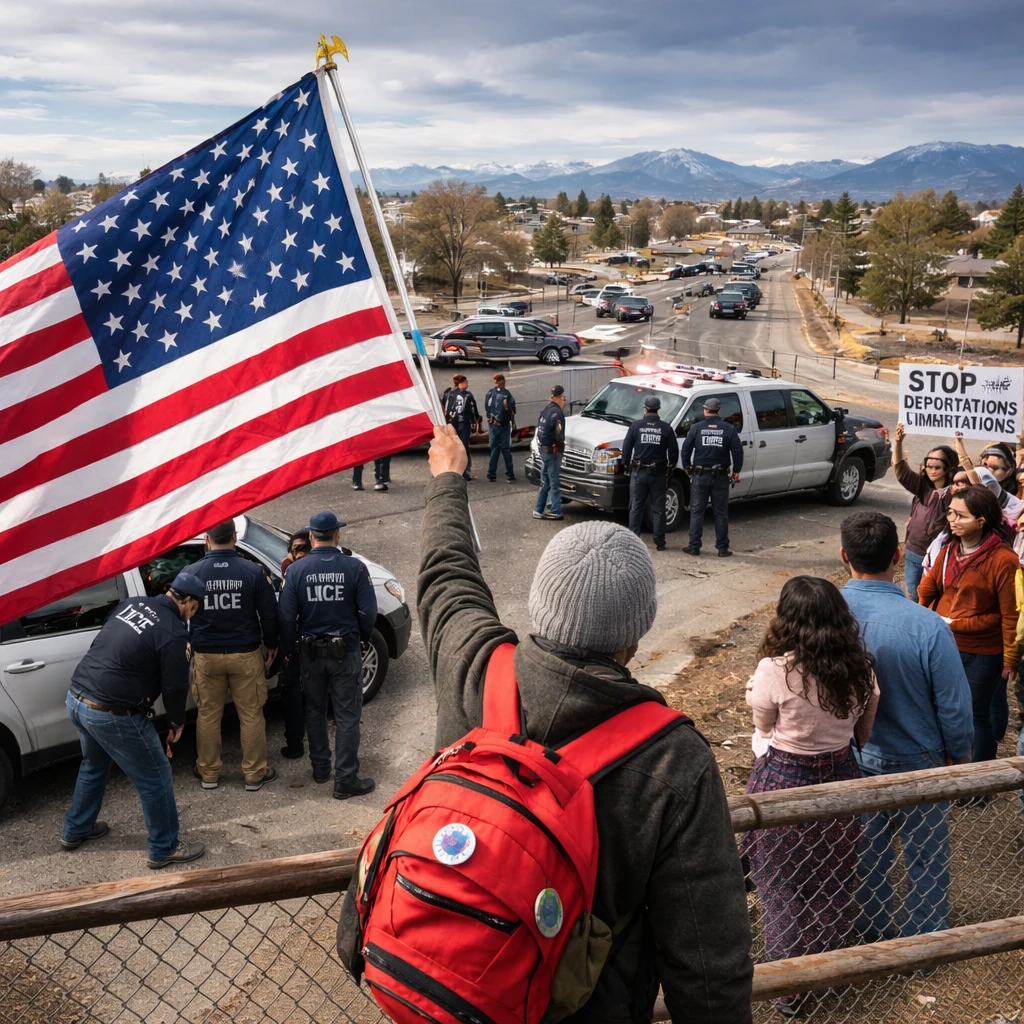
In the northeastern expanse of Colorado’s 8th Congressional District, nestled among agricultural lands, oil fields, and busy shopping centers, residents are confronting the consequences of an aggressive immigration enforcement campaign backed by President Donald Trump. This district, which leans politically volatile and includes a significant Hispanic population, has witnessed an intensifying debate about immigration policy spurred by recent federal actions in Minneapolis.
Miranda Niedermeier, a 35-year-old resident and a Trump supporter in earlier phases of his presidency, reflects this ambivalence. Initially encouraged by measures targeting undocumented immigrants with criminal records, Niedermeier’s stance has shifted notably in response to recent developments. She recounts how federal officers’ actions, particularly two fatal incidents involving U.S. citizens during enforcement operations in Minneapolis, have engendered alarm and disappointment.
"At first, they were apprehending criminals," Niedermeier said. "Now they’re disrupting immigration proceedings over minor traffic violations, sometimes for the smallest alleged offenses. It’s horrifying because this approach doesn’t align with Christian values. This is a country that shouldn’t be forced into life-or-death situations like this. What is happening is unacceptable."
These events in Minnesota have left a palpable impact on the sentiment within the 8th District, influencing opinions among diverse voters. Edgar Cautle, a 30-year-old Mexican American who works in oil fields and supports Trump, voiced his concern about the imagery of agents detaining children and separating families. He fears these images are damaging the president’s reputation within his own base.
"He really should dial back the intensity on immigration enforcement," Cautle remarked. "These tactics are turning people against him."
Given the slim margins by which congressional seats in the district were decided in the 2024 election — for example, Republican Gabe Evans’s victory by just 2,449 votes out of more than 333,000 cast — even minor shifts in voter sentiment could influence control of the U.S. House of Representatives this fall. Evans, a former law enforcement officer with familial ties to the Mexican American community, has expressed the need for a focused immigration enforcement strategy. He advocates prioritizing removal of individuals involved in criminal activities rather than those residing illegally but abiding by other laws, coining the phrase "gangbangers, not grandmas" to encapsulate his stance.
Speaking in an interview, Evans identified concerns surrounding Immigration and Customs Enforcement’s (ICE) recent claim that it may enter homes using administrative warrants without judicial approval. He anticipates questioning Department of Homeland Security officials at an upcoming House hearing about this matter.
"We’ve seen ICE acting cautiously in our district," Evans observed. "They have concentrated their efforts on targeting criminals without disrupting critical industries like meatpacking and dairy farms that employ many immigrant workers. If ICE were pursuing deportation quotas indiscriminately, we would expect to see widespread raids impacting these sectors, but that hasn’t happened here."
Despite his criticism of some enforcement actions, Evans also blamed Democrats for politicizing the situation, stating their rhetoric exacerbates public perception of ICE as operating without bounds. "Some want to fan the flames simply to create campaign issues for November," he said.
In district communities where Hispanic voters constitute approximately 40 percent of the electorate, many express profound unease with the administration’s heightened enforcement. Across over twenty interviews conducted throughout the district, every Hispanic-identifying voter consistently voiced offense at the crackdown, with several worried about their own safety despite citizenship status.
Jennifer Hernandez, a 30-year-old Walmart shopper in Brighton, reflected this anxiety: "I worry whether my last name or my appearance might make me a target. I fear being caught up in enforcement activities even though I’m a citizen."
Conversely, other residents, including some who support Trump, welcomed the operation. Herb Smith, a 61-year-old Black generator installer and Trump backer, justified the need for immigration enforcement, citing concerns he harbored during his previous residence in Minneapolis about the Somali immigrant community there.
"They must clean up immigration," Smith asserted. "From my experience, some groups have been harmful to the community."
Similarly, Dominic Morrison, a 39-year-old telecommunications technician, acknowledged the tragic loss of life during enforcement but stressed the necessity of upholding immigration laws.
"Everyone wants a better life," Morrison said, "but entering another country without permission would not be accepted by them."
Democrats in the district express sharp opposition to the enforcement escalation and point to Representative Evans and the Trump administration as responsible parties. Retired electrical technician Jim Getman, an active volunteer in Democratic campaigns, condemned the inaction of local Republicans concerning the crackdown.
"Evans has not spoken out against these measures," Getman said. "He’s been a consistent supporter of everything Trump does."
Meanwhile, concerns about racial profiling and the fear of wrongful detention permeate immigrant communities. Joe Hernandez, 27, a forklift operator and resident of Commerce City, described the pervasive uneasiness his family experiences despite all holding citizenship or legal resident status.
"We feel like we’re walking on eggshells," Hernandez explained while filling water outside a Mexican market in a heavily immigrant neighborhood.
His distress has reached the point where he and his siblings, all born in the U.S., have contemplated relocating to family-owned property in Mexico for their safety. Having abstained from voting in 2024, Hernandez now plans to participate in the upcoming election, a decision he believes is shared by others as frustrations mount.
"More people are realizing that we have to vote to make a difference," he said.
The intersecting perspectives within Colorado’s 8th District reveal a complex political tapestry shaped by immigration enforcement policies under the current administration. As the midterm elections approach, the balance of political power may hinge upon how these sentiments translate into voter behavior amid ongoing debates over law enforcement priorities and community safety concerns.