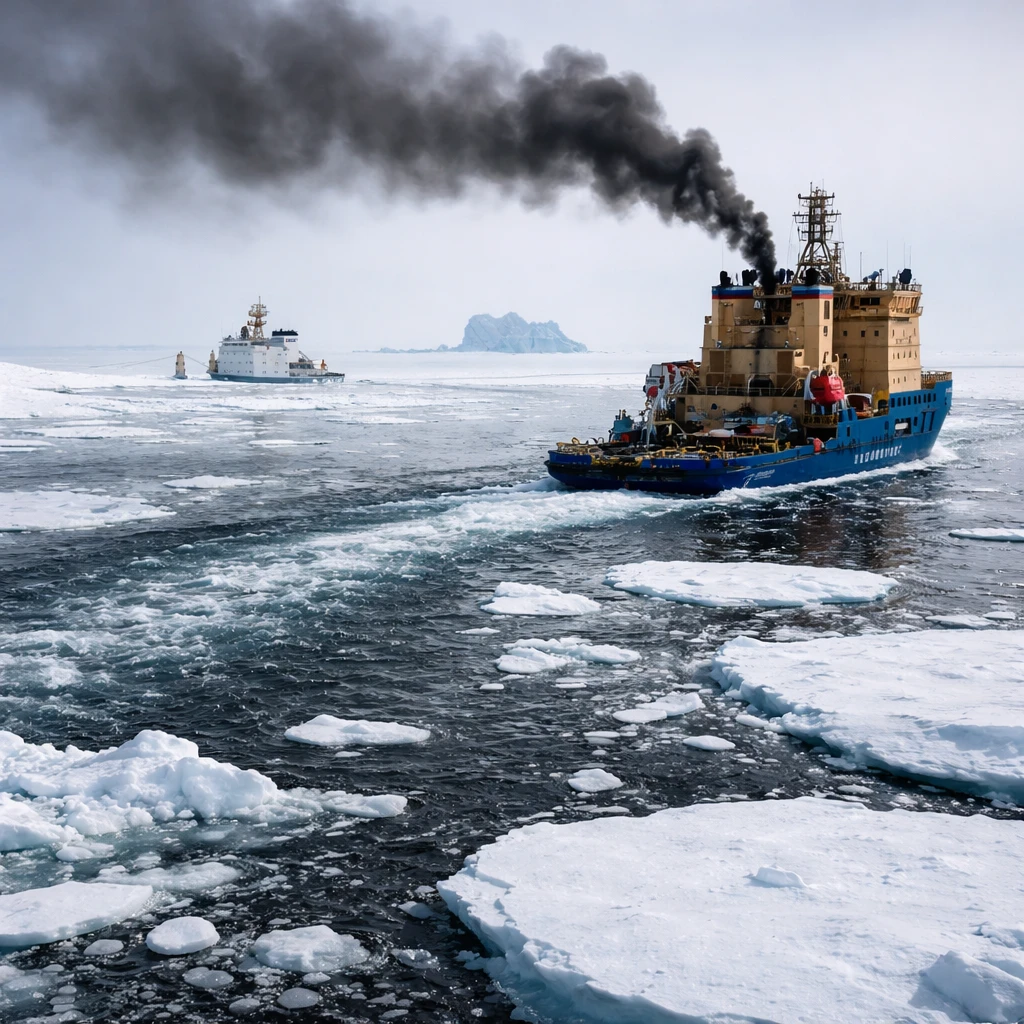

The Arctic region is witnessing substantial growth in maritime shipping as the warming climate melts traditionally impassable sea ice. This phenomenon has opened navigable sea routes that were previously inaccessible for vessels, prompting a significant rise in Arctic shipping activity. This increase has raised environmental concerns, particularly regarding emissions of black carbon or soot from ships, which exacerbate the melting of Arctic ice by darkening ice surfaces and reducing their ability to reflect sunlight.
Black carbon deposited on glaciers, snow, and sea ice absorbs solar radiation instead of reflecting it back into space, thereby accelerating regional warming. This feedback loop enhances the Arctic's status as the fastest-warming area globally and contributes to altering weather patterns beyond the region.
Sian Prior, the lead adviser for the Clean Arctic Alliance, a coalition focusing on Arctic shipping pollution, highlighted the urgency to regulate emissions, emphasizing that black carbon remains unregulated in the Arctic. Such regulatory oversight is critical to disrupting the ongoing cycle of intensified warming driven by soot emissions from vessels.
This week, at gatherings involving international maritime authorities, several nations advocated for the adoption of cleaner fuel standards tailored for ships operating in Arctic waters. In particular, France, Germany, the Solomon Islands, and Denmark have jointly proposed that the International Maritime Organization (IMO) introduce mandatory use of "polar fuels" by vessels north of the 60th parallel. Polar fuels are characterized by a lighter composition and emit significantly fewer carbon pollutants compared to residual fuels commonly employed in maritime transport.
The proposed regulations outline compliance methods and specify the geographical scope to ensure that all maritime vessels operating in Arctic waters adhere to these cleaner fuel requirements. The expectation was for this proposal to be reviewed by the IMO’s Pollution Prevention and Response Committee during the current sessions, with potential deliberation by an additional committee in April. However, the efficacy of such regulations is underscored by shortcomings in existing measures; a 2024 ban on the use of heavy fuel oil, a particular residual type, has so far only minimally curtailed black carbon emissions due to various exemptions and delays in enforcement.
The endeavor to curtail black carbon emissions intensifies amid complex geopolitical dynamics that influence Arctic governance. For example, U.S. interest in assuming sovereignty over Greenland drew international attention to the region recently but overshadowed environmental concerns, including pollution control.
Political positions diverge on climate change policies impacting shipping emissions. Notably, during the previous U.S. administration, efforts to impose carbon fees on shipping vessels at the IMO – a strategy to incentivize cleaner fuel usage and fleet electrification – were actively opposed by the administration's lobbying, resulting in delayed policy advancement. This political backdrop significantly challenges the pace at which black carbon mitigation policies in the Arctic may be implemented.
Within the Arctic states themselves, contrasting economic and industrial priorities complicate the adoption of stricter environmental regulations. Iceland exemplifies this tension: despite leadership in green technologies like carbon capture and geothermal heating, the nation struggles to regulate marine pollution effectively. The influence of the fishing industry, a vital economic sector, fosters resistance to measures such as fuel taxes or mandates for cleaner fuel adoption.
Arni Finnsson, chair of the Iceland Nature Conservation Association, noted the fishing sector’s reluctance to engage on environmental issues, alongside economic objections rooted in additional operational costs. Although the Icelandic government shows growing awareness of these environmental challenges, its policy actions remain contingent on industry acceptance. As a result, Iceland has not taken a definitive stance on the polar fuel proposal but expressed cautious support pending further evaluation.
Shipping in the Arctic encompasses a diverse array of vessels, including cargo ships, fishing boats, and certain cruise liners, all contributing to growing black carbon emissions. Statistics from the Arctic Council indicate a 37% increase in ships venturing north of the 60th parallel between 2013 and 2023, with the total distance covered by these vessels rising by 111% over the same period. Correspondingly, black carbon emissions escalated, reaching an estimated 3,310 metric tons in 2024 compared to 2,696 metric tons in 2019, underscoring the environmental repercussions of intensified ship traffic.
A study conducted by Energy and Environmental Research Associates attributes the largest share of black carbon emissions in the Arctic to fishing vessels. The research also highlights the limited impact so far of the 2024 heavy fuel oil ban, primarily constrained by waivers allowing certain ships to continue their use until 2029. Consequently, environmental organizations and supportive nations advocate for more stringent fuel regulations as the pragmatic approach to mitigating black carbon pollution, recognizing that outright restrictions on maritime traffic are unlikely due to the economic incentives in fishing, resource extraction, and shipping efficiency.
Sea routes such as the Northern Sea Route cut transit times between Asia and Europe, offering significant logistical advantages despite being navigable only a few months annually and requiring escort by icebreakers. The operational hazards combined with environmental considerations have led some shipping firms to voluntarily avoid these routes. For instance, Søren Toft, CEO of the Mediterranean Shipping Company—the largest container freight company worldwide—publicly committed to not using the Northern Sea Route, reflecting cautious industry engagement with Arctic navigation amid the ongoing debate.