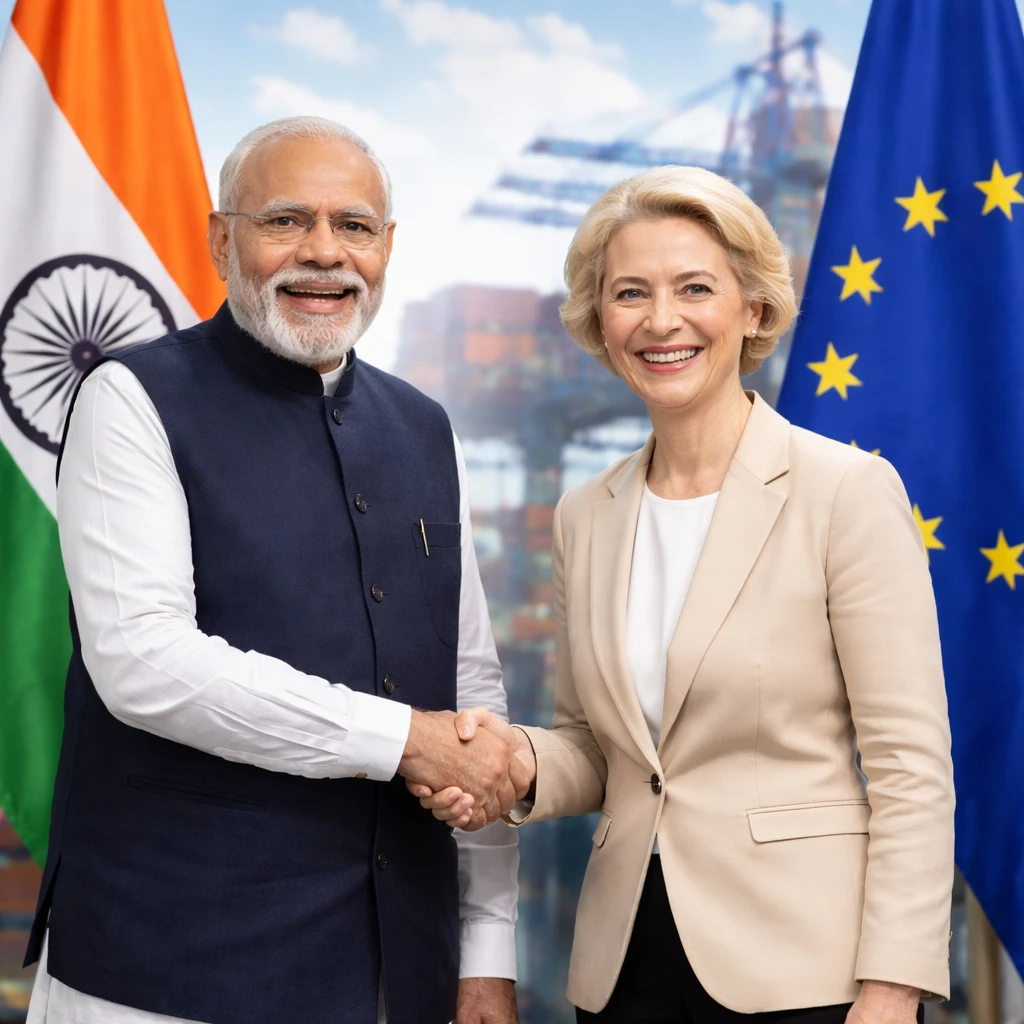

After close to 20 years of detailed dialogue and negotiations, India and the European Union have finalized a landmark free trade agreement aimed at significantly strengthening economic and strategic connections. EU officials have lauded the accord as a profoundly impactful pact, highlighting that it could reshape trade relations for an estimated 2 billion individuals globally.
The trade agreement unites two of the world's largest economic markets amid a backdrop of increasing trade tensions, notably with the United States imposing substantial import tariffs on both India and the EU. These tariffs have disrupted traditional trade pathways and encouraged major economies to pursue new alliances.
In a virtual address delivered at an energy conference, Indian Prime Minister Narendra Modi emphasized the agreement's importance, stating that it "will bring major opportunities for the people of India and Europe." He underscored that the collaboration represents 25% of the world's gross domestic product and accounts for approximately one-third of global commerce.
Under the terms of the deal, nearly all goods traded between India and the 27 EU member states will benefit from tariff elimination or reduction. The scope covers diverse sectors such as textiles, pharmaceuticals, and machinery, while also lowering previously steep import taxes on European products like wine and automobiles.
Beyond trade, the agreement includes a framework designed to expand defense and security cooperation between India and the EU. The parties have also formulated a separate agreement aiming to simplify the movement of skilled professionals and students, signaling that their partnership extends well beyond economic considerations.
The momentum for this agreement intensified in part due to U.S. policies, including President Donald Trump's aggressive trade stance that incorporated threats of punitive tariffs towards European allies. During a joint press event in New Delhi alongside European Commission President Ursula von der Leyen and European Council President António Costa, Prime Minister Modi indicated that the EU-India partnership would contribute to greater stability within the international system amidst current global disruptions.
Reflecting on the deal, Commission President von der Leyen heralded it as "the mother of all deals," emphasizing that it exemplifies a real win-win collaboration between two major global players. She further remarked that the pact delivers a powerful message advocating cooperation as the optimal solution to worldwide challenges.
The trade agreement is anticipated to enhance supply chain integration and boost joint manufacturing capabilities between the Indian and European economies. Projections indicate that exporters on both sides may save up to 4 billion euros (around 4.7 billion U.S. dollars) annually due to tariff reductions, which is expected to create employment opportunities for millions in both regions.
Formal endorsement of the accord is likely later this year, following a meticulous review of legal provisions by officials and the ratification by the European Parliament. Indian Trade Minister Piyush Goyal has expressed expectations for the deal to take effect by year-end.
Regarding tariff specifics, India will reduce or remove duties on 96.6% of EU exports, with Brussels implementing similar phased reductions expected to cover nearly 99% of Indian exports by trade value. Indian industries such as textiles, apparel, engineering goods, leather, handicrafts, footwear, and marine products stand to gain significantly. Conversely, European benefits will mainly involve wine, automobiles, chemical products, and pharmaceuticals.
A quota management system has been agreed upon for specific categories including automobiles, wines, and whisky, designed to reduce previously high tariff barriers. European Commission sources clarified that duties on EU-manufactured vehicles imported into India will gradually decline from a prohibitive 110% to approximately 10%, with complete elimination for car parts anticipated within five to ten years. Additionally, tariffs as high as 44% on machinery, 22% on chemicals, and 11% on pharmaceuticals are set to be largely abolished.
Indian tariffs on premium European wines will drop dramatically from 150% to 20%. However, India has excluded certain sensitive agricultural products such as dairy items and cereals from the agreement, citing domestic concerns. Likewise, the EU has declined to offer tariff concessions on Indian sugar, meat, poultry, and beef products, as confirmed by Indian Trade Ministry officials.
This agreement represents India's strategic effort to diversify export markets in response to heightened U.S. tariffs, including an additional 25% levy linked to India's continued imports of discounted Russian oil. Collectively, U.S. tariffs on Indian products amount to nearly 50%, affecting India’s traditional reliance on American markets.
For the EU, the new trade pact is an opportunity to broaden access to one of the most rapidly growing major economies and to lessen dependence on volatile global markets. Trade between the EU and India reached 136.5 billion U.S. dollars in 2024-2025, with ambitions to grow this figure to about 200 billion dollars by 2030, according to Indian government officials.
Trade analyst Ajay Srivastava summarized that the agreement aims to establish a dependable commercial corridor between two significant economic centers at a time when the global trade system is experiencing fragmentation.
This move also reflects the EU's adjustment to changing geopolitical dynamics, especially following strained relations with the United States, where protectionist measures and diplomatic frictions have caused disappointment among Europe’s 27 member states. Over the past year, EU leaders, guided by President von der Leyen, have pursued additional agreements with nations including Japan, Indonesia, Mexico, and those in South America, in a strategy described as "strategic autonomy," signaling a desire for reduced over-reliance on a U.S. partner perceived as unpredictable.