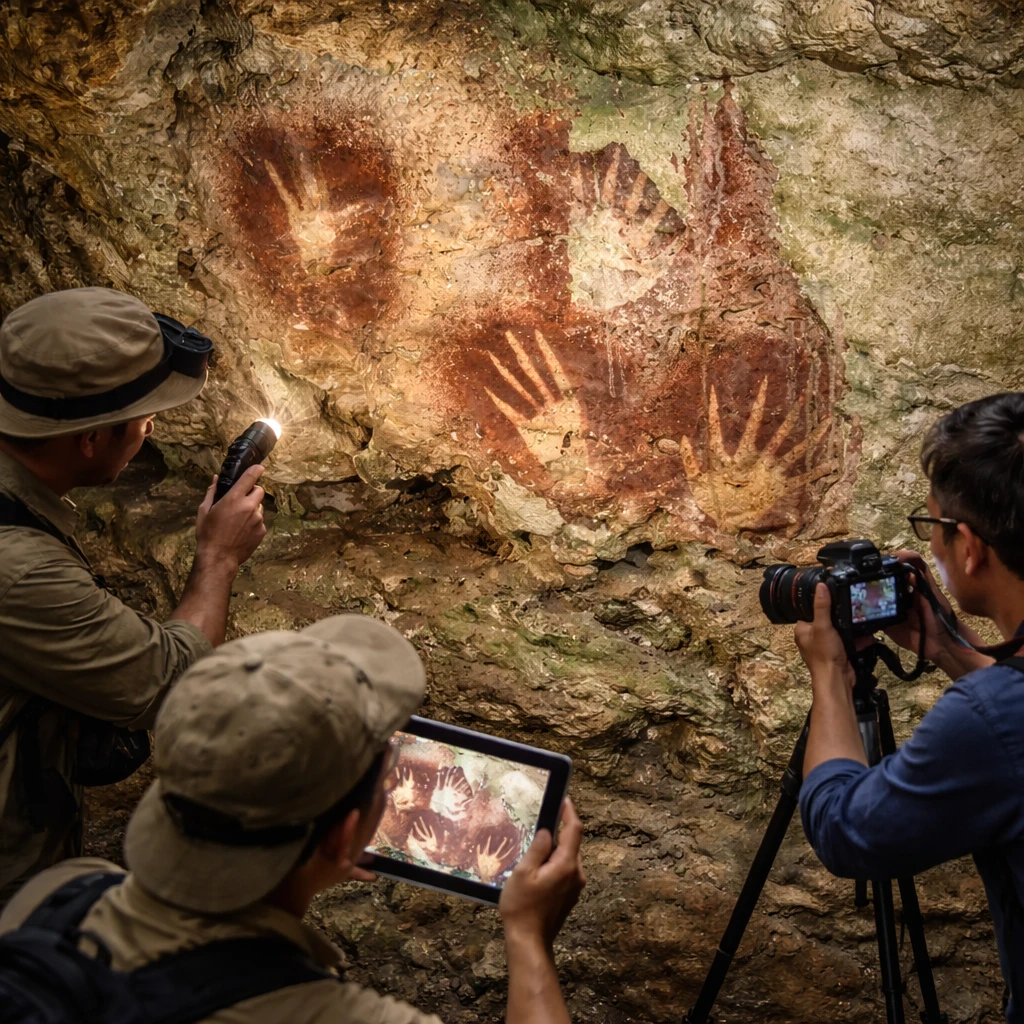

Scientists recently examined tan-hued handprints discovered within caves on Sulawesi, an island in Indonesia, finding that these images rank among the earliest known cave art artifacts studied by researchers to date. Detailed analysis by a team of Indonesian and Australian experts revealed that these prints were produced by blowing pigment around hands pressed against cave surfaces, resulting in a negative silhouette. Notably, some fingertips were deliberately modified to form sharper, more pointed outlines, indicating a sophisticated stylistic choice.
The estimated age of this prehistoric artwork was determined by dating mineral layers that formed atop the pigment, revealing these hand stencils are at least 67,800 years old. This timeline positions the Sulawesi cave art as some of the oldest recognized representations in a more complex tradition of rock art, reflecting an established and vibrant cultural practice in prehistoric Indonesia. Maxime Aubert, a researcher at Griffith University and co-author of the study published in Nature, emphasized the significance of these findings as indicative of shared artistic customs among early human groups in the region.
Independent paleoanthropologist Genevieve von Petzinger expressed enthusiasm upon reviewing the study, noting that the results aligned precisely with anticipated patterns regarding early symbolic behavior in human history.
Historical records affirm Indonesia's role as a focal point for some of the world's earliest discovered cave paintings, with global archaeological research uncovering a multitude of ancient artworks, including engravings and markings on bones and stones dating back hundreds of thousands of years. For example, cross-hatched designs on rocks in South Africa have been estimated to be approximately 73,000 years old, highlighting a trajectory of human creative development worldwide.
The discovery in southeastern Sulawesi contributes essential evidence to discussions on the emergence of artistic expression among early humans, offering concrete dates that help trace the evolution from rudimentary marks to more intentional and meaningful imagery. These insights provide a chronological framework vital for comprehending humanity's creative origins.
Uncertainty remains regarding the identity of the individuals who created these handprints. Possibilities include Denisovans, an ancient human species known to have inhabited the area and potentially interacted with Homo sapiens ancestors before their extinction, or early anatomically modern humans migrating out of Africa, who may have traversed regions including the Middle East and Australia around this period. The delicate alterations seen in fingertip shapes within the cave art suggest anatomical human characteristics.
Additional figurative art found within the same caves feature depictions of human forms, birds, and horse-like animals; however, these were executed significantly later, dating to roughly 4,000 years ago. The artistic timeline on Sulawesi thus spans a considerable duration, indicating a long-standing tradition of cave art in the region.
Researchers anticipate that continued exploration of adjacent islands may reveal even older artistic expressions, potentially providing further clarity on the dissemination and development of prehistoric art practices throughout the region and globally. Aubert noted that while the current findings are groundbreaking, they represent an invitation for ongoing investigation to deepen understanding of early human cultural behavior.