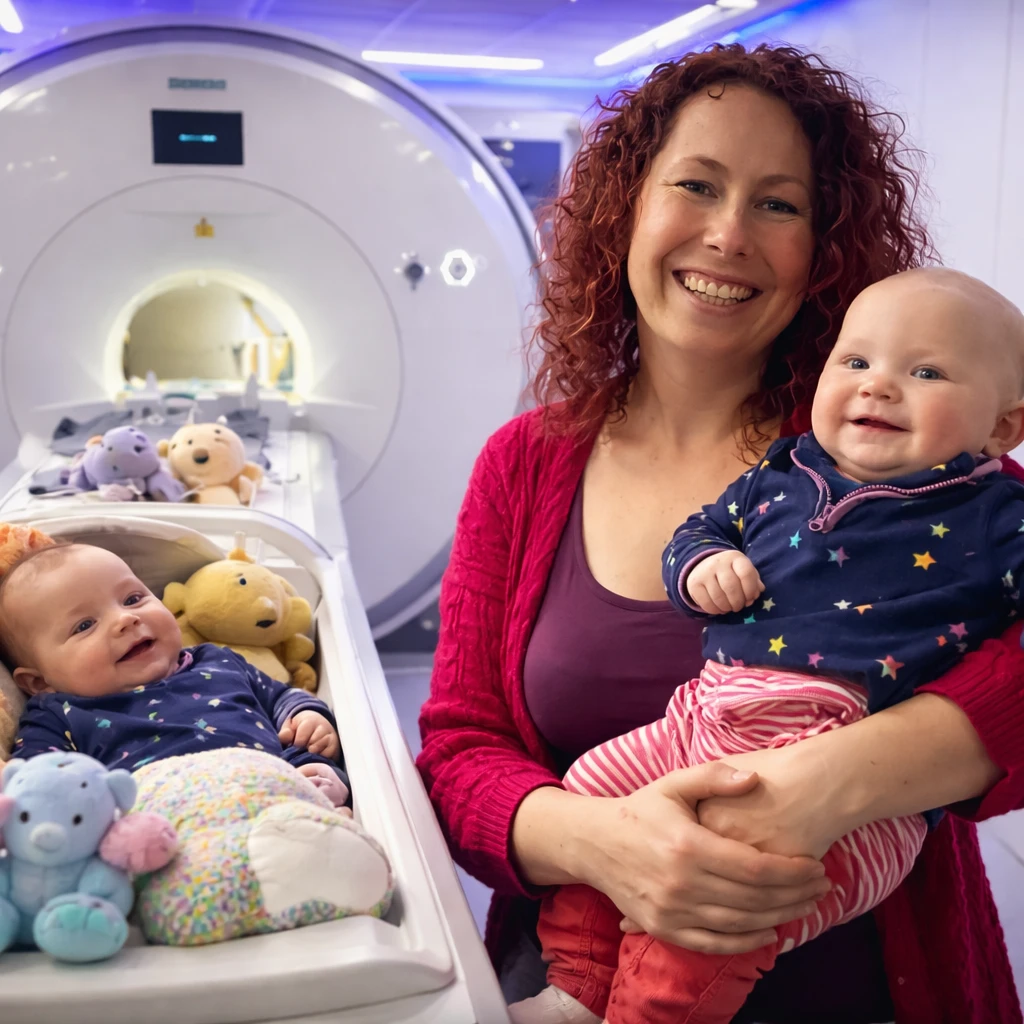

A pioneering study involving functional magnetic resonance imaging (fMRI) has provided compelling evidence that infants at just two months old can distinguish between different categories of objects. This discovery, published in the journal Nature Neuroscience, challenges earlier assumptions regarding the timeline of cognitive abilities in infancy and offers new insights into early childhood brain development.
The research team analyzed brain activity data from 130 awake infants aged two months, exposing them to images representing twelve categories frequently encountered during the first year of life, including natural elements such as trees and living creatures like animals. Remarkably, when an infant observed an image of a living entity, for example, a cat, their brain exhibited specific activation patterns distinct from those elicited by images of inanimate objects. This neural differentiation was measurable and consistent among subjects.
Lead researcher Cliona O’Doherty highlighted the significance of these findings, emphasizing the complexity of infant interaction with their surroundings. According to O’Doherty, "This demonstrates that even at two months, infants engage with the visual world at a level of sophistication previously unappreciated, suggesting an advanced underlying cognitive framework early in life."
The utilization of fMRI technology was instrumental in reaching these conclusions, as it offers a more precise and direct method of assessing visual processing compared to earlier studies which relied primarily on infants' gaze duration as an indicator of categorization ability. Such prior methods, although useful, often presented challenges in accurately gauging responses from very young subjects. Earlier research had posited that infants might develop the ability to distinguish broad categories of objects, such as animals versus furniture, around three to four months of age.
In the context of this new work, O’Doherty noted a more complex early categorization capacity present at two months, stating, "Our data clearly shows that infants can group different categories much earlier than former research suggested." This finding not only redefines our understanding of infant cognitive milestones but also opens avenues for investigating the early development of perception and cognition.
The study extended to include follow-up scans of some infants at nine months of age, with successful data acquisition from 66 participants. This longitudinal component revealed a marked strengthening in the brain's discrimination between living and non-living objects as the infants matured, reinforcing the notion of ongoing refinement in neural processing over the first year of life.
Looking forward, researchers anticipate that such imaging techniques could eventually correlate early brain activity patterns with cognitive development trajectories later in childhood. Liuba Papeo, a neuroscientist affiliated with the National Center for Scientific Research in France, remarked on the methodological rigor of the study, particularly the substantial cohort size, calling it "impressive and unique." Papeo further noted the inherent challenges in conducting fMRI studies with infants, as remaining still while awake in the scanner necessitates careful acclimatization and comfort measures.
O’Doherty, who conducted the research at Trinity College Dublin, detailed practical steps to optimize infant comfort during scans. The infants were placed on a bean bag within the MRI scanner to secure a snug, restful position. The visual stimuli were presented on a large screen positioned in a way that provided an immersive experience akin to "IMAX for babies," ensuring engagement without distress.
This study not only enriches the scientific literature on infant brain development but also underscores the capabilities of advanced neuroimaging to uncover subtle cognitive processes in early life, informing future research and potential clinical applications.