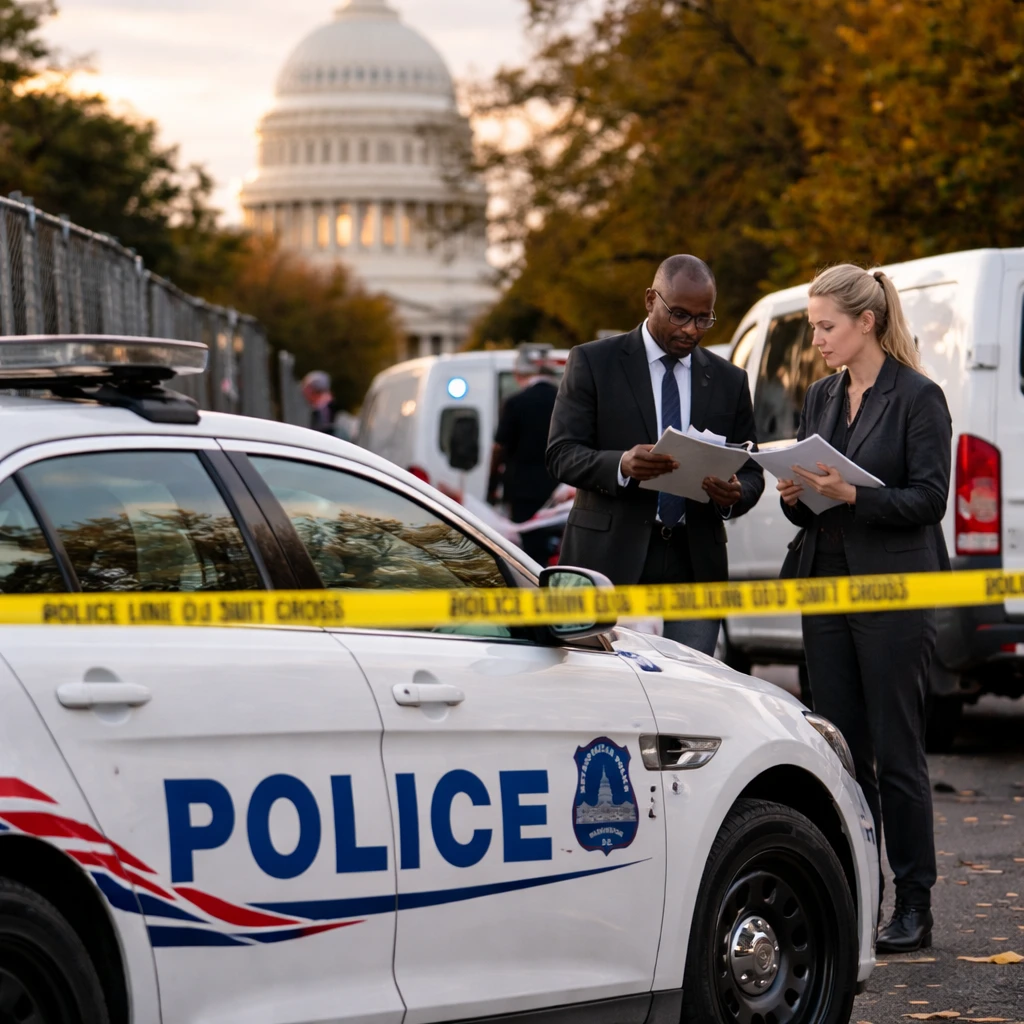

The Washington Inspector General's office officially announced an investigative review on Monday centering on the Metropolitan Police Department's crime data reporting procedures. This marks a continuation of heightened examination into the methodologies the department employs to compile and present its crime statistics.
Inspector General Daniel Lucas addressed a letter to interim police Chief Jeffery Carroll outlining the probe's overarching goal: to critically assess the framework, rollout, and functioning of the MPD's internal systems designed to collect, categorize, and disseminate crime data and corresponding statistics.
Heightened scrutiny of the MPD's data collection comes amid a backdrop of federal involvement initiated last summer when then-President Donald Trump declared a monthlong emergency order to federalize the department. This order activated a federal law enforcement surge within the nation’s capital, framed by the Republican administration as a measure to counteract rising crime rates.
Last month, a report authored by the House Committee on Oversight and Government Reform laid bare serious concerns regarding the behavior of former MPD Chief Pamela Smith. According to the Republican-led committee’s findings, Smith was accused of exerting pressure on police commanders, including threats, punishments, and retaliatory actions, particularly targeting those who reported elevated crime figures.
The congressional report alleges that the former police chief deliberately influenced her subordinates to adjust departmental data, thereby artificially reducing reported crime rates to project a lower incidence of criminal activity in the city.
In parallel, an investigation undertaken by the U.S. Attorney Jeanine Pirro’s office identified widespread misclassification within MPD reports. This misclassification further contributed to the underreporting of crime statistics, masking the true scope of criminal incidents. Pirro’s inquiry commenced in August amid the surge of federal officers deployed to Washington D.C., a city governed predominantly by Democrats, in response to what was described by the Trump administration as a critical crime wave. The emergency directive effectively placed the president in command of the local police department for a 30-day span.
Neither the Inspector General’s nor Pirro’s investigations recommended criminal charges against any individuals. Instead, Pirro emphasized the onus on the MPD to institute internal reforms to rectify systemic shortcomings revealed by the probes.
Mayor Muriel Bowser’s office confirmed that the mayor requested the Inspector General's involvement following the public release of these reports. This initiative aims to conduct an independent, comprehensive examination to clarify ambiguities and respond to the concerns raised.
Throughout the period marked by the federal law enforcement influx and emergency order, local officials have consistently maintained that decreases in crime rates predated the federal intervention. Furthermore, the investigations observed that while the augmented law enforcement presence and National Guard deployment contributed significantly to crime reduction, existing inaccuracies in crime reporting undermined the acknowledgment of these improvements.
According to official MPD data, there were 127 homicides in the District of Columbia last year, denoting a 32% decrease compared to the previous year.
Former Chief Smith, who has since vacated her position, contested accusations that any criminal data manipulation occurred during her leadership.
Interim Chief Carroll, appointed amid ongoing controversy, acknowledged these concerns and indicated the department’s commitment to addressing them. Planned corrective actions include enhanced training for officers responsible for crime classification and the establishment of an audit team charged with verifying accurate crime report categorizations.
During a joint press conference, Mayor Bowser reiterated her intent to leverage the Inspector General’s office to investigate the issues raised more thoroughly. She highlighted that prior reports lacked sufficient evidence and contextual understanding, as well as the absence of direct dialogue with the implicated department.