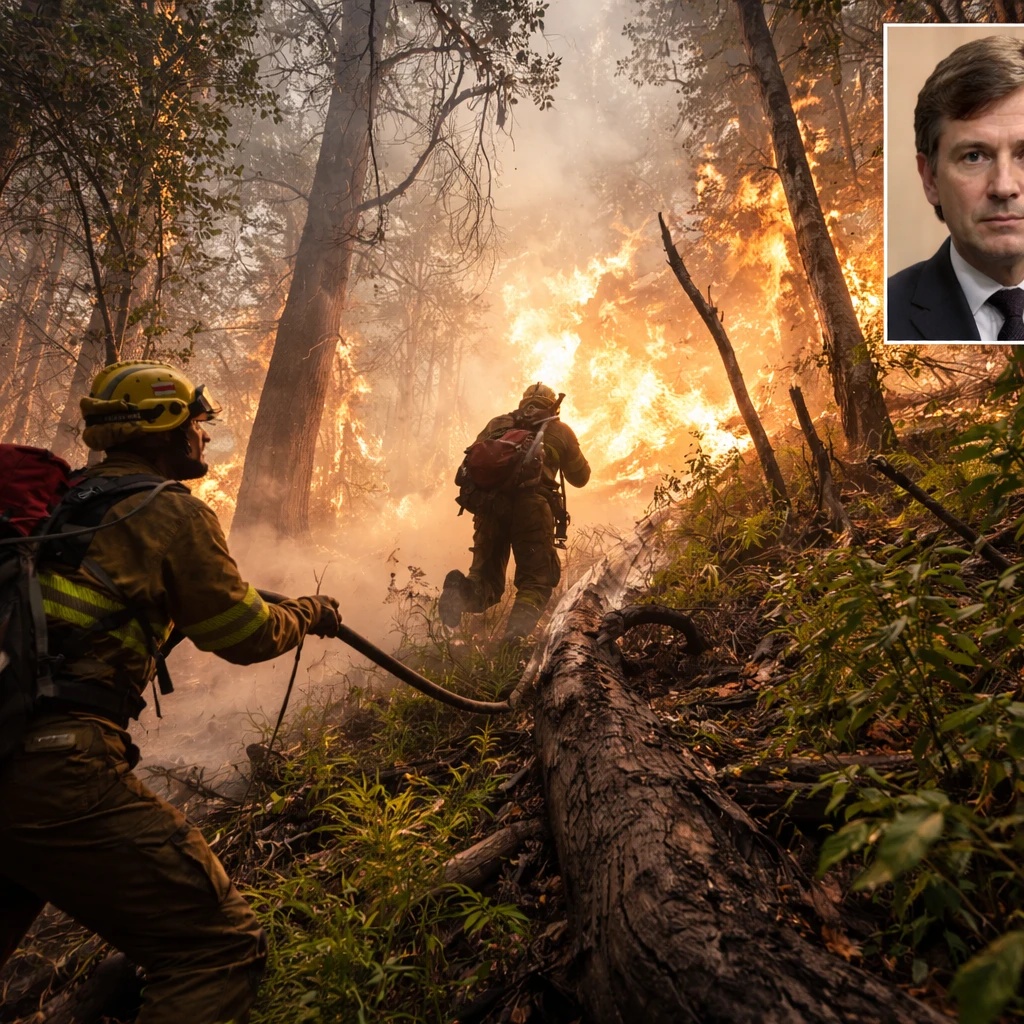

In the Patagonian region of Argentina, the once serene, densely wooded slopes are currently engulfed in flames resembling scenes out of a war zone. Towering plumes of smoke rise sharply into the sky, mimicking mushroom clouds often associated with missile strikes. At night, massive fires illuminate the horizon in vivid hues of mango-orange, distorting the beloved landscapes immortalized in the cultural memory of explorers and writers for generations.
Significant portions of the Los Alerces National Park, recognized by UNESCO as a World Heritage Site and home to ancient trees some 2,600 years old, have succumbed to destructive wildfires. These blazes represent some of the worst seen in decades across a drought-stricken Patagonia, ravaging over 45,000 hectares (110,000 acres) of native forests in the past six weeks.
The intense fires have forced the evacuation of thousands of residents and tourists, with the flames continuing their spread as late as Monday. This unfolding ecological disaster has generated soaring frustration directed toward Argentina’s radical libertarian President, Javier Milei. Since taking office, Milei’s stringent fiscal austerity has slashed funding for programs and agencies responsible not only for firefighting deployment but also for park conservation and wildfire prevention initiatives.
Luis Schinelli, a park ranger assigned to Los Alerces, one of only sixteen covering the park’s 259,000 hectares (642,000 acres), voiced deep concern over governmental priorities: "There is a political will from the current government to dismantle the institutions combating fires. They are pushing us beyond our limits."
Upon assuming power with a pledge to rescue Argentina’s economy from chronic debt, Milei drastically cut the National Fire Management Service’s budget by 80% in 2024 compared to the previous year. This decision has undermined the agency’s capacity to dispatch firefighting brigades, maintain aerial firefighting assets such as tanker planes, acquire additional equipment, and monitor fire hazards.
Adding to challenges, a projected further 71% funding cut for 2026 threatens to erode the fire management infrastructure even more, according to budget reviews by Fundación Ambiente y Recursos Naturales (FARN), an Argentine environmental research and advocacy organization. This decline in resources arrives as climate change has rendered extreme weather events more frequent and intense, compounding wildfire risks.
Veteran firefighter Hernán Mondino remarked on the apparent disconnect between political rhetoric and ground realities: "They claim climate change isn’t happening live, but we are experiencing it regardless. So far, we have seen no indication the government is concerned about our situation." Attempts to reach the Ministry of Security, now overseeing fire response after the downgrading of the Environment Ministry, have gone unanswered.
Milei’s fiscal measures have contributed to economic stabilization, reducing annual inflation from 117% in 2024 to 31% last year—the lowest in nearly a decade. His confrontational approach against what he deems bureaucratic excess and socially progressive policies has also led to political alignment with former US President Donald Trump, whose own administration pursued similar downsizing with comparable effects on scientific research and disaster response programs.
Further straining international climate cooperation, Milei threatened withdrawal from the Paris Agreement and boycotted the UN climate summit, dismissing anthropogenic global warming as a "socialist lie." These stances have ignited anger within Argentina, where exceptional heat and drought, characteristic of a warming planet, are fueling the ongoing Patagonian wildfires.
Local residents, such as 41-year-old Lucas Panak, have grown increasingly compelled to act independently. Panak recounted mobilizing with friends to battle flames near the village of Cholila after municipal fire brigades were reassigned to other areas: "There is a lot of pent-up anger. Folks here are deeply uncomfortable with our country’s politics."
The emergence of the current fires can be traced back to an initial ignition caused by lightning near a lake at the northern edge of Los Alerces in early December. Firefighters faced difficulties responding promptly due to the remote location and lack of firefighting aircraft to transport crews and suppress fires on steep slopes. This response delay provoked the resignation of the park administration and accusations of negligence by local citizens through a formal criminal complaint as flames quickly spread.
Experts, however, argue the key issue does not lie solely in response failures, but rather in the absence of preventive measures. Andrés Nápoli, director of FARN, emphasized that "fighting fires is not just about actions during an outbreak, but about continuous prevention throughout the year," which has been largely eliminated under current policies.
Alongside budget cuts to the fire management agency, the Milei administration reduced National Parks Authority funding by tens of millions of dollars last year, resulting in layoffs or resignations of hundreds of rangers, firefighters, and administrative personnel. Increased tourist visitation each year further stresses the diminished personnel, who cite difficulties in monitoring fire risks, maintaining trails, and educating visitors. In March, deregulation eliminated requirements for licensed guides in hazardous tourism activities such as glacier trekking and rock climbing, raising concerns over safety and oversight.
National parks’ labor representatives, like Alejo Fardjoume, warn of the compounding effects of decreased professional staffing and technical capabilities, projecting growing vulnerabilities over time. An official 2023 report recommended a minimum of 700 firefighters to cover park territories, yet current employment has dropped to 391, losing 10% of staff due to layoffs and resignations under Milei’s tenure.
Budget restrictions have also eroded firefighter training opportunities and lowered equipment availability. Many firefighters rely on secondhand clothing and donations to equip themselves adequately. Authorities at Los Alerces assert that fiscal austerity did not impede firefighting efforts against current fires. Ariel Rodríguez, interim park superintendent, cautions about operational limits in dangerous, inaccessible terrains: "You cannot deploy large numbers of personnel with chainsaws in steep, risky areas."
Nevertheless, exhausted firefighters report ongoing attrition driven by poverty-level wages failing to keep pace with inflation, forcing many to secure supplementary employment in gardening or agriculture. The average firefighter in Patagonian parks earns approximately 600 US dollars monthly, with lower earnings in less costly provinces. As firefighter numbers shrink, remaining crews bear increased workloads, resulting in extended shifts and reduced rest. Firefighter Mondino expressed the burden: "From the outside it seems everything is working, but we pay the price with our bodies. If a colleague is absent, we have to cover more tasks, work harder, and sleep less."
During much of the wildfire outbreak, President Milei remained publicly silent, maintaining routine engagements. His prominence on stage with a former girlfriend dancing to Argentine rock ballads amidst mounting provincial governors’ pleas to declare a state of emergency drew political criticism. Centrist legislator Maximiliano Ferraro condemned Milei’s celebratory behavior "while Patagonia burns," and left-wing opposition parties organized protests nationwide.
Ultimately, Milei declared a state of emergency last Thursday, unlocking federal funds of 70,000 US dollars for volunteer firefighting efforts and asserting a commitment to a "historic battle against the fires" on social media platforms.
At a firefighter base camp, workers recovering from fatigue expressed cautious optimism about new support but mourned the irreversible losses. Volunteer Mariana Rivas, providing impromptu massages and medical checks, reflected on the long-term impact: "It hurts because this is not just a beautiful landscape—we live here. There is anger about what could have been avoided, and frustration that each year seems worse than the last."