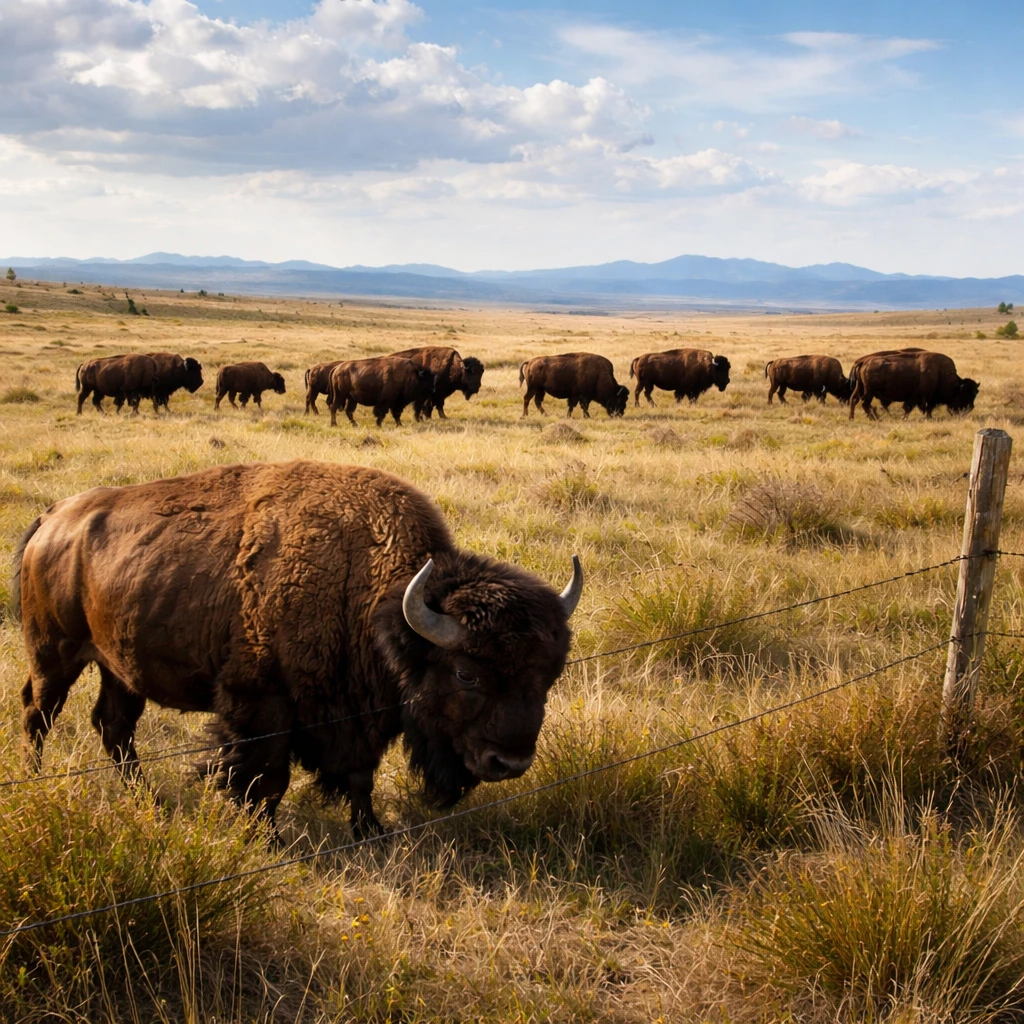

On Friday, the U.S. Department of the Interior declared it would withdraw grazing permits held by American Prairie for sustaining its bison population in Phillips County, Montana. This action marks the resolution of a more than three-year contest involving the Montana livestock industry, supported by Governor Greg Gianforte and the Montana Department of Justice, against American Prairie, a nonprofit organization focused on prairie ecosystem restoration in north-central Montana.
The Montana Stockgrowers Association (MSGA) welcomed the decision, labeling it as a "win for public lands ranching in Montana." In a statement released Friday, MSGA President Lesley Robinson expressed satisfaction with the Bureau of Land Management's (BLM) move, emphasizing their commitment to lawful land management and noting the ruling as a significant victory for ranching families, rural communities, and public land grazers throughout the Western United States.
Conversely, American Prairie criticized the permit revocation, describing the action as setting a "troubling precedent" for stakeholders depending on predictable and consistent federal land management policies. The organization's CEO, Ali Fox, marked the decision as arbitrary and unfair, stating in an emailed message that the change lacked grounding in new evidence or emerging impacts. Fox highlighted that such reversals undermine confidence in federal processes and emphasized that Montana's livestock owners deserve transparency and dependable rulings.
American Prairie underscored the ecological importance of bison within prairie ecosystems, referencing extensive and well-documented studies supporting the species' role in prairie health.
In a formal letter dated January 16, signed by Sonya Germann, State Director of the BLM’s Montana/Dakotas office, the Interior Department contested American Prairie’s categorization of its bison herd, which in 2024 numbered around 900 animals.
American Prairie had utilized four grazing leases for approximately three years amid proceedings conducted by the Interior Department’s Office of Hearings and Appeals—a quasi-judicial body tasked with reviewing federally administered grazing permits. The nonprofit noted to Montana Free Press that it previously secured permission to graze bison on other revoked BLM leases dating back to the mid-2000s, and has maintained successful operations over the last two decades.
In December, Interior Secretary Doug Burgum, appointed during the prior administration, directed the BLM to re-examine the grazing permits initially approved under the Biden administration in 2022. This directive was based on an interpretation of the 1934 Taylor Grazing Act mandating that grazing on federally owned public lands be limited to domestic animals maintained for production-oriented objectives.
This statutory interpretation served as the foundation for the recent revocation. In her 24-page decision letter, Germann pointed out moments where American Prairie's admissions clearly indicated that the bison were not managed with production goals, thus disqualifying them from being categorized as livestock or domestic animals under applicable laws. She further mentioned that reinstating cattle-only permits on allotments previously authorized for bison or cattle-plus-bison grazing aligns BLM's actions with its statutory responsibilities.
Previously, the BLM had recognized in its 2022 record of decision approving the Montana bison grazing plan that bison grazing operated within leases across Colorado, New Mexico, North Dakota, South Dakota, and Wyoming. At that time, the agency acknowledged opposition from some public land users but determined that differing viewpoints did not present a scientific controversy or regulatory non-compliance.
Since its establishment in 2001, American Prairie, initially called American Prairie Reserve, has pursued the acquisition of extensive land holdings and grazing leases to support a rewilding effort across 3.2 million acres to restore prairie biodiversity. By late 2024, it reported controlling over 500,000 acres via private property and federal grazing leases, a milestone attributed to recent large ranch purchases.
The nonprofit's growing presence has incited resistance from Republican officials and local livestock producers concerned about its influence over land ownership, cultural issues, and tax policies in central Montana. Groups like the United Property Owners of Montana have rallied under slogans such as "Save the Cowboy" to oppose American Prairie's expansion.
Montana Attorney General Austin Knudsen and Governor Gianforte, both opponents of the 2022 grazing approval, heralded the BLM's reversal as a triumph for Montana's agricultural community. Knudsen remarked that revoking the grazing permit safeguards the livestock industry and ranching populace from what he described as elitist efforts to displace them.
American Prairie hinted at the possibility of contesting the decision through federal courts, asserting in their Friday release that they are currently reviewing the recent rulings and evaluating their options moving forward.