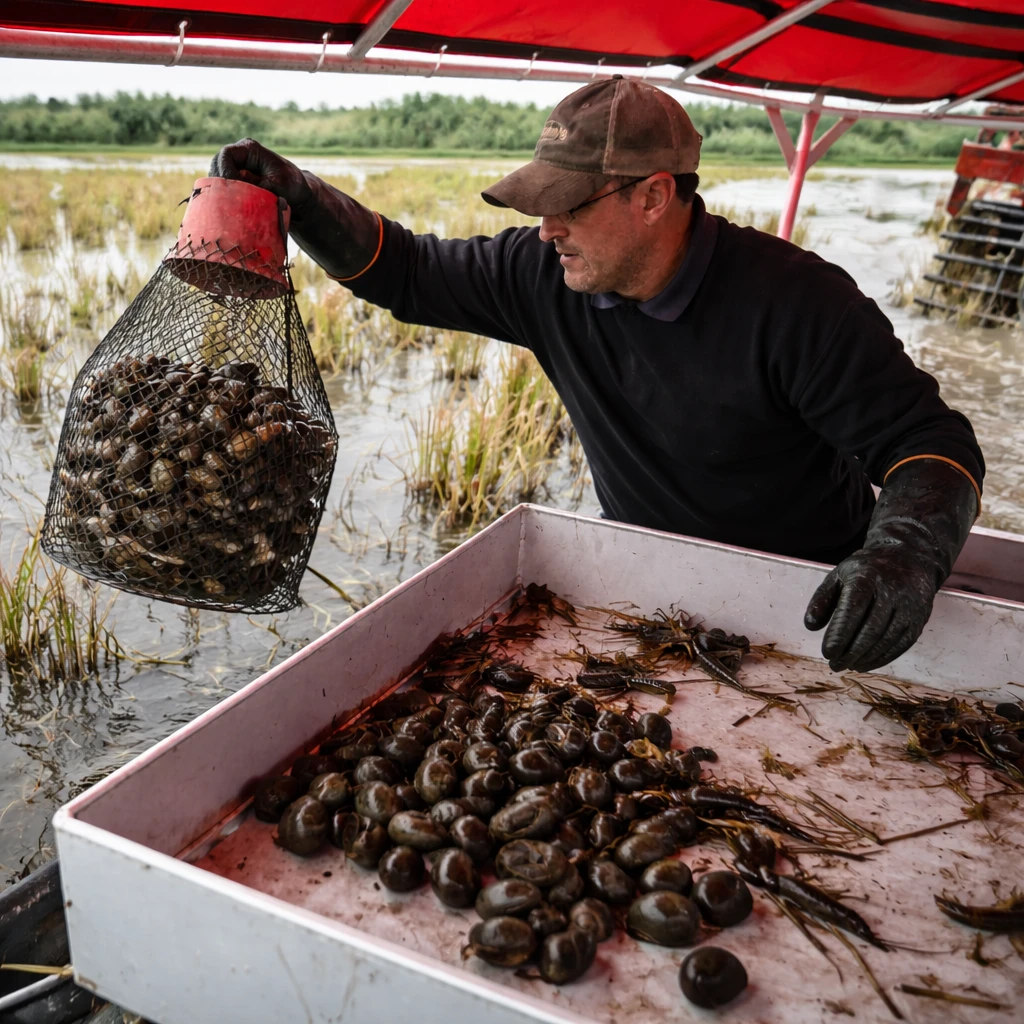
In southern Louisiana’s agricultural heartland, farmers who have long depended on the traditional combination of rice and crawfish cultivation are facing new and formidable adversaries in the form of invasive species disrupting their livelihoods. Josh Courville, a lifelong crawfish harvester operating near Kaplan, Louisiana, reports an increasing presence of large apple snails within the fields under his management. For every crawfish extracted from traps, Courville estimates encountering three to four sizeable apple snails, roughly the size of a baseball, accumulating on sorting tables. These resilient snails endure various environmental conditions in fields, drainage ditches, and irrigation infrastructure, capable of laying thousands of distinctive pinkish-orange eggs each month. This proliferation has left farmers feeling disheartened and impotent, as Courville notes the limited control available over their spread.
These invasive snails typify broader challenges occurring in Louisiana, where rice and crawfish are frequently cultivated concurrently within the same acreage. In addition to apple snails, farmers now contend with an emerging threat from delphacids, a group of diminutive insects. These pests cause direct harm to rice plants by feeding on their sap and facilitating the transmission of viruses that exacerbate crop damage. While much about these threats remains uncertain, investigative efforts are underway to understand the factors contributing to their expansion. Potential influences under examination include agricultural practices, pesticide usage, global trade and transportation routes, and the occurrence of extreme weather events.
Entomological experts, including Hannah Burrack, professor and chair at Michigan State University’s entomology department, acknowledge uncertainties surrounding the relationship between climate change and pest distributions. Still, there is consensus that a warming climate may enable such pests to establish themselves beyond their historical southern ranges, thereby expanding their geographic footprint.
The stakes are high given the challenging economics of rice production, and the interdependence of successful rice and crawfish harvests within rotation systems integral to Louisiana agriculture. Steve Linscombe, director of The Rice Foundation, an organization supporting rice research and education, highlights that pest-related crop losses could translate into increased costs for U.S. consumers and place financial burdens on producers.
Courville’s experience managing the fields for Christian Richard, a sixth-generation rice farmer, illustrates the rapid rise of apple snail populations. These populations surged following a significant flood event in 2016, with the snails inflicting marked destruction during rice planting seasons. Richard describes the snails’ feeding in newly planted wet fields as reminiscent of scenes from science fiction, with individual snails creating small whirlpools as they consume seedlings, resulting in the loss of entire 100-acre fields.
Louisiana State University researchers estimate apple snails have become widespread across approximately 78 square miles in the state. To mitigate damage, farmers, including Richard and his team, adopt a planting strategy that involves initially keeping fields dry until rice plants establish sufficient height before flooding them to support crawfish development. While this method predated the snail introduction, it is now essential and notably increases operational costs.
Chemical control options for apple snails remain limited due to the risk of harming crawfish, which, along with rice, are directly consumed by people, restricting pesticide use. Some farmers experiment with copper sulfate treatments despite their substantial financial implications, as noted by Courville. The cumulative effect results in diminished production levels, reduced revenue, and increased labor demands.
Employees like Cecilia Gallegos, who has worked harvesting crawfish for several years, attest to the snails’ impact on their workload. The process of separating snails from crawfish extends working hours, especially during the demanding spring season when harvests peak, sometimes delaying labor into the early morning hours. Snails inadvertently caught are typically destroyed after separation.
Parallel to the snail invasion, scientists are intensifying efforts to understand and manage delphacids, minuscule insect pests becoming increasingly prevalent. These pests have been detected across Louisiana, prompting researchers to employ specialized sampling techniques, including heavy-duty butterfly nets and vacuum devices similar to those used for collecting specimens in entomological studies. The insects’ ability to feed on rice plants and spread harmful viruses raises concerns about their potential to cause substantial crop losses.
Louisiana’s situation echoes challenges faced in neighboring Texas last year, where delphacid infestations led to crop yields declining by up to 50% in the ratoon crop, which constitutes the second annual rice harvest. The severity of the impact in Texas has led to reductions in planted acreage and financial caution, with some farmers facing difficulties securing loans. Tyler Musgrove, a rice extension specialist at Louisiana State University’s AgCenter, observes that by late 2025 most Louisiana rice fields had been affected by delphacids, although the majority of that year’s crop was already harvested, leaving the prospects for the current season uncertain.
The presence of delphacids represents a significant entomological event in U.S. rice production, potentially the most consequential since the pest’s initial introduction in the 1950s. Although the insects appeared to have subsided in the intervening decades, their recent resurgence across several rice-producing states—including Texas, Louisiana, Arkansas, and Mississippi—raises questions about their long-term establishment, with ongoing research aimed at monitoring their overwintering abilities.
Experts emphasize the complexity of managing these invasive species without resorting to costly or environmentally detrimental pesticide applications. There is also growing interest in understanding the differential impacts when rice and crawfish are cultivated together versus rice monocultures. According to Adam Famoso, director of Louisiana State University’s Rice Research Station, solutions will require integrated strategies beyond conventional breeding or chemical control approaches.
Complicating pest management is the influence of climate variability, which disrupts predictive models historically used to anticipate pest outbreaks and population surges, thereby hampering farmers’ ability to plan effectively. Burrack highlights that such changes challenge the fundamental capacity for agricultural producers to reliably cultivate their intended crops in traditional locations.
The agricultural community continues to seek balance between effective pest management, economic viability, and environmental stewardship as these invasive species firmly establish themselves within southern Louisiana’s rice and crawfish industries. The evolving situation underscores the need for ongoing research, adaptive farming practices, and collaborative efforts among farmers, scientists, and policymakers to safeguard vital food resources amid changing ecological conditions.
February 6, 2026
News & Politics
Invasive Snails and Insects Challenge Southern Louisiana Rice and Crawfish Farmers
Southern Louisiana agriculture grapples with apple snails clogging crawfish traps and insect pests threatening rice crops, prompting costly adaptations.

Maya Rios
Energy & Utilities Analyst
Summary
In southern Louisiana, agricultural producers who cultivate rice and crawfish are confronting significant challenges due to invasive species. Large apple snails are overwhelming crawfish traps and damaging rice fields, while newly detected insect pests called delphacids threaten rice crops with potentially severe yield reductions. The invasion, exacerbated by environmental factors and limited pesticide use options, is imposing operational difficulties and increasing costs for farmers. Researchers continue to investigate the cause and spread of these pests and seek sustainable management strategies, mindful of the possible climate change implications that may favor pest proliferation.
Key Points
Southern Louisiana rice and crawfish farmers are confronted with infestations of invasive apple snails clogging crawfish traps and damaging rice crops by feeding on seedlings and laying large quantities of eggs.
Tiny insect pests known as delphacids pose a new threat by feeding on rice plants and transmitting damaging viruses, with observed significant yield losses in neighboring Texas raising concerns for Louisiana producers.
Farmers have adopted costly adaptations in crop management, including dry planting methods and selective pesticide use, complicated by restrictions to protect edible crops and co-cultured species like crawfish. This leads to increased labor, production costs, and operational stresses.
Risks
- The proliferation of invasive apple snails and delphacid insects threatens the sustainability and productivity of rice and crawfish farming in southern Louisiana, potentially leading to lowered crop yields and financial strain on farmers.
- Limited chemical controls due to the overlap of edible crops and crustacean farming increases vulnerability to pest infestations and raises production costs, impacting the agricultural supply chain and commodity markets.
- Climate change may exacerbate pest spread and complicate forecasting, reducing farmers' ability to plan effective pest management strategies, adding uncertainty to crop outputs and market stability.
Disclosure
This article is based on recent field reports and expert analyses regarding invasive species impacting southern Louisiana agriculture. All information is derived from current observations and scientific research without speculative claims or endorsements.