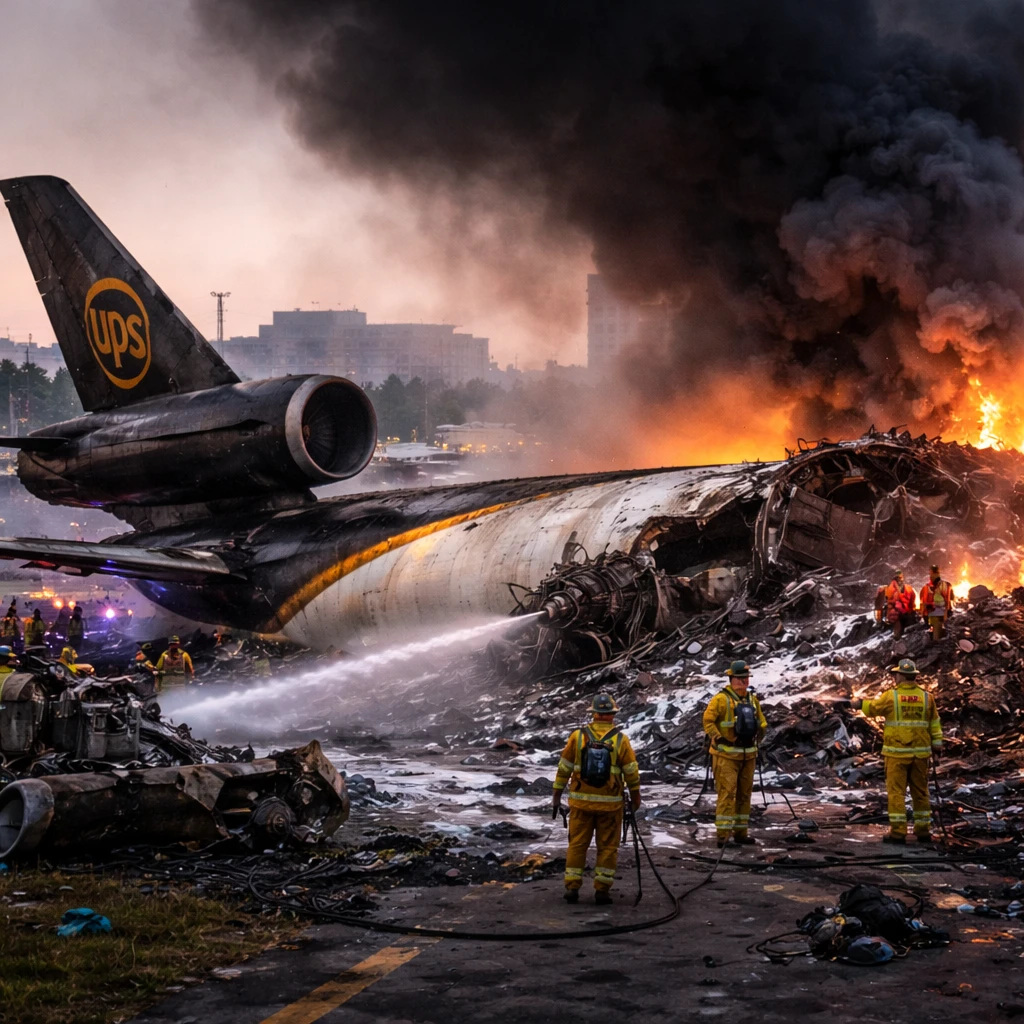
In November 2025, a UPS MD-11 cargo aircraft crashed soon after takeoff from Louisville, Kentucky, when its left engine detached from the wing during the runway roll, killing all three crew members aboard and 12 individuals on the ground near Muhammad Ali International Airport. The crash reignited scrutiny over engine mount failures associated with this aircraft model, particularly a component known as the spherical bearing race that secures the engine to the wing.
The National Transportation Safety Board (NTSB) disclosed on Wednesday that Boeing, which now owns McDonnell Douglas—the original manufacturer of the MD-11—had documented in 2011 several failures of this crucial engine mount part on three separate aircraft. However, at that time, Boeing did not consider these incidents to pose a flight safety issue. The affected part is a key element fastening the engine assembly to the wing structure.
Historical parallels exist, notably a 1979 crash in Chicago where an American Airlines DC-10 lost its left engine on takeoff, causing 273 deaths. The DC-10 is the direct predecessor of the MD-11, and while that incident initially prompted a global grounding of the fleet, the NTSB concluded the immediate cause of the crash was damaged caused during maintenance, not a fundamental design defect. Nonetheless, various accidents linked to engine failures had been reported for the DC-10 series.
Jeff Guzzetti, a former crash investigator with the FAA and NTSB, expressed surprise that Boeing did not classify the 2011 discovered failures as a safety of flight condition, particularly since a 1980 McDonnell Douglas service bulletin had already identified such failures as serious. He also highlighted questions about UPS's response to Boeing's 2011 service bulletin and the rigor of any maintenance performed based on that guidance.
Regular maintenance protocols for the UPS MD-11 included detailed inspections of the engine mount parts at intervals measured by takeoffs and landings. The last intimate inspection of the relevant parts occurred in October 2021, approximately four years before the crash, with the next scheduled inspection not due until after about 7,000 more flight cycles. Notably, investigators found cracks in some parts of the engine mount, which had not been discovered in routine maintenance, raising concerns about whether the inspection intervals were sufficient.
Unlike Federal Aviation Administration (FAA) airworthiness directives, which mandate specific repairs or replacements, Boeing's 2011 service bulletin recommended but did not require that operators replace the spherical bearings, suggesting a redesigned component that might reduce failure risk. It allowed operators to replace defective bearings with an older model that had, alarmingly, demonstrated susceptibility to failure.
Former federal investigator Alan Diehl stressed that the UPS crash underscored the need for more frequent or thorough maintenance on aging airframes, especially given the potential for catastrophic outcomes. The NTSB has not specified whether additional bearing failures have been documented after Boeing’s 2011 communication.
Visual evidence released by the NTSB depicts flames emerging as the aircraft's rear engine section began detaching, followed by the engine separating entirely and passing over the wing, which subsequently caught fire. This sequence aligns with the physical failures discovered in the spherical bearing and its fractured lugs after the crash.
The root cause of the engine's departure remains undetermined, pending the NTSB's final report, which typically takes over a year to complete. However, the bearing failure is a central investigative focus. Concurrently, lawsuits have been initiated examining both Boeing's prior knowledge and UPS's reaction to the 2011 service bulletin, suggesting that early warning signs were present but perhaps not acted upon sufficiently.
Legal counsel representing victims noted that despite prior warnings, appropriate measures to prevent such a disaster seem not to have been fully implemented, raising questions about organizational responsibility.
The investigative findings also clarified that neither of the MD-11's other engines caught fire before the accident, countering earlier hypotheses that debris from the left engine damaged the center engine.
With the ongoing NTSB investigation limiting comments, Boeing, UPS, and the FAA have all refrained from discussing details. However, both Boeing and UPS have expressed condolences to the families affected by the tragedy.
The aircraft involved was 34 years old, and despite having achieved only a modest altitude of 30 feet during takeoff, it crashed into several industrial structures, igniting a large fireball visible for miles. This model of airplane, no longer used by commercial passenger airlines due to inefficiency, remains operational in cargo fleets like UPS’s and FedEx’s as well as in firefighting roles.
Following the incident, all MD-11 aircraft still in service, along with ten related DC-10 models, have been grounded. Legal opinions suggest that, given their age and the risks, these aircraft may have exceeded their operational lifespans and warrant retirement from active duty.
January 14, 2026
News & Politics
Investigation Highlights Preexisting Engine Mount Flaws in UPS MD-11 Crash
NTSB reveals Boeing's 2011 caution on engine mount component predates fatal 2025 Louisville accident

Maya Rios
Energy & Utilities Analyst
Summary
A preliminary report from the National Transportation Safety Board (NTSB) has disclosed that Boeing issued a warning in 2011 regarding a broken engine mount part found on MD-11 aircraft, including the UPS cargo plane that crashed in Louisville, Kentucky in 2025. This crash involved the separation of the plane’s left engine during takeoff, resulting in 15 fatalities, including the three pilots aboard. While Boeing did not initially classify the issue as a safety threat, questions have arisen about maintenance protocols and the adequacy of Boeing's earlier alerts.
Key Points
Boeing identified engine mount part failures in 2011 but did not classify them as safety-critical, which is now central to the investigation of the 2025 UPS MD-11 crash.
Maintenance schedules for inspecting engine mount components on the MD-11 appear to have allowed existing cracks to remain undetected prior to the crash, raising questions about inspection adequacy.
The MD-11 involved was an aging aircraft model no longer used in passenger service but still operated by cargo carriers, with the crash prompting grounding of these planes and scrutiny over their service life.
Risks
- Potential deficiencies in maintenance and inspection protocols for aging aircraft components could lead to catastrophic failures, impacting safety and regulations in cargo and commercial aviation sectors.
- Uncertainties stemming from Boeing's 2011 service bulletin and subsequent operator adherence may affect liability considerations and influence aircraft manufacturer and operator risk management.
- Grounding of MD-11 and related DC-10 aircraft poses operational and financial challenges for cargo operators relying on these models, impacting fleet management and replacement strategies.
Disclosure
No new factual information beyond the NTSB preliminary report and associated expert commentary is presented. The investigation remains ongoing, and final conclusions are pending.