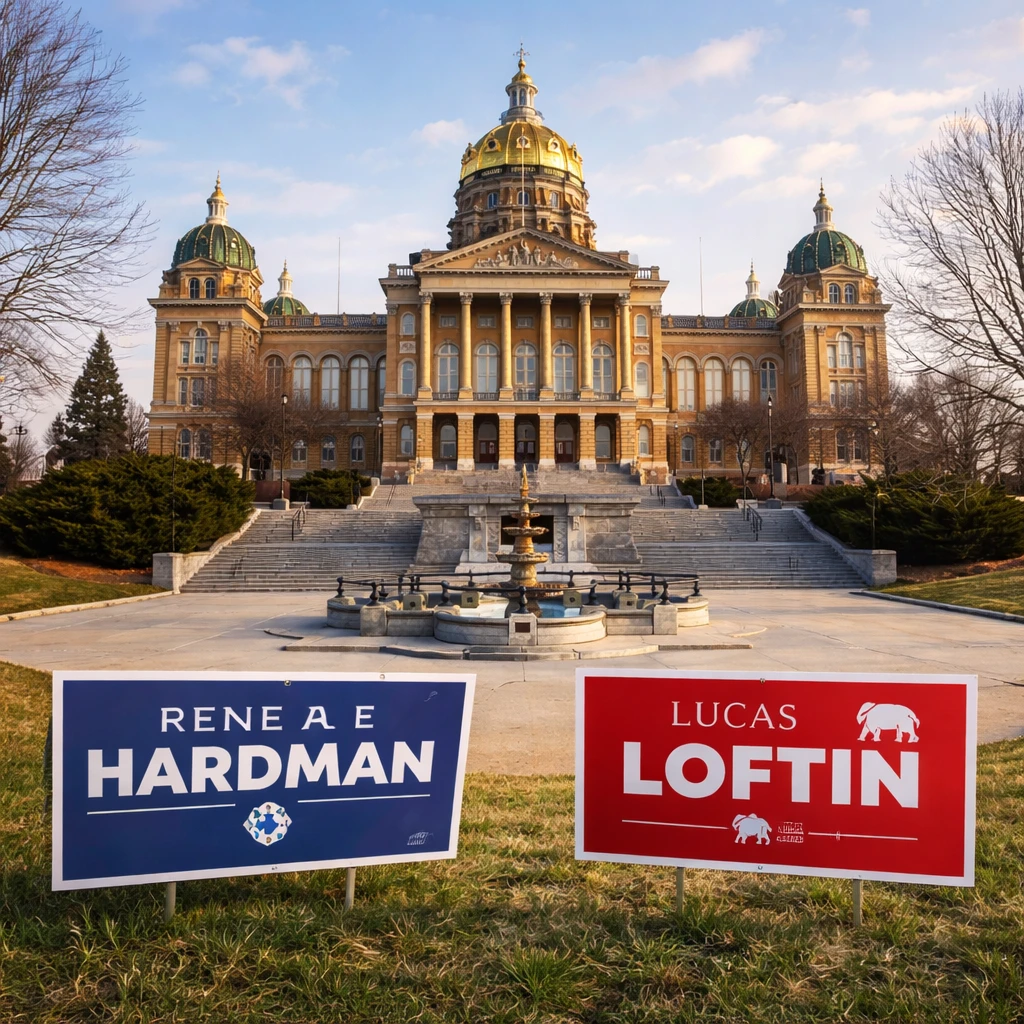

On Tuesday, registered voters in Iowa’s 16th state Senate district, encompassing parts of West Des Moines, Windsor Heights, Clive, and a portion of eastern Dallas County, will participate in a special election to fill the Senate seat left vacant by the late Claire Celsi. Celsi, a Democrat and three-term incumbent, passed away on October 6. The election's outcome holds significant ramifications for control of the Iowa state Senate, with Republicans poised to attain a supermajority.
The candidates vying for this seat are Renee Hardman, a Democrat with experience on the West Des Moines City Council and as mayor pro tempore, and Lucas Loftin, a Republican employed by an environmental and outdoor services company based in Clive.
Currently, Republicans maintain a dominant 33-16 majority in the Iowa Senate, just one seat short of the 34-seat threshold needed for a two-thirds supermajority. This special election gained increased attention following a Democratic victory in a prior August special election that interrupted the GOP's control. Under Iowa law, achieving a two-thirds supermajority grants the party enhanced legislative powers, including overriding gubernatorial vetoes, calling special sessions, authorizing specific payments, and confirming governor appointees. Notably, Republicans already hold a supermajority in the Iowa House of Representatives.
District 16’s recent voting patterns illustrate its Democratic leaning. Senator Celsi secured her third term in 2024 with 69% of the vote. Similarly, in the 2020 presidential election, Vice President Kamala Harris received approximately 58% of the district’s vote, while former President Donald Trump garnered about 41%, with only one precinct favoring him. Ironically, the precinct that Trump carried was also Celsi’s weakest performing area, where she obtained roughly 61% of votes.
According to the Iowa Secretary of the Senate, the two-thirds majority is critical for significant legislative decisions, heightening the stakes of this special election. The democratic and republican voter registration balance in District 16 shows approximately 37% Democrats, 30% Republicans, and nearly 32% independents or unaffiliated voters, out of nearly 45,000 registered voters as of December 1.
Voter turnout in the district was about 67% during the last general election in 2024, buoyed by the presidential race. Of those votes, around 62% were cast in-person on election day, and 38% were absentee ballots.
Election day polls will close at 8 p.m. CST (9 p.m. EST), after which vote counting will commence. Historical data from the 2024 general election indicates that vote tallies were first reported approximately 22 minutes after closing, with nearly complete results available within three hours.
Iowa law does not mandate automatic recounts, but candidates have the option to request and fund a recount unless the vote margin is under 1% or fewer than 50 votes, thresholds under which recounts are state-funded. The entity covering the election will declare a winner only when the lead is unassailable or legal challenges or recounts could not alter the outcome.
This special election carries considerable political weight, as its result may alter the GOP's legislative authority in Iowa’s Senate and affect governance dynamics, including veto override capabilities and appointment confirmations.