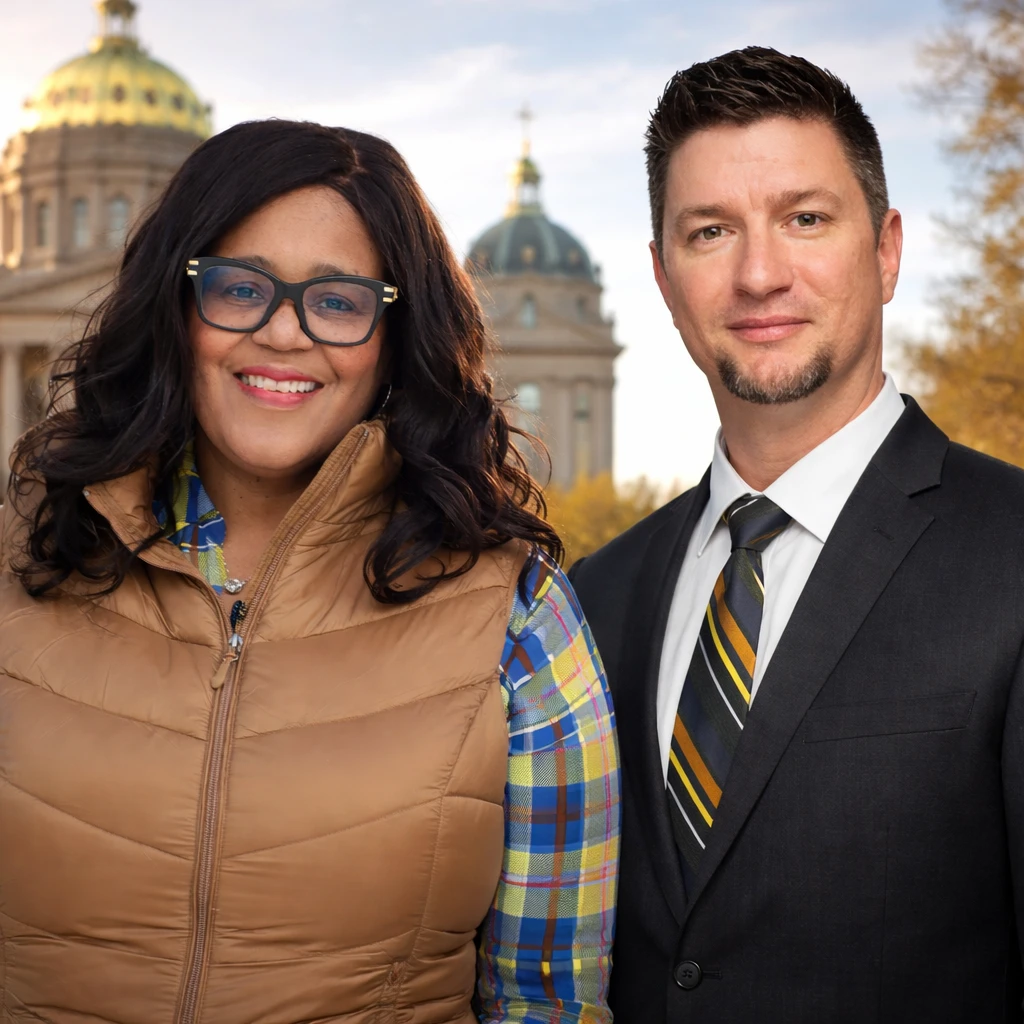

As the year 2026 approaches, residents in certain Des Moines suburban areas will participate in a consequential special election to fill a vacant Iowa state Senate seat. This election, scheduled for the last Tuesday of the year, pits Democrat Renee Hardman against Republican Lucas Loftin for the district formerly represented by Claire Celsi, a Democrat who passed away on October 6.
The vacant seat's outcome bears substantial importance for the Iowa Senate's political composition. Currently, Republicans hold 33 seats, while Democrats possess 16 following Celsi's death, after having gained a seat in an August special election. Should the Republicans reclaim this seat, their numbers will reach 34, reinstating a two-thirds supermajority in the 50-member chamber.
This supermajority facilitates smoother passage of legislation favoring the Republican agenda and simplifies approval processes for appointments made by Republican Governor Kim Reynolds to state agencies and commissions. Conversely, a Democratic victory through Hardman would reduce the Republican caucus to a simple majority, requiring bipartisan cooperation to advance gubernatorial appointments and potentially limiting unilateral Republican influence in the Senate.
The district in question displays a demographic advantage favoring Democrats by about 3,300 registered voters, with approximately 37% affiliated with the Democratic Party and 30% with the Republican Party. Approximately one-third of registered voters in the district align with neither major party. The timing of the election during a holiday week injects an element of unpredictability due to potential variances in voter turnout and engagement.
Examining prior election results, Senator Celsi secured reelection in 2024 with a commanding 69% of the district's votes against a Libertarian challenger. However, the 2022 election results presented a narrower margin, with Celsi achieving 58% against a Republican opponent’s 42%, mirroring the district’s support for Republican President Donald Trump in that election cycle.
Renee Hardman is poised to become the first Black woman elected to the Iowa state Senate if victorious. She currently serves as CEO of Lutheran Services of Iowa, a nonprofit organization, and holds a seat on the West Des Moines City Council. Lucas Loftin’s professional background includes work as a tree trimmer and progression to a role in software and data project management within Wright Service Corp., an environmental services provider.
The implications of this election extend beyond political representation, influencing governance structures, appointment approvals, and legislative agendas in Iowa. Political analysts and stakeholders are closely monitoring the race amidst expectations for the Senate's legislative session commencing in 2026.