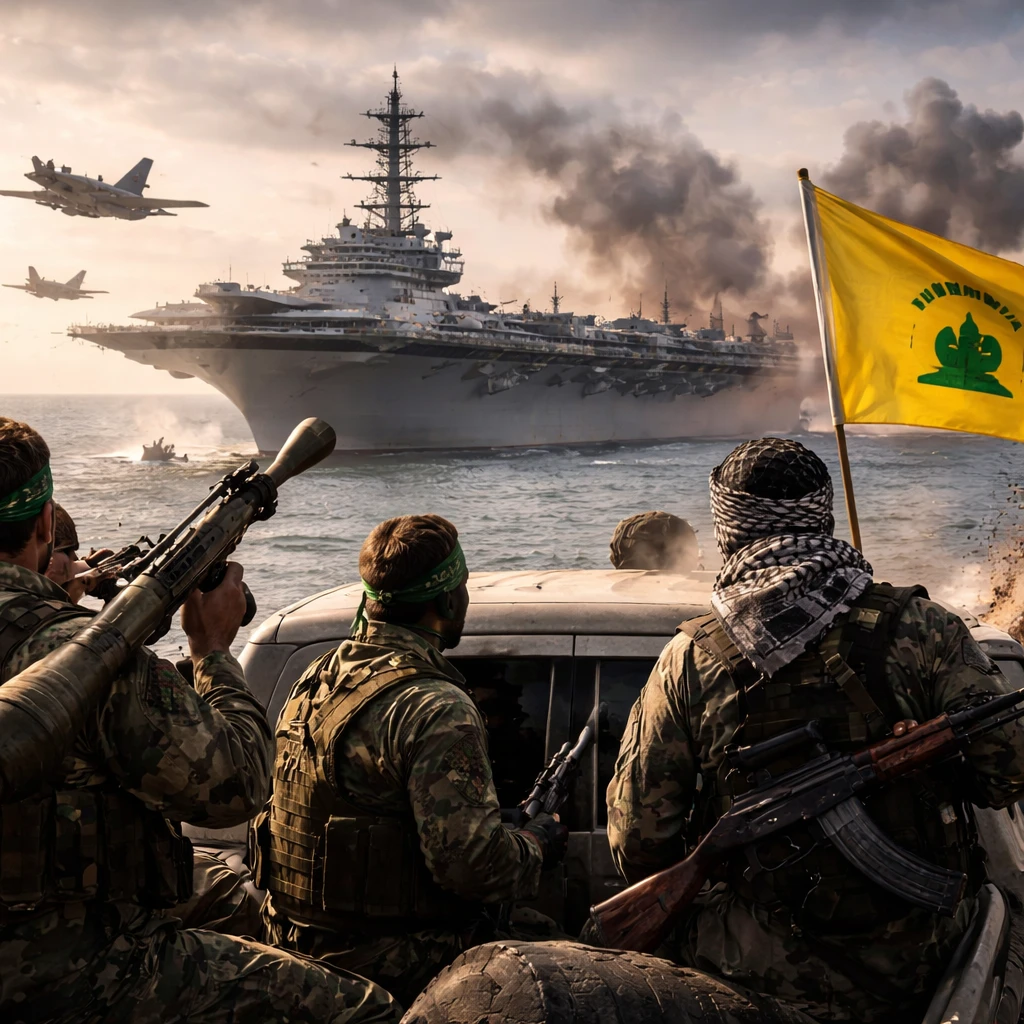

In a development heightening concerns of conflict in the Middle East, two Iranian-aligned militia groups have indicated a willingness to initiate new hostilities, potentially in support of Iran, as the United States confirmed the deployment of an aircraft carrier to the region on Monday. The arrival of the USS Abraham Lincoln strike group follows President Donald Trump’s directive to reposition naval assets amid threats of military intervention in response to Iran’s suppression of nationwide protests.
The Houthi rebels of Yemen, supported by Iran, suggested on Monday a resumption of attacks against maritime targets in the Red Sea. This assertion came shortly after Kataib Hezbollah, a paramilitary faction in Iraq with long-standing ties to Iran’s Revolutionary Guard, issued a stern warning late Sunday. The group cautioned that any strike against Iran could spark a “total war” within the regional theater. These statements emerged during a period of heightened anticipation in the Middle East as observers await potential U.S. military measures.
Notably, both the Houthis and Kataib Hezbollah abstained from direct engagement during the recent 12-day conflict initiated by Israel against Iranian positions in June, which also involved U.S. airstrikes targeting Iran’s nuclear infrastructure. Their prior restraint is interpreted as indicative of ongoing challenges facing Iran’s coalition of allied armed entities, commonly referred to by Tehran as the “Axis of Resistance,” especially in light of Israel’s targeted operations during its conflict with Hamas in Gaza.
U.S. Naval Forces Arrive to Bolster Regional Security
The positioning of the USS Abraham Lincoln and accompanying guided missile destroyers was officially confirmed by U.S. Central Command via social media, emphasizing their mission to enhance stability and security across the Middle East. President Trump framed this deployment as a precautionary measure, aimed at maintaining readiness should the administration decide to execute a strike against Iran. Specific red lines articulated by the U.S. include Iran’s violent treatment of protesters and the potential for widespread executions of detainees linked to the protests.
An Iranian military official, speaking anonymously on state television, dismissed the U.S. threat as overstated, underscoring Iran’s own augmentation of military assets in response. The official further characterized the USS Abraham Lincoln as a viable target rather than a credible deterrent.
Varied Responses from Iran-Backed Entities
Historically, Iran has exerted influence in the Middle East through the “Axis of Resistance,” a network of proxy groups operating in Gaza, Lebanon, Yemen, Syria, Iraq, and other regions. Designed primarily as a strategic buffer, this coalition has experienced fragmentation following coordinated strikes by Israel targeting several members, including Hamas and Hezbollah, amid conflicts spanning Gaza and Lebanon.
The recent overthrow of Syria’s long-standing leader Bashar Assad, which ended years of brutal conflict with Iran’s backing, further complicates the regional dynamics. Hezbollah, one of Iran’s most formidable allies, remains publicly noncommittal regarding its potential involvement in an escalated conflict that could arise from U.S. or Israeli actions against Iran.
Hezbollah’s deputy leader, Sheikh Naim Kassem, addressed supporters in Beirut, acknowledging inquiries about the group’s possible response to a U.S.-Israel war with Iran. He affirmed Hezbollah’s preparedness to defend against aggression but refrained from detailing operational specifics, indicating that tactical decisions would be guided by situational considerations and overarching strategic interests.
Proactive Threats from Iraqi and Yemeni Militants
Conversely, militias in Iraq and Yemen have issued more overt threats, which appear aligned with Iranian strategic interests. The Houthis circulated a brief video featuring imagery of a burning vessel, captioned simply as “Soon,” alongside footage from a January 2024 attack on a Marshall Islands-flagged tanker in the Gulf of Aden. This attack was part of an extensive campaign aimed at pressuring Israel amid its campaign in Gaza.
Although the Houthis had ceased such operations following a Gaza ceasefire, they have indicated their willingness to resume attacks if circumstances demand. In Iraq, Kataib Hezbollah spokesperson Ahmad “Abu Hussein” al-Hamidawi declared that any conflict targeting the Islamic Republic would result in severe consequences, warning of the harshest retaliation which would leave no enemy presence in the region.
In a related diplomatic posture, the United Arab Emirates announced on Monday that it would prohibit its airspace, land, and maritime territory from being utilized for military actions directed at Iran, advocating instead for dialogue and diplomatic solutions.
Iran Issues Stark Warnings as Military Preparedness Intensifies
Iranian Defense Ministry spokesperson General Reza Talaei-Nik reiterated cautions directed at Israel and the United States on Monday, declaring that any attack would provoke a response more severe and decisive than previously encountered. He stressed the necessity for full and comprehensive readiness.
Separately, Foreign Ministry spokesman Esmail Baghaei emphasized to press members that instability in the region would not be confined to Iran alone, characterizing insecurity as a contagion with regional repercussions.
Over the weekend, Iranian authorities unveiled a provocative poster in Tehran’s Enghelab Square depicting the USS Abraham Lincoln engulfed in blood, accompanied by a warning underscoring the consequences of provoking Iran. Despite these warnings, Tehran is still contending with the aftermath of the June conflict, during which its air defense capabilities suffered substantial losses, senior commanders were killed, and nuclear infrastructure was damaged by U.S. precision strikes.
Heightened security concerns have led Iran to issue restrictions on small aircraft operating within its airspace, exempting only oil industry and emergency medical flights. Concurrently, many Western airlines have started circumventing Iranian airspace amid the heightened tensions, although Gulf carriers traveling to Moscow continue to utilize this route. Notably, Iranian air defenses previously downed a civilian Ukrainian airliner in 2020, with significant loss of life.
Escalating Death Toll Amid Iran’s Protest Crackdown
The recent wave of protests erupting on December 28, sparked by a collapse in the Iranian rial, quickly expanded nationwide. The regime's violent suppression has resulted in extensive casualties and arrests amid a prolonged countrywide internet blackout, the deepest in Iran’s history.
Data from a U.S.-based watchdog, the Human Rights Activists News Agency, estimates the death toll from the unrest at 5,973 with over 41,813 arrests recorded. These figures, derived from an activist network inside Iran, have historically provided reliable insights though independent verification has proven challenging. This death rate surpasses prior periods of unrest, drawing parallels to the turmoil surrounding Iran’s 1979 Islamic Revolution.
Officials from Iran report a significantly lower toll of 3,117 deaths, including a classification of nearly 700 individuals as "terrorists." Historically, Iran’s government has been known to underreport or minimize casualty figures arising from internal conflicts and civil unrest.