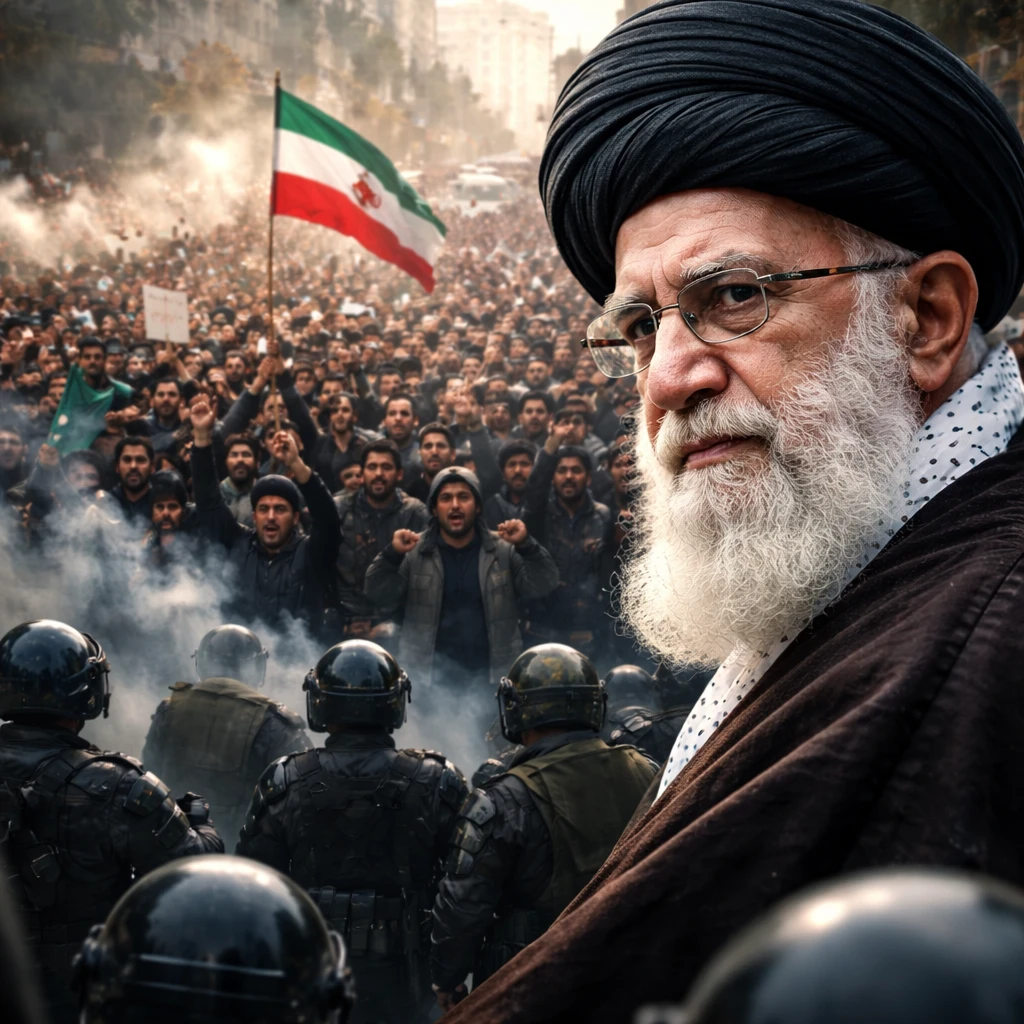
In Tehran and cities across Iran, nationwide protests persist into early Friday, enduring stringent government efforts to quell dissent. Supreme Leader Ayatollah Ali Khamenei publicly criticized U.S. President Donald Trump's declarations of support for peaceful demonstrators, accusing him of having "hands stained with the blood of Iranians." State media broadcast footage of protesters chanting "Death to America!" underscoring the regime's hostile posture towards external influences amid the unrest.
In a public address at his Tehran compound, Khamenei chastised protesters by asserting they were damaging their own communities to align with U.S. interests. He stated, "They are ruining their own streets to please the president of the United States, who encourages their actions, but should focus on issues within his own country." This rhetoric foreshadows intensified security interventions similar to previously observed government responses to mass demonstrations.
Complementing Khamenei's stance, judiciary chief Gholamhossein Mohseni-Ejei emphasized that any punitive measures against protestors would be resolute and uncompromising, highlighting the regime's commitment to a firm crackdown.
Despite a sweeping internet blackout and cut-off of international telephone services, activists circulating brief videos on social media platforms have documented scenes of protesters gathered around bonfires and strewn debris in Tehran and elsewhere. Iranian state outlets have blamed "terrorist agents" affiliated with the U.S. and Israel for inciting fires and violence, and alluded to casualties without providing detailed figures.
The scope of the ongoing demonstrations remains difficult to ascertain fully owing to the communication embargo. Nevertheless, the unrest signifies an escalation from initial protests that erupted over Iran's troubled economy on December 28, escalating into the most pronounced challenge confronting the regime in years. Reports indicate at least 42 deaths and more than 2,270 detentions have resulted thus far, according to the U.S.-based Human Rights Activists News Agency.
Opposition figures, notably Crown Prince Reza Pahlavi, son of the late monarch who fled prior to the 1979 Islamic Revolution, have played a mobilizing role. Pahlavi called for demonstrations on Thursday and Friday evenings, signaling a renewed bid to influence public sentiment. Calls for protests at 8 p.m. on consecutive nights led to widespread participation, with chants both condemning the current regime and supporting the monarchy—a historically perilous expression of dissent.
Critics had previously scrutinized Pahlavi for ties with Israel, particularly following Israel's 12-day conflict with Iran in June, raising complex questions about the opposition's backing. Nonetheless, his role in shaping protest momentum appears significant, as highlighted by observers such as Holly Dagres of the Washington Institute for Near East Policy, who remarked that the coordinated protests responding to Pahlavi's appeals demonstrate a potent drive among Iranians to challenge the Islamic Republic.
Illustrating the regime’s intent to control the narrative, the internet shutdown not only impeded international awareness of the events but may have facilitated security forces' capacity to engage protesters with lethal force undetected.
On Thursday night, as local time reached 8 p.m., multiple neighborhoods in Tehran erupted with chants against the "dictator" and the "Islamic Republic," along with calls heralding the return of Pahlavi. Observers noted thousands taking to the streets before all communications went dark nationwide. Pahlavi responded by urging European and American leaders to collectively hold the Iranian government accountable and to restore channels through which the Iranian people's voices might be expressed.
This comprehensive communication blackout extended to state-run and semi-official news agencies, with the first acknowledgment from state television of the protests occurring at 8 a.m. the following day. Reports from state TV cited incidents of violence including fires set to public transportation and emergency vehicles, as well as casualties, without in-depth detail.
The economic backdrop to these protests remains a critical factor. Iran's currency faced severe devaluation in December, reaching exchange rates of approximately 1.4 million rials to the U.S. dollar, following escalated sanctions and regional conflicts including the previous summer's skirmishes. Economic grievances have fueled growing discontent that sparked these widespread demonstrations.
U.S. President Donald Trump has reiterated his warning that the United States will respond forcefully should Iranian security forces resort to lethal measures against peaceful protesters. In recent interviews, he emphasized the gravity of this message to Tehran and suggested potential shifts in Iranian leadership dynamics, speculating on Supreme Leader Khamenei's future amid the crisis.