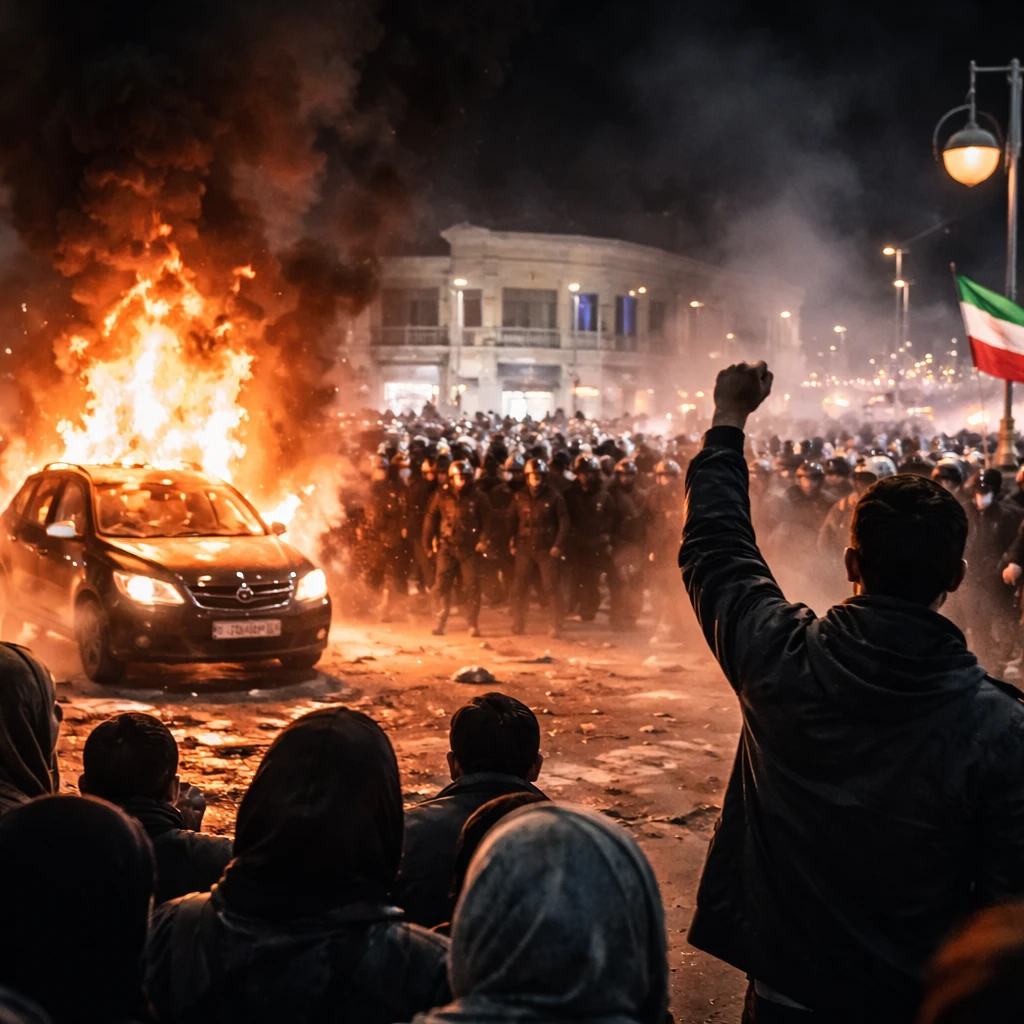
Demonstrations challenging the Iranian theocratic regime have now persisted for over two weeks, with the death toll linked to related violence climbing above 116, activist groups report. The Human Rights Activists News Agency (HRANA), based in the United States and known for credible reporting during prior unrest phases, estimates more than 2,600 individuals have been detained during the protests.
Communication blackouts compound the difficulty in independently assessing the situation within Iran, as internet services and phone lines have been curtailed nationwide. Despite these restrictions, Iranian state television continues to broadcast, focusing primarily on the casualties suffered by security forces and asserting that governmental control remains intact. The state media increasingly refers to protesters as "terrorists," though it acknowledges ongoing protests into Sunday morning across Tehran and the northeastern holy city of Mashhad.
In a stern escalation of rhetoric, Supreme Leader Ayatollah Ali Khamenei has indicated an impending crackdown on dissent despite cautions from abroad. On Saturday, Iran’s attorney general Mohammad Movahedi Azad, through state media, declared any participation in protests tantamount to being an "enemy of God," a charge punishable by death under Iranian law. This decree extends beyond active protesters to include those reportedly aiding noxious rioters.
The official statement mandated swift and uncompromising legal action, emphasizing the need for prompt indictments and trials of individuals accused of betraying national security or facilitating foreign threats to sovereignty. It stressed that the judiciary should operate without leniency or mercy toward those involved.
Meanwhile, U.S. President Donald Trump has openly expressed solidarity with the protest movement, signaling readiness to assist demonstrators in their pursuit of freedom. U.S. media outlets citing anonymous officials have reported that Trump has been presented with various military contingencies against Iran, although no decisive action has been taken. Secretary of State communications underscored a firm stance, cautioning that President Trump’s commitments should be taken seriously.
On the ground in Iran, state media displayed vivid scenes illustrating the complex situation. Following a weekend start to the workweek, many schools and universities resorted to online learning amid security concerns. State channels repeatedly broadcast a martial composition linked to national resistance history, alongside imagery of pro-government rallies and footage purportedly showing armed protesters confronting security forces.
Verified video clips from Tehran's northern neighborhood of Saadat Abad depicted sizable gatherings, with protesters vocally opposing the Supreme Leader. Similarly, the Fars news agency, regarded as friendly to the Revolutionary Guard, circulated surveillance imagery from Isfahan depicting violent clashes, including protester use of firearms and incendiary devices against government properties.
Reports from semiofficial sources detail numerous fatalities among the Guard's Basij volunteer forces and multiple security personnel across several Iranian cities, including Gachsaran, Hamadan province, Bandar Abbas, Gilan, and Mashhad. Detentions of nearly 200 individuals alleged to be affiliated with armed terrorist cells possessing firearms, grenades, and gasoline bombs were also announced.
The state television further showed footage from a funeral procession in Qom, a city renowned for its Shiite seminaries, reflecting the human toll of the ongoing unrest.
Iran's government has severely restricted internet access and international phone communications since Thursday, permitting limited activity from state-operated and semi-official media outlets. Qatar’s Al Jazeera remains one of the few foreign media platforms actively reporting from inside Iran.
An external opposition figure, exiled Crown Prince Reza Pahlavi, who called for protests over consecutive days last week, appealed for continued demonstrations into the weekend. He encouraged protesters to wave the old lion-and-sun flag and other pre-1979 national emblems to symbolically reclaim public spaces. Pahlavi’s backing, including controversial ties to Israel, has drawn criticism, and the degree to which protesters endorse him personally remains unclear.
Online footage appeared to verify sustained protests continuing into Saturday night. The movement initially ignited on December 28, triggered by the collapse of the Iranian rial - trading at over 1.4 million to one U.S. dollar - alongside economic hardships exacerbated by international sanctions linked to Iran’s nuclear activities. The unrest has shifted focus from economic grievances to overt challenges against the existing theocratic system.
In reaction, several airlines, including Austrian Airlines and Turkish Airlines, have suspended flights to Iran as a precautionary step amid the turmoil.
There is growing apprehension that the communications blackout may provide cover for Iranian security forces to intensify deadly operations against protesters, reminiscent of the brutal suppression during 2019 demonstrations when hundreds reportedly lost their lives. Ali Rahmani, son of imprisoned Nobel laureate Narges Mohammadi, expressed grave concern over the potential for further violent oppression.
"They are fighting, and losing their lives, against a dictatorial regime," Rahmani said, highlighting the high stakes faced by demonstrators in their struggle.