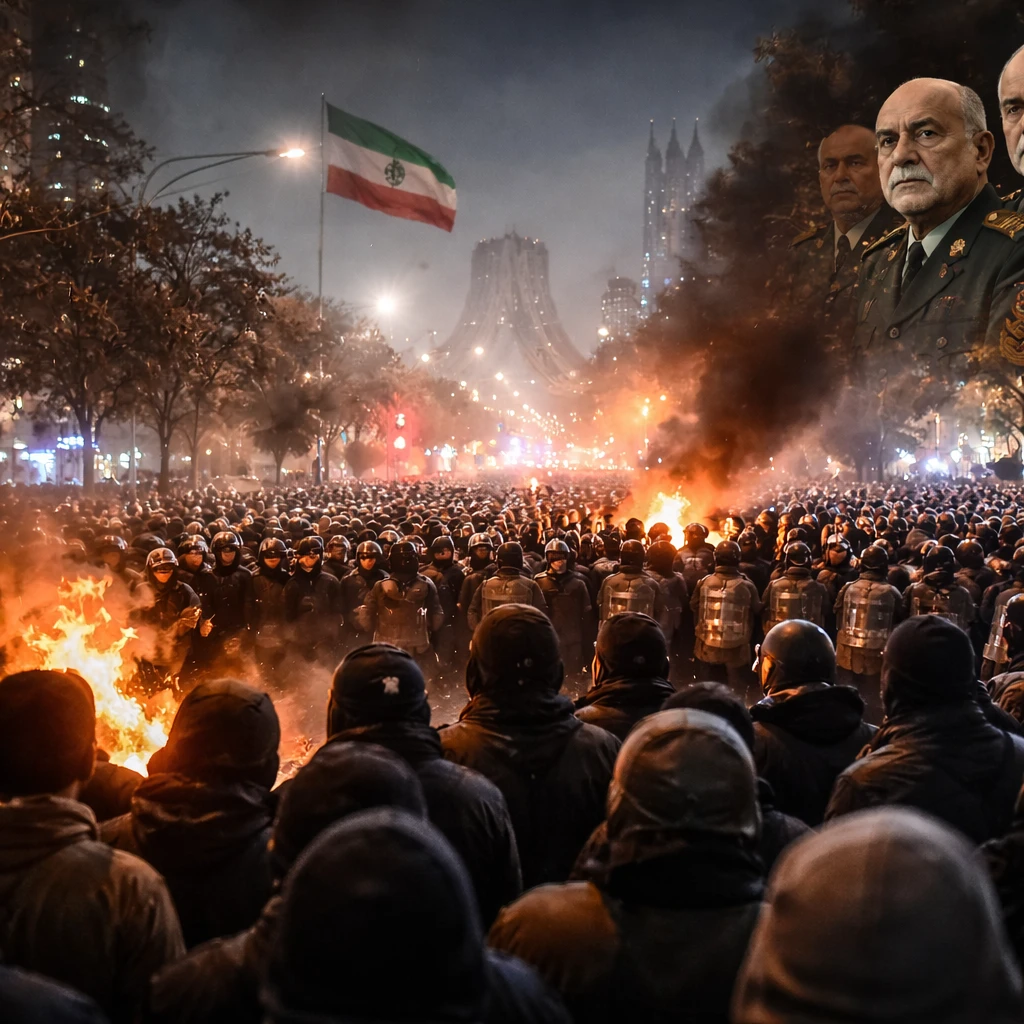
Iranian authorities reinforced their stance against any potential U.S. military action amid sweeping protests challenging the country’s theocratic structure. On Sunday, Mohammad Bagher Qalibaf, the speaker of Iran’s parliament, articulated that the U.S. military and Israeli forces would be deemed "legitimate targets" should the U.S. initiate strikes against the Islamic Republic. This declaration came as demonstrators flooded the streets of Tehran and Mashhad, marking over two weeks of unrest.
Activists report a death toll rising to at least 203, though concerns persist that the true figures may be substantially higher. The Iranian government has yet to issue official casualty statistics. Compounding the difficulty of monitoring the situation, Iran has implemented a near-total internet shutdown and severed phone communications, intensifying fears that hard-line security factions may be executing severe crackdowns under reduced international scrutiny.
President Donald Trump has publicly expressed support for the protestors, tweeting that "Iran is looking at FREEDOM, perhaps like never before," and pledging U.S. readiness to assist. U.S. media sources cite anonymous officials indicating that options for military strikes against Iran have been presented to Trump, though no definitive decision has been announced.
During a live broadcast of a parliamentary session, Qalibaf commended Iranian police forces and the Revolutionary Guard, especially their Basij volunteers, for their steadfast response to the unrest. He further issued direct warnings to Israel—referred to as "the occupied territory"—and the U.S. military, asserting that preemptive action against American bases, ships, and Israeli targets within the region would be justified if Iran perceived any threat. "We do not consider ourselves limited to reacting after the action and will act based on any objective signs of a threat," he stated emphatically. Parliamentary lawmakers echoed sentiments of defiance, vocally chanting "Death to America!" during the session.
The current seriousness of Iran’s threat to initiate offensive operations remains uncertain, particularly following damage to the nation's air defense capabilities during a brief conflict with Israel in June. Decision-making authority on military responses rests with Iran’s Supreme Leader, Ayatollah Ali Khamenei, who is 86 years old.
The U.S. military has declared a robust presence throughout the Middle East, indicating preparedness to defend personnel, partners, allies, and interests. In the recent past, Iranian forces targeted U.S. troops at Al Udeid Air Base in Qatar, while U.S. naval assets operate out of Bahrain. Israeli officials, who requested anonymity, have stated they are "watching closely" developments involving Iran and the U.S. Prime Minister Benjamin Netanyahu recently engaged in discussions with U.S. Secretary of State Marco Rubio concerning Iran. Netanyahu praised Iranian protestors, calling their courage "tremendous heroism," consistent with his historically hawkish approach toward Iran.
The U.S.-based Human Rights Activists News Agency, reliant on networks inside Iran, updated the death toll on Sunday to 203 fatalities, distinguishing 162 as protestors and 41 as security personnel. The group notes ongoing verification processes for claims suggesting significantly higher casualties and has recorded over 3,280 arrests related to the unrest. Past assessments by this agency have been considered reliable. Due to communication blackouts, independent verification by international media remains constrained.
At the Vatican, Pope Leo XIV referenced Iran as "a place where ongoing tensions continue to claim many lives," expressing hope for dialogue and peace to prevail for society's overall welfare.
Videos apparently transmitted from Iran via satellite internet networks, possibly Starlink, depict gatherings of protestors in northern Tehran's Punak district. Authorities appear to have restricted movement by closing streets while protestors illuminate their phones and use metal objects to produce noise. Fireworks have been reported in these assemblies.
The Human Rights Activists News Agency characterizes Tehran’s protest activity as fragmented, fleeting, and adaptive, responding to the pronounced security presence and scrutiny. Drone surveillance and security deployments reportedly continue across known protest sites.
In Mashhad, Iran's second-largest city situated roughly 725 kilometers northeast of Tehran, footage aims to show direct confrontations between protestors and security forces. Similar incidents are reported in Kerman, approximately 800 kilometers southeast of the capital.
State-controlled media on Sunday morning aired reports and live segments intended to demonstrate calm in various urban centers but excluded Tehran and Mashhad. Official narratives have intensified, with senior security official Ali Larijani equating certain protest actions with those of ISIS, accusing demonstrators of homicide and arson. Funeral broadcasts for deceased security forces were part of state programming, alongside announcements of ongoing casualties in Kermanshah, Fars Province, and North Khorasan Province, including images of bodies and morgue scenes.
Even reformist President Masoud Pezeshkian, previously advocating for conciliatory measures, adopted a stronger tone during a Sunday interview. He emphasized the necessity of addressing public concerns but underscored the priority of preventing societal destruction by what he labeled as "rioters."
Calls for continued demonstrations emerged as exiled Crown Prince Reza Pahlavi issued a message encouraging protesters to renew their efforts on Sunday. While protestors have chanted support for the former monarchy, motivations behind these expressions remain ambiguous, fluctuating between loyalty to Pahlavi and a desire for pre-revolution conditions. Pahlavi's perceived alliances, including ties with Israel, have elicited criticism.
The protests trace back to December 28, prompted initially by the devaluation of the Iranian rial, trading at over 1.4 million to the U.S. dollar, exacerbated by extensive international sanctions largely related to Iran’s nuclear program. The discontent has evolved into overt opposition to the ruling theocratic regime.
International media contributions and regional coverage continue amid this complex and fluid scenario.