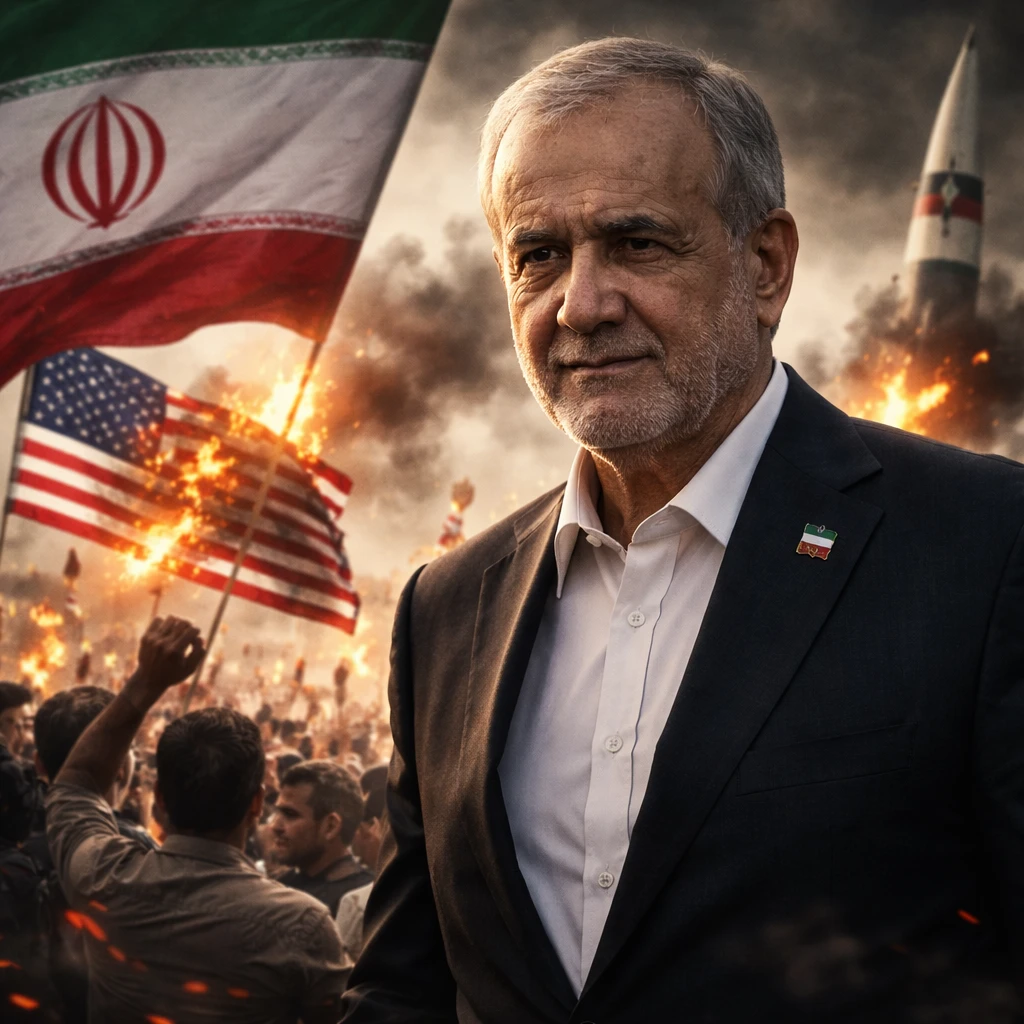

Tehran – Iranian President Masoud Pezeshkian publicly declared on Tuesday that the Islamic Republic’s response to any hostile attack would be both severe and deterrent in nature. This declaration occurred in the context of recent comments by U.S. President Donald Trump, who warned that the United States might execute military strikes should Iran attempt to revive its nuclear capabilities.
Posting on the social media network X, Pezeshkian stated, "The answer of the Islamic Republic of Iran to any cruel aggression will be harsh and discouraging." Although he did not provide specific details of what such a response might entail, his remarks were widely interpreted as a direct rejoinder to Trump’s comments the day prior.
During an extensive joint press event at his Mar-a-Lago residence in Florida with Israeli Prime Minister Benjamin Netanyahu, President Trump remarked, "Now I hear that Iran is trying to build up again. And if they are, we’re going to have to knock them down. We’ll knock them down. We’ll knock the hell out of them. But hopefully that’s not happening." Their dialogue included discussions about the potential for renewed U.S. military operations against Iran, several months after a 12-day aerial conflict in June resulted in nearly 1,100 Iranian casualties, inclusive of high-ranking military personnel and scientific experts. Iran’s retaliatory missile strikes during that conflict caused 28 fatalities in Israel.
Trump further indicated readiness for decisive military measures by stating on Monday, "If it’s confirmed, they know the consequences, and the consequences will be very powerful, maybe more powerful than the last time." These remarks underscored the U.S. administration’s stance on Iran’s nuclear advancements.
President Pezeshkian also noted on Saturday that hostilities between Iran and its rivals have intensified, asserting, "We are in a full-scale war with the U.S., Israel and Europe; they don’t want our country to remain stable." Despite these escalating tensions, Iranian officials maintain that the country has ceased uranium enrichment activities at all nuclear facilities, signaling a tentative openness to renewed diplomatic engagement regarding its atomic program.
International intelligence assessments and evaluations by the International Atomic Energy Agency indicate that Iran’s organized nuclear weapons program was last active in 2003. However, Tehran’s recent enrichment of uranium up to 60 percent purity remains a technical precursor to weapons-grade levels, which hover near 90 percent.
Concurrently, Iran is grappling with significant civil unrest. The nation's currency recently plummeted to historic lows against the U.S. dollar, prolonging protests that have continued into their third day. This economic turmoil precipitated the resignation of the governor of the Central Bank on Monday.
Eyewitness accounts and social media footage document rallies occurring in Tehran and various other cities and towns, where police deployed tear gas in efforts to disperse crowds. In some locations, demonstrators confronted security forces, reportedly throwing stones and resisting police attempts at crowd control. University campuses, including Tehran University and other principal institutions, became sites of student demonstrations.
In response to the unrest, Pezeshkian convened with business leaders to listen to their concerns and articulated the administration’s commitment to addressing societal difficulties and enhancing conditions. He tasked Interior Minister Eskandar Momeni with initiating dialogue with the protesters.
Meanwhile, Mohammad Hadi Sobhanian, head of the country’s tax authority, announced plans for the government to adjust fiscal policies strategically in favor of the business sector, including reducing penalties associated with delayed tax payments.
Additionally, the government declared the forthcoming closure of offices and banks on Wednesday as a measure to manage energy consumption during the approaching winter. These closures will precede weekly holidays on Thursday and Friday, with Saturday also being observed as a religious holiday.