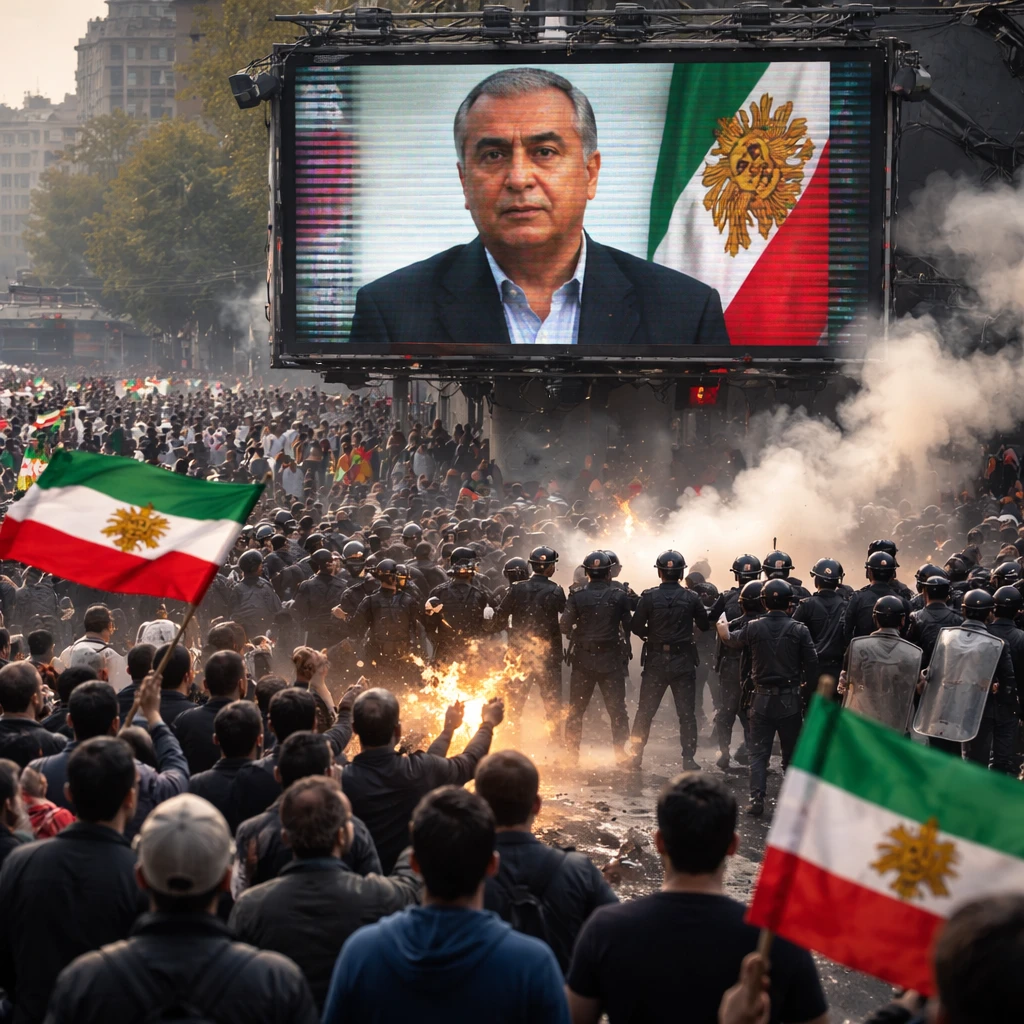

Satellite transmissions of Iran's state television were hacked, resulting in the unauthorized broadcast of video clips endorsing the country's exiled crown prince and calling on security personnel to refrain from using violence against civilians, according to online footage recorded early Monday. This incident forms the latest of several disruptions amid a nationwide wave of protests that have faced harsh government suppression.
Activists state that the death toll from government-enforced crush of the demonstrations has now reached a minimum of 3,941 people. They express concerns that the true number could be significantly higher as information continues to leak out of Iran, which still experiences considerable internet blackout mandated by authorities.
In diplomatic fallout related to the crackdown, Iranian Foreign Minister Abbas Araghchi had been invited to speak at the World Economic Forum in Davos, Switzerland, but the invitation was subsequently withdrawn over the deaths linked to the protests. Meanwhile, tensions between the United States and Iran remain elevated following an ultimatum issued by U.S. President Donald Trump, who set two clear red lines for Tehran: the killing of peaceful demonstrators and mass executions following the protests.
Adding to the geopolitics, tracking data points to the U.S. aircraft carrier USS Abraham Lincoln and accompanying naval vessels recently passing Singapore and entering the Strait of Malacca. This movement potentially positions the fleet en route toward the Middle East, following its previous deployment in the South China Sea.
Details of the broadcast disruption
The hacked satellite signals affected several channels under Iran's Islamic Republic of Iran Broadcasting (IRIB). The unauthorized video included segments of exiled Crown Prince Reza Pahlavi and footage apparently showing Iranian police or security personnel. It claimed, without providing evidence, that some security forces had laid down their arms and pledged allegiance to the people.
One on-screen message addressed the military and security services directly, stating, "Don’t point your weapons at the people. Join the nation for the freedom of Iran." The semiofficial Fars News Agency, reportedly linked to the paramilitary Revolutionary Guard, released a statement from IRIB acknowledging temporary disruptions to the satellite signal by an unknown source but did not address the content of the broadcast.
The crown prince's office confirmed that footage featuring Reza Pahlavi was shown, but did not respond to queries about the hacking incident. Although it remains uncertain how much internal support Pahlavi commands, there have been chants favoring the former monarchy during protests and nightly gatherings since the security crackdown commenced.
This incident is not without precedent; in 1986, The Washington Post reported that the CIA provided the prince’s allies with a miniaturized television transmitter to hijack Iranian broadcasts for eleven minutes. In 2022, Iranian TV channels similarly aired content from the Mujahedeen-e-Khalq opposition group and messages calling for the death of Supreme Leader Ayatollah Ali Khamenei.
U.S. naval movements amid regional tension
With diplomatic strains continuing, analysis of ship-tracking data shows that the USS Abraham Lincoln aircraft carrier strike group, along with Arleigh Burke-class guided missile destroyers USS Frank E. Petersen Jr., USS Michael Murphy, and USS Spruance, traversed the Strait of Malacca after a stop near Singapore. This positioning may indicate deployment toward Middle East waters.
The Lincoln had recently operated in the South China Sea as a deterrent related to China-Taiwan tensions. U.S. media have reported the vessel is heading toward the Middle East, although it would require several days to bring its air complement within operational range. The absence of an aircraft carrier and amphibious ready group in the Middle East complicates potential military responses concerning Iran, especially given the opposition by Gulf Arab states to direct confrontation.
International responses and institutional actions
The World Economic Forum rescinded the invitation extended to Iran's Foreign Minister Abbas Araghchi for the Davos forum. The organization stated, "Although he was invited last fall, the tragic loss of lives of civilians in Iran over the past few weeks means that it is not right for the Iranian government to be represented at Davos this year." Iranian Ambassador to Switzerland Mahmoud Barimani condemned this decision as an unreasonable act influenced by anti-Iranian and radical American-Zionist pressures.
Separately, the Munich Security Conference rescinded invitations to Iranian government officials, citing the recent governmental crackdown as a justification.
Rising death toll and ongoing repression
The reported fatalities from this crackdown surpass those recorded in previous decades of unrest in Iran and evoke comparisons to the turmoil surrounding the 1979 revolution. The U.S.-based Human Rights Activists News Agency (HRANA) estimates the death toll at a minimum of 3,941, with expectations for further increases. HRANA’s methodology relies on an activist network within Iran to verify deaths and arrests, though independent verification remains unavailable.
Official Iranian figures have not been transparently disclosed. However, Supreme Leader Khamenei acknowledged on Saturday that the protests resulted in “several thousand” deaths and attributed culpability to the United States. This statement marked the first public admission by a senior Iranian official regarding the scale of the casualties since demonstrations began on December 28 over economic difficulties.
HRANA additionally reports that over 25,700 people have been arrested amid the unrest. The announcement from senior Iranian officials suggests that while perpetrators of violence and “sedition” will face punishment, there may be clemency for others deemed less involved. Iranian authorities’ severe prosecution raises concerns about potential executions, given Iran's global standing as a leading executor of capital punishment.