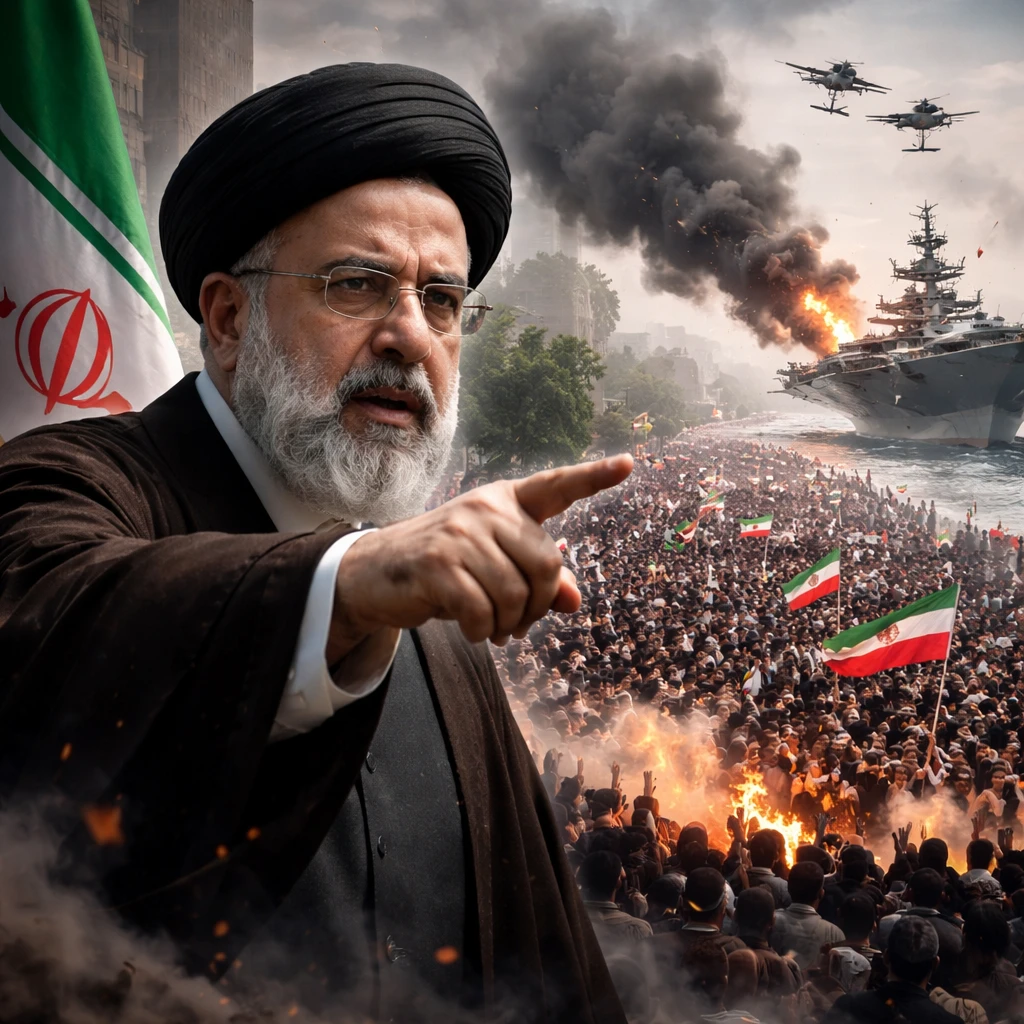

In the context of ongoing widespread protests and governmental crackdowns in Iran, the country’s chief prosecutor firmly denied claims made by U.S. President Donald Trump that Iran halted the executions of 800 detainees linked to the demonstrations. These comments emerged despite reports from activist organizations indicating a death toll exceeding 5,000 individuals, with fears that the actual numbers may be considerably higher due to limited communication facilitated by an extensive internet blackout persisting for more than two weeks.
Heightened tensions between Iran and the United States have been underscored by the deployment of a U.S. aircraft carrier group moving closer to the Middle East. President Trump described this movement as an “armada” while addressing journalists, suggesting a demonstration of military readiness. Analysts note that such a buildup could provide means for possible military strikes against Iran, although no actual strikes have been carried out thus far. Trump previously identified the execution of prisoners and the killing of peaceful protesters as red lines potentially prompting military action.
According to an analytical report from the New York-based Soufan Center, despite apparent reversals in Trump’s stance—potentially influenced by regional leaders and the recognition that airstrikes might be insufficient to destabilize the Iranian regime—military deployments continue, implying that kinetic options remain possible.
President Trump has publicly asserted on multiple occasions that the Iranian government suspended the execution of approximately 800 protesters; however, Iran’s top judicial official, Mohammad Movahedi, refuted these claims via a judiciary-affiliated news agency. Movahedi stated that no such figures exist and that the judiciary has not made any such decisions. His remarks indirectly referenced Iran’s Foreign Ministry and its head Abbas Araghchi, who has been involved in ongoing nuclear negotiations and communications with U.S. envoy Steve Witkoff, suggesting possible miscommunication or misinformation conveyed externally.
Movahedi emphasized the independence of Iran’s judicial system, noting a clear separation of powers and refuting any foreign influence on internal decisions. Contrasting the Iranian official account, a White House representative—speaking anonymously—reiterated that Trump’s warnings were instrumental in preventing the executions. This official acknowledged the administration’s close monitoring of the situation and affirmed that all options remain under consideration if executions proceed, although no direct evidence supporting the claims was disclosed.
Iranian judiciary authorities have categorized some detainees as "mohareb" or "enemies of God," a charge historically associated with the death penalty, with precedents including the mass executions in 1988. At a recent special session of the United Nations Human Rights Council, combining comments from the U.N.’s High Commissioner for Human Rights, Volker Türk, concern was raised over conflicting Iranian statements concerning the fate of protesters in detention. He highlighted Iran’s prominent ranking among countries executing the highest numbers of people globally, with at least 1,500 executions reported in the previous year, marking a 50% increase from 2024.
Meanwhile, Iran’s Friday prayer leader, Mohammad Javad Haji Ali Akbari, disparaged Trump with derogatory epithets and warned of retaliatory measures targeting U.S. interests and bases in the region should actions be taken against Iran’s leadership.
The Iranian foreign ministry reacted strongly to a resolution by the European Parliament condemning the regime’s repression and murders amid the protests. The resolution demanded the release of detainees and called for designating the Revolutionary Guard—a pivotal force in quelling protests—as a terrorist organization. Iran’s foreign ministry condemned the resolution as insulting and warned that any interference with Iran’s armed forces would be met with reciprocal actions, holding initiators accountable for consequences.
Regarding the escalating casualty figures, the U.S.-based Human Rights Activists News Agency reported over 4,700 protester fatalities and cited more than 27,600 arrests. This data aligns with the group’s previous accurate reports during times of unrest and is compiled through an extensive network of local activists. These figures surpass previous surges of political unrest deaths in Iran over recent decades, evoking comparisons to the turmoil around Iran’s 1979 Islamic Revolution. Iranian government figures, released recently, indicate a lower death toll of 3,117, including civilians, security forces, and labeled “terrorists,” but such official statistics are typically viewed as conservative or incomplete by external observers. Verification remains challenging due to communication blackouts and restricted access.
Simultaneously, U.S. military assets, including the aircraft carrier USS Abraham Lincoln and accompanying warships, have been repositioned from the South China Sea into the Indian Ocean, with intentions to possibly forward deploy near Iran. A U.S. Navy official confirmed these movements anonymously. President Trump stated the repositioning was precautionary, allowing leverage for potential intervention, while acknowledging the possibility of non-engagement. Trump also referenced ongoing nuclear negotiations preceding a 12-day conflict initiated by Israel against Iran, noting the prior U.S. airstrikes on nuclear facilities and warning Iran of future military operations that could eclipse those strikes.
Additionally, the United Kingdom’s Ministry of Defence indicated deployment of its Eurofighter Typhoon squadron to the Persian Gulf in a defensive capacity given the regional tensions.