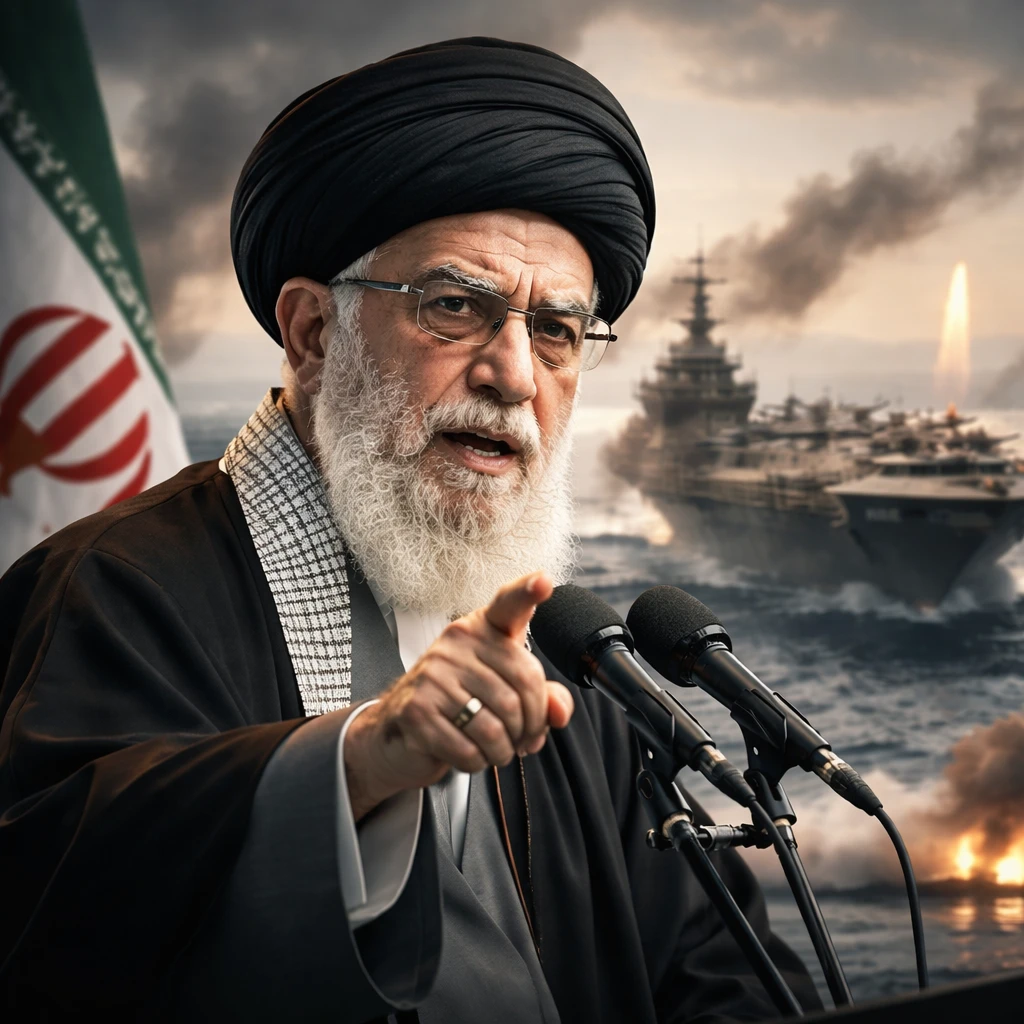

In a recent address amid ongoing national commemorations, Iran’s Supreme Leader Ayatollah Ali Khamenei delivered a forceful warning to the United States regarding potential military conflict. Speaking on Sunday, he cautioned that any American military action against Iran would escalate into a widespread regional war across the Middle East. He emphasized that while Iran does not seek to instigate hostilities or unjust aggression against any nation, it is prepared to respond decisively against any attacks or harassment. This explicit admonition marks Khamenei’s strongest public statement to date amidst the circulating threats and mounting geopolitical tensions.
This heightened rhetoric unfolds as the US Navy's nuclear-powered aircraft carrier USS Abraham Lincoln, accompanied by warships, operates in the Arabian Sea. This naval deployment was ordered by President Donald Trump in response to Iran’s violent suppression of recent mass protests spreading throughout the country. Despite the ongoing posturing, it remains uncertain whether US military action will be undertaken. President Trump has repeatedly expressed a willingness to negotiate with Iran and highlighted concerns regarding Tehran's nuclear program as part of the broader diplomatic challenges at hand.
During his address at his residence in Tehran, Khamenei accused the United States of coveting Iran's natural resources such as oil and gas, asserting that America's historical engagement with the region was driven by desires to control these assets. He stated, "The Americans must be aware that if they wage a war this time, it will be a regional war." He further clarified Iran’s stance: "We are not the instigators, we are not going to be unfair to anyone, we don’t plan to attack any country. But if anyone shows greed and wants to attack or harass, the Iranian nation will deal a heavy blow to them."
Additionally, Khamenei condemned the nationwide protests that began in late December, initially triggered by an economic crisis and a sharp devaluation of the Iranian rial. He characterized the demonstrations as a coup attempt aimed at crippling key institutions responsible for governing the country. He accused protestors of targeting governmental and Revolutionary Guard facilities, banks, mosques, police stations, and even burning Quranic texts. This hardening attitude contrasts somewhat with his earlier recognition that some grievances raised by the populace were legitimate. Loyalist forces reportedly detained tens of thousands of demonstrators in recent weeks, facing allegations of severe crackdowns and human rights abuses.
The U.S.-based Human Rights Activists News Agency, which maintains an information network within Iran to verify incidents, alleges that over 49,500 individuals have been arrested amidst these confrontations and that the death toll exceeds 6,700, predominantly comprising protestors. Independent verification of these figures is challenging due to Iranian government restrictions on internet access. Iranian officials have acknowledged fewer casualties, reporting just over 3,100 deaths, including civilians, security personnel, and labeled others as terrorists. Historically, official tallies from Iran on politically sensitive unrest have been considered incomplete or understated, with current figures marking the deadliest period of domestic upheaval in decades.
Compounding regional tensions, Iran had scheduled live-fire military exercises in the strategically critical Strait of Hormuz for Sunday and Monday. This narrow maritime passage through which around one-fifth of global oil shipments traverse remains a focal point of international security concerns. The U.S. Central Command issued warnings against any provocations against American vessels or disruptions to commercial navigation during these drills.
Meanwhile, Iran’s parliamentary speaker, Mohammad Bagher Qalibaf, a former commander of the Islamic Revolutionary Guard Corps (IRGC), announced the reciprocal designation of all European Union militaries as terrorist organizations. This reaction followed the European Union’s labeling of the IRGC as a terrorist entity for its role in suppressing protests. This declaration, largely symbolic, aligns with Iran’s previously enacted law allowing reciprocal terror designations against foreign militaries. The IRGC commands Iran's ballistic missile arsenal and wields expansive economic influence, answering ultimately only to Khamenei. During the parliamentary session, lawmakers donned IRGC uniforms in solidarity with the force and vocally condemned the United States and Israel, chanting slogans demanding their demise.
President Trump, for his part, has set out clear thresholds for American military involvement, specifically cautioning that the killing of peaceful protestors or execution of detained individuals would cross intolerable lines. Trump has increasingly linked the situation in Iran to concerns over its nuclear capabilities, a matter previously addressed in international negotiations prior to regional conflict events earlier in the year. While the United States conducted strikes on Iranian nuclear facilities during a confrontation with neighboring Israel, satellite observation of some sites suggested ongoing efforts by Iran to obscure these facilities. Speaking en route to Florida, President Trump refrained from announcing a definitive course of action against Iran and acknowledged that the nation is engaged in serious negotiations with the United States over nuclear issues, though uncertainty remains regarding the outcomes of these talks.
This constellation of military presence, national unrest, and international diplomatic friction underscores a volatile moment in Middle Eastern geopolitics. With both the United States and Iran staking entrenched positions and signaling readiness to escalate, the potential for broader conflict remains a pressing concern across economic sectors tied to energy security, defense, and regional investments.