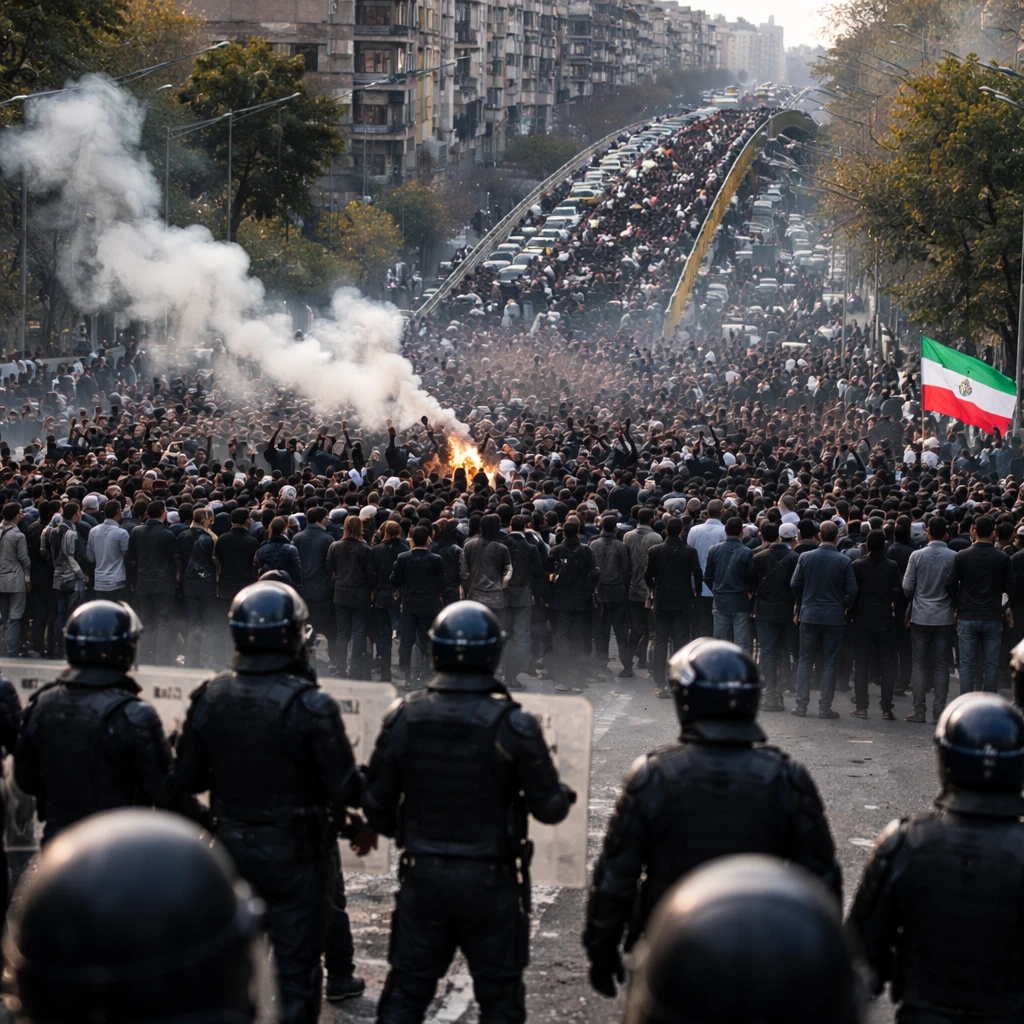
The death toll from the ongoing protests sweeping Iran has surged to a reported minimum of 2,003 fatalities, according to figures released by the Human Rights Activists News Agency, based in the United States. These statistics represent the most significant loss of life in Iran due to civil unrest in decades, rivaling the turmoil witnessed during the 1979 Islamic Revolution. The protests, which erupted slightly over two weeks ago as a response to economic hardship, have rapidly expanded in scope, targeting the leadership structure of the Islamic Republic, particularly focusing on 86-year-old Supreme Leader Ayatollah Ali Khamenei.
Images obtained by journalists from demonstrations in Tehran reveal slogans and graffiti explicitly calling for Khamenei’s death, a serious charge under Iranian law that could entail the death penalty.
Following the dissemination of this elevated death toll, U.S. President Donald Trump announced via his social media platform, Truth Social, a campaign of support for the protestors, urging them to "KEEP PROTESTING - TAKE OVER YOUR INSTITUTIONS!!!" Trump further informed that he had canceled all meetings with Iranian officials until the cessation of what he termed "senseless killing of protesters," promising aid without detailing its nature.
In a contrasting diplomatic communication, Iranian Foreign Minister Abbas Araghchi spoke to the Qatar-sponsored Al Jazeera network, confirming ongoing dialogues with U.S. envoy Steve Witkoff that began prior to and continued after the protests. However, Araghchi characterized U.S. proposals as incompatible with Iran’s interests and refrained from commenting on Trump’s recent statements.
According to activist accounts, of the over 2,000 fatalities, approximately 1,850 were protesters, 135 were affiliated with government forces, and an additional nine children and nine civilians unaffiliated with the demonstrations were also killed. More than 16,700 individuals have been detained amid the unrest. With extensive internet disruptions and shutdowns of international phone lines, monitoring the situation from abroad remains challenging, and independent verification of death and arrest figures is limited. The Iranian government has not issued comprehensive casualty numbers.
Skylar Thompson of the Human Rights Activists News Agency expressed profound shock at the severity and rapid escalation of fatalities, exceeding four times the death toll of the 2022 Mahsa Amini protests within a notably shorter timespan. Thompson also cautioned that the reported figures might be conservative estimates.
Residents in Tehran described a heavily militarized environment, with anti-riot police equipped with protective gear and arsenal including batons, shields, shotguns, and tear gas launchers, positioned strategically throughout major intersections. Parallel to these forces, members of the Revolutionary Guard's volunteer Basij militia operated openly with firearms and batons, while plainclothes security operatives maintained a visible presence in public areas.
The unrest has caused extensive damage to government and financial infrastructures, including the burning of several banks and state offices. Banking transactions struggle to operate effectively in the absence of internet connectivity, compounding economic challenges for the populace.
Despite the tension, many commercial establishments, including Tehran’s Grand Bazaar—where the protests initially ignited on December 28 due to the Iranian rial's collapse—reopened, reportedly under orders from security authorities. Shopkeepers recounted being compelled to operate regardless of prevailing risks, though no official confirmation of such directives was provided by state media.
Authorities appear to have targeted equipment such as Starlink satellite terminals, conducting raids in northern Tehran neighborhoods where satellite dishes are common despite official prohibitions. Enforcement against private satellite dishes had previously been relaxed in recent years but now seems intensified amidst the current crisis.
In public spaces, citizens were observed confronting uniformed and plainclothes security personnel, who reportedly stopped individuals without cause. State television broadcast messages indicating that mortuary services would be provided free of charge, alluding to prior concerns about exorbitant fees related to the release of bodies during the crackdown.
In a public statement aired on state media, Supreme Leader Khamenei commended nationwide pro-government rallies held on Monday, describing them as a warning to American politicians to cease deceit and avoid relying on "traitorous mercenaries." He emphasized the strength and vigilance of the Iranian people against foreign adversaries. Coverage included chants condemning the United States, Israel, and other perceived enemies, with Iran’s attorney general warning that protesters would be treated as "enemies of God," a designation carrying potential capital punishment.
The socio-political atmosphere remains fraught with uncertainty, as many Iranians, particularly the youth, express a persistent desire to continue protests despite pervasive hopelessness and fears of further repression. Conversations among ordinary citizens reflect concern about possible external military interventions prompted by international reactions to the ongoing crisis.