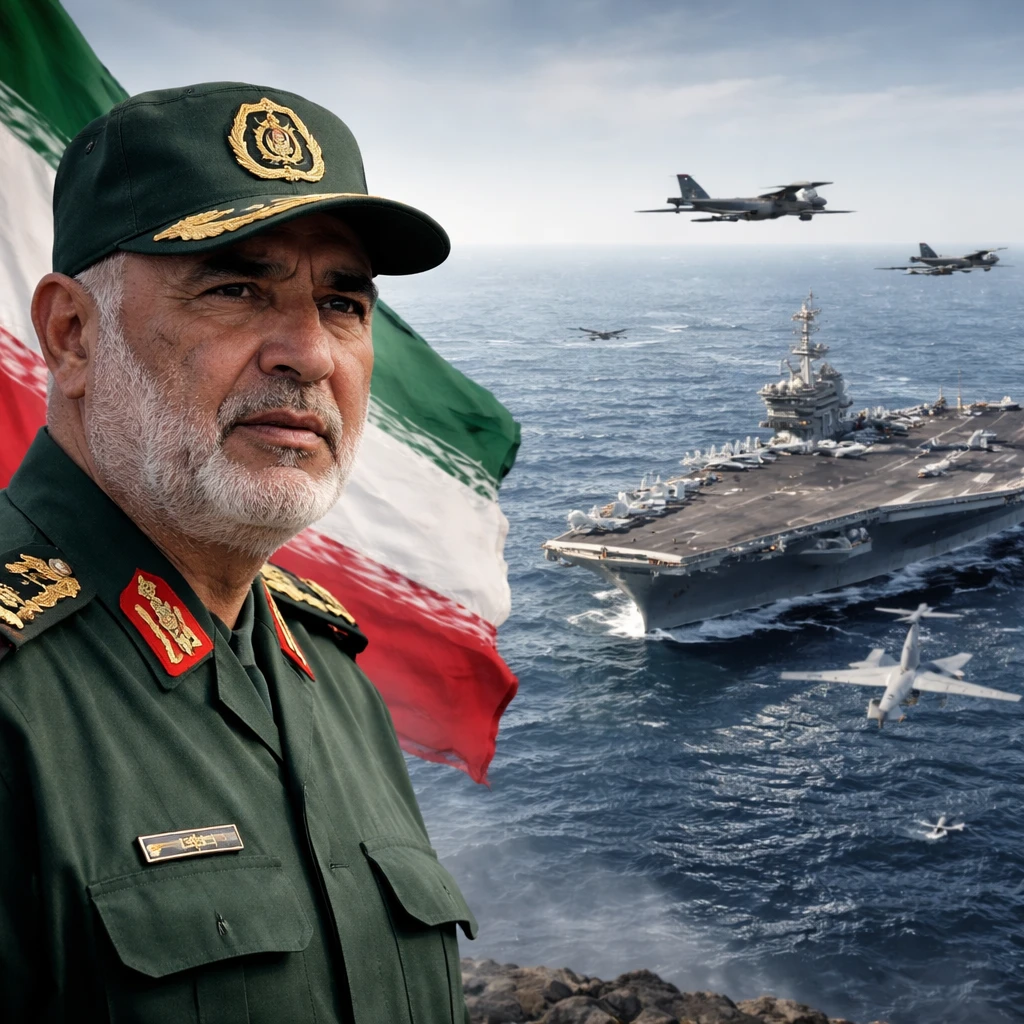

In a tense climate underscored by recent domestic turmoil and heightened international military presence, the commander of Iran's paramilitary Revolutionary Guard has issued a firm admonition to the United States and Israel. General Mohammad Pakpour emphasized that the Guard stands "more prepared than ever, with the finger on the trigger," as U.S. naval vessels, including the aircraft carrier USS Abraham Lincoln, navigate toward the Middle East.
This statement was disseminated through Nournews, a news outlet aligned with Iran’s Supreme National Security Council, via its Telegram channel. Pakpour urged Washington and Tel Aviv to "avoid any miscalculations," reiterating the Guard's readiness to follow commands from the country's supreme leader.
The warning arrives at a time when U.S.-Iran tensions have sharply escalated, following Iran’s forceful crackdown on nationwide protests that erupted on December 28. These demonstrations, spurred by a precipitous decline in the Iranian rial and deepening economic distress, persisted across the country for approximately two weeks, resulting in thousands of casualties.
According to human rights activists, more than 40,000 individuals have been detained in connection with these protests. Reports from various activist organizations also suggest fears that some detainees could face the death penalty.
U.S. Administration’s Firm Position
President Donald Trump has issued repeated warnings to Iran, delineating clear red lines regarding military actions—specifically condemning the killing of peaceful protesters and large-scale executions of detainees.
Trump has alleged that Iran halted plans to execute approximately 800 detainees from the protests, though the source of this claim remains unspecified. However, Iran's Attorney General Mohammad Movahedi categorically denied the veracity of this allegation in statements to Mizan News Agency, which is affiliated with Iran’s judiciary.
In remarks aboard Air Force One, Trump noted on Thursday that American naval forces are positioning closer to Iranian waters "just in case" Tehran takes aggressive measures. He confirmed a significant fleet, including the USS Abraham Lincoln, is moving through the Indian Ocean. The president qualified that military deployment might ultimately not be required.
Trump also referenced the history of diplomatic engagements between U.S. officials and Iran regarding the nation's nuclear program preceding Israel’s 12-day conflict with Iran in June, in which U.S. military involvement included airstrikes on Iranian nuclear sites. The president warned Iran that any future military confrontation would exceed the scale of previous U.S. operations targeting Iran’s uranium enrichment capabilities.
Impact on Aviation and Regional Travel
The escalating tension has disrupted commercial air traffic, motivating at least two European airlines to suspend or delay flights to the region. Air France, for example, canceled weekend flights between Paris and Dubai, citing real-time monitoring of geopolitical conditions to ensure flight safety. The airline plans to resume services later on Saturday.
Similarly, Luxair of Luxembourg postponed a flight to Dubai by 24 hours, aligning its decisions with other carriers responding to increased uncertainty and security concerns in regional airspace. The airline indicates continued assessment will dictate if flights proceed as scheduled.
Flight tracking data also revealed cancellations for flights operated by Dutch carriers KLM and Transavia arriving in Dubai from Amsterdam and disruptions to KLM services to Tel Aviv in Israel.
Persistent Human Rights Concerns and Rising Casualty Figures
While no new protests have been reported in recent days within Iran, the death toll attributed to the unrest continues to climb as information gradually emerges, despite the country’s most extensive internet blackout in history lasting over two weeks.
The U.S.-based Human Rights Activist News Agency reported on Saturday that fatalities have reached approximately 5,200, a number expected to increase further. The agency also noted over 40,879 arrests linked to the demonstrations. These assessments are grounded in a network of on-the-ground activists verifying incidents.
The death toll now exceeds casualties recorded in previous protest cycles or civil disturbances throughout the Islamic Republic’s recent history, evoking memories of the upheaval that accompanied the 1979 Islamic Revolution.
Iran’s government released its first official death count on Wednesday, citing 3,117 individuals killed, including 2,427 civilians and security personnel, while labeling the remainder as "terrorists." Historically, Iranian authorities have tended to underreport or omit fatalities during episodes of unrest.
The same activist group updated the arrest figures upwards by a significant margin from prior estimates exceeding 27,700, reflecting an extensive crackdown.
Concerns persist over the possibility of capital punishment being applied to protesters detained, with Iranian judiciary officials referring to some detainees as "mohareb" or "enemies of God," a charge historically associated with the death penalty. This designation has been utilized previously to justify mass executions, most notably in 1988.
During a special session of the United Nations Human Rights Council in Geneva, Volker Türk, the UN High Commissioner for Human Rights, expressed alarm over conflicting Iranian statements regarding the fate of detainees, highlighting Iran as one of the world’s leading executioners, with at least 1,500 executions last year — an increase of 50% since 2024.