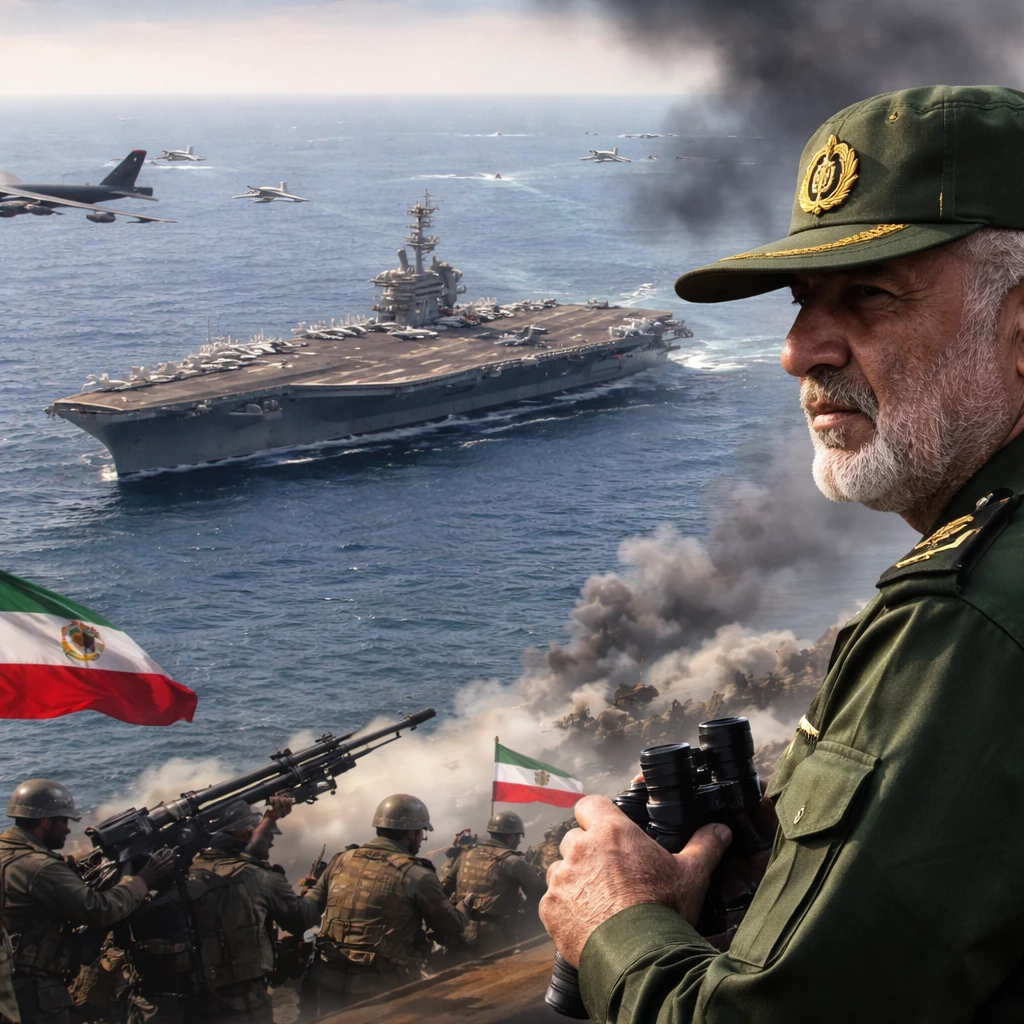

In a clear sign of escalating geopolitical tension, General Mohammad Pakpour, commander of Iran’s paramilitary Islamic Revolutionary Guard Corps (IRGC), has issued a forceful warning toward the United States and Israel. This declaration came as American naval vessels, including the aircraft carrier USS Abraham Lincoln, advanced through the Indian Ocean toward the Middle East.
Pakpour stated that the IRGC is "more ready than ever," with its "finger on the trigger" to swiftly carry out commands from Iran’s Commander-in-Chief. He cautioned the United States and Israel against any misjudgments, emphasizing the military’s preparedness in the face of what Tehran perceives as external threats.
The tension follows a violent crackdown on widespread protests beginning December 28, incited by the collapse of Iran’s currency, the rial. The protests, which spanned approximately two weeks, have led to thousands of deaths and tens of thousands of arrests nationwide.
Activist networks report that more than 40,000 individuals have been detained since the unrest began. Concerns are mounting regarding potential capital punishment for some detainees. Iranian judicial authorities have applied the term "mohareb," or "enemies of God," to certain detainees—a designation historically linked to the death penalty and mass executions.
Meanwhile, U.S. President Donald Trump reaffirmed his warnings to Tehran, specifying two red lines: the killing of peaceful protestors and the mass execution of those apprehended. Trump claimed that Iran had halted executions for roughly 800 detainees, although Iranian officials have not corroborated this. Additionally, he described the deployment of a substantial U.S. naval presence near Iran as a precautionary measure.
Trump also referred to previous U.S.-Iran negotiations over Iran's nuclear program and recalled recent Israeli military actions and U.S. airstrikes targeting Iranian nuclear facilities. He threatened that future U.S. military operations could dwarf previous strikes.
The deteriorating situation has prompted several European airlines to alter their operations. Air France canceled return flights between Paris and Dubai over the weekend, citing ongoing geopolitical instability and prioritizing flight safety. Similarly, Luxembourg's Luxair postponed its flight to Dubai, aligning its decisions with other airlines reacting to the uncertain airspace conditions.
Dutch carriers KLM and Transavia have canceled inbound flights to Dubai, with KLM also discontinuing some flights to Tel Aviv. The airlines have yet to provide official statements, and Dubai airport’s arrival data corroborates these changes.
Despite a cessation of active demonstrations in recent days, the death toll from the protests continues to rise as information gradually emerges through restricted internet channels. The U.S.-based Human Rights Activists News Agency estimates about 5,200 deaths, the highest reported figure in decades of unrest, exceeding any previous protests and recalling the severity of the 1979 Islamic Revolution era.
Iran’s government on Wednesday reported a lower death toll of 3,117, including civilians, security personnel, and a classification of "terrorists". Past government figures have often been questioned due to underreporting tendencies.
Human rights officials at a recent U.N. Human Rights Council session voiced alarm at Iran's conflicting statements about executing detained protesters. The U.N. High Commissioner for Human Rights noted Iran's status as one of the highest executioner nations globally, with at least 1,500 executions last year, marking a 50% increase compared to prior years.